Guides
Getting started with multifamily EV charging across the U.S.
Multifamily EV charging starts with parking, panel capacity and billing rules, not hardware. A planning order for apartment, condo and HOA boards.
What to take away
- Settle parking, electrical capacity and billing before you price a single charger. Hardware is the cheapest decision you will make.
- Bring the utility in during week one. Calling it once the drawings are nearly done is what forces redesigns.
- Dwell time beats output. Cars sit overnight, so a modest port everyone can reach usually beats a fast one four people fight over.
- Accessible layout is a first-draft decision. You cannot retrofit it once the pedestals are set in concrete.
Most multifamily charging projects go wrong in the same place. Somebody gets a quote for eight chargers, the board approves it, and then an electrician points out that the service panel has no room left. The quote was never the problem. The order of operations was.
So start with the building. Where do people park, who is allowed to park there, how much electrical capacity is genuinely spare, and who pays for the power? Those four answers shape everything that follows, and not one of them appears on a vendor's spec sheet.
What follows is a planning order, not an electrical design. You will still need a licensed contractor, a permit review, and in a condo, a careful read of your own governing documents.
Write down what the project is for
A rental owner and a condo board want different things, and they should not be working from the same brief.
An owner usually buys an amenity and wants it to run without generating work.
A board usually solves a fairness problem: two residents already own EVs and want chargers at their assigned spaces, and three more will ask next spring.
A third building wants a small installation now, holding conduit and panel room for a phase two that may never come.
Survey residents before you guess at a port count. Ask who owns an EV today, who expects to within three years, how far they drive on an ordinary day, whether their space is assigned, and whether overnight charging would cover them.
Then treat the answers as a picture of demand, not an order form. Stated interest always runs ahead of purchases.
The Department of Energy's guidance on charging at apartments and condominiums is blunt about this. Shared buildings carry problems detached houses do not, and parking, electrical access, billing and legal questions all need answers before anyone goes to procurement.
Map the parking and the panel
Draw the site: parking spaces, accessible routes, electrical rooms, panels and meters. Then add walls, planting beds and the paths conduit could follow, along with the intake facts that make a parking plan worth drawing.
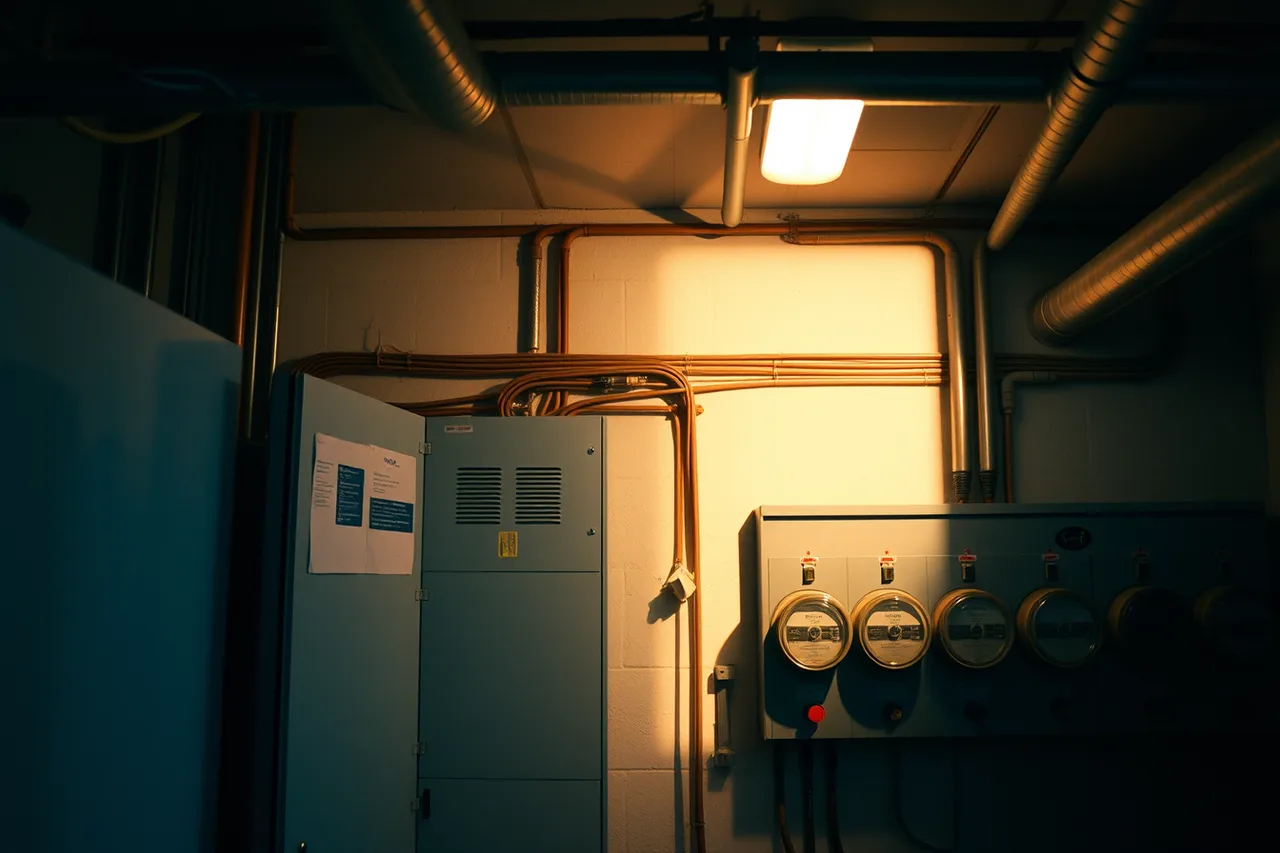
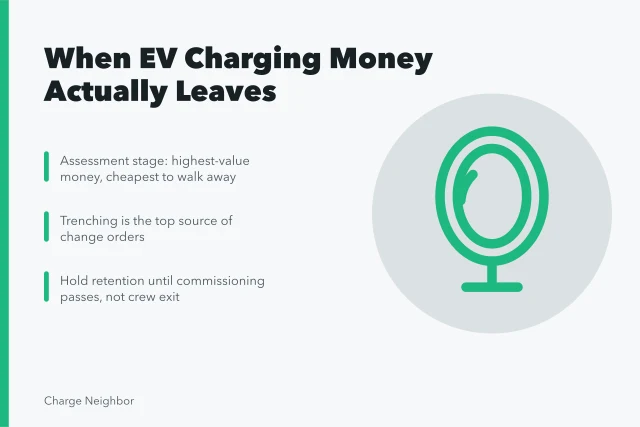
Pace out distances for a rough number, but let a designer measure. Trenching, cutting pavement and upgrading a service will move a budget far more than choosing between two charger brands.
Ask a licensed electrical contractor or engineer to write down:
- what service and panel capacity is genuinely spare, in amps
- the age and condition of the existing gear
- workable circuit routes to each parking area
- how the load would be metered
- whether load management could stretch what you already have
- what capacity a later phase would need
Then call the utility, before the drawings are finished rather than after. The utility knows what the feeder can carry, which rate you would land on, whether a make-ready program would pay for trenching, and what work has to happen on its side of the meter. That one call has rescued more projects than any piece of hardware.
Pick an access model first
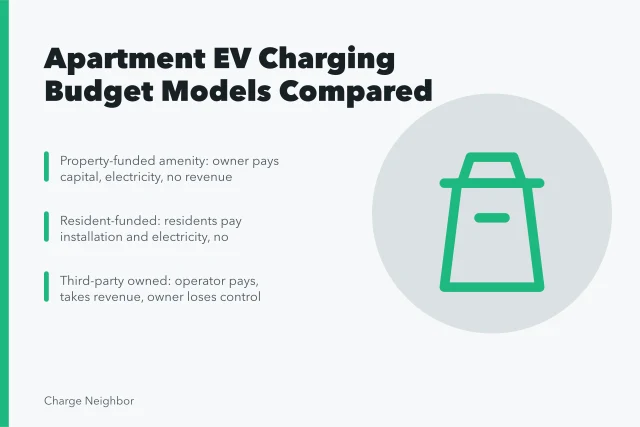
There are three, and the choice drives cost more than anything else you decide.
| Model | Works well when | Watch out for |
|---|---|---|
| Dedicated port per space | Spaces are assigned and few residents want one | Long, expensive wire runs to scattered spaces |
| Shared pool of ports | Parking is common and demand is growing | Needs real rules for idle cars and reservations |
| Mixed | Some assigned, some common parking | Two sets of rules to explain and enforce |
Dedicated charging is easiest to explain to a resident but often most expensive to build. The spaces needing power are rarely near the panel.
Shared charging uses infrastructure hard, which is efficient. It works only if you decide in advance who may charge, how they identify themselves, what it costs, whether guests count, and what happens when somebody leaves a full car plugged in for two days.
Write those policies before you buy. They decide whether you need a network, a payment system, new signage, or a change to the resident agreement.
Match the output to how long cars actually sit
Residential cars park for ten or twelve hours. That changes the arithmetic completely.
Level 1 can be enough for a low-mileage driver, or for a small pilot where existing outlets allow a safe, code-compliant setup. Level 2 puts back far more overnight and is what most new multifamily installations use. Above that, you are mostly paying for speed nobody is awake to use.
The number that matters is not the sticker kilowatts on one unit. It is the power available to the whole system, divided by how many cars plug in at once.
A designer can use power sharing so eight ports draw from a circuit that could never feed eight cars at full tilt. For overnight parking, that trade costs residents almost nothing; ask for both figures: total system power, and the minimum guaranteed to each connected car.
Decide whether you need a network
Unnetworked equipment charges cars. That is the entire feature list, and for a small building where the association absorbs the electricity cost, it can be exactly right.
Networked stations authenticate users, meter sessions, apply prices, allow remote diagnosis, and often manage load. They also bring a subscription, a payment processor, and a long relationship with a software company.
Before signing, ask four things. Who owns the session data, and who at the property gets to read it? Can you export it in a format you could actually use? What does the charger do when the internet drops?
And can this hardware move to a different network if the vendor's terms change? Equipment speaking Open Charge Point Protocol 1.6 or later is likelier to survive that last question, but "OCPP compatible" on a brochure is not a certification. Ask which functions are implemented, and who tested them.
Budget the whole thing, not the boxes
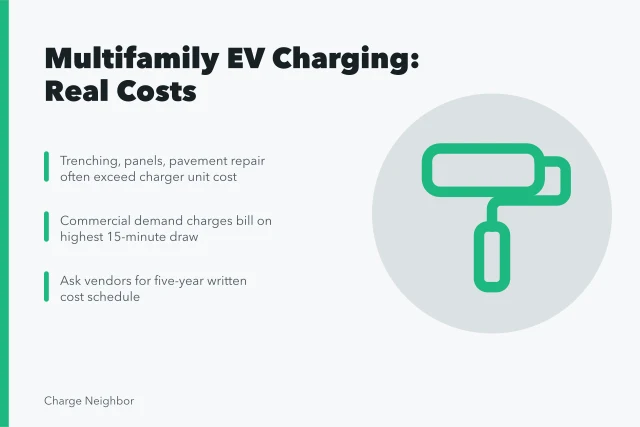
Split the budget into equipment, design, utility work, permits, construction, networking, operations and contingency. Construction is the line that surprises people: conduit, conductors, panels, switchgear, protection, pedestals, bollards, signs, pavement repair, communications cabling and accessible routes. It is also why the same charger costs several times more here than at a house.
Budget the running costs separately, because somebody pays them every month. Electricity, any demand charges, network fees, payment processing, cellular service, inspections, repairs, snow clearing, resident support. Name who pays each one, and write down what happens to prices if the utility rate moves.
Incentives exist at federal, state, utility and sometimes city level. Do not put one into an approved budget until eligibility is confirmed in writing. Programs close, rules shift, and a credit assumed at the board vote and lost at filing makes for an unpleasant meeting.
Buy a system, not a box
A useful request for proposals describes the site, the users, the service level you want, the access rules, whatever electrical information you have, the future port count, your data needs and the support you expect. Ask bidders to separate what they are assuming from what they are committing to.
Insist on a responsibility table naming who handles design, permits, utility coordination, installation, commissioning, network setup, resident support, preventive maintenance, spare parts, security updates, and data export when the contract ends. Every blank in that table turns into an argument later.
Compare on total cost and on how the thing will actually be run. A cheap unit attached to proprietary networking, a two-year warranty and an expensive service agreement is not cheap.
Get accessibility right on the first drawing
Codes come from your state and local authority, permitting varies by jurisdiction, and a licensed electrical contractor should confirm which drawings, calculations and certifications your inspector expects.
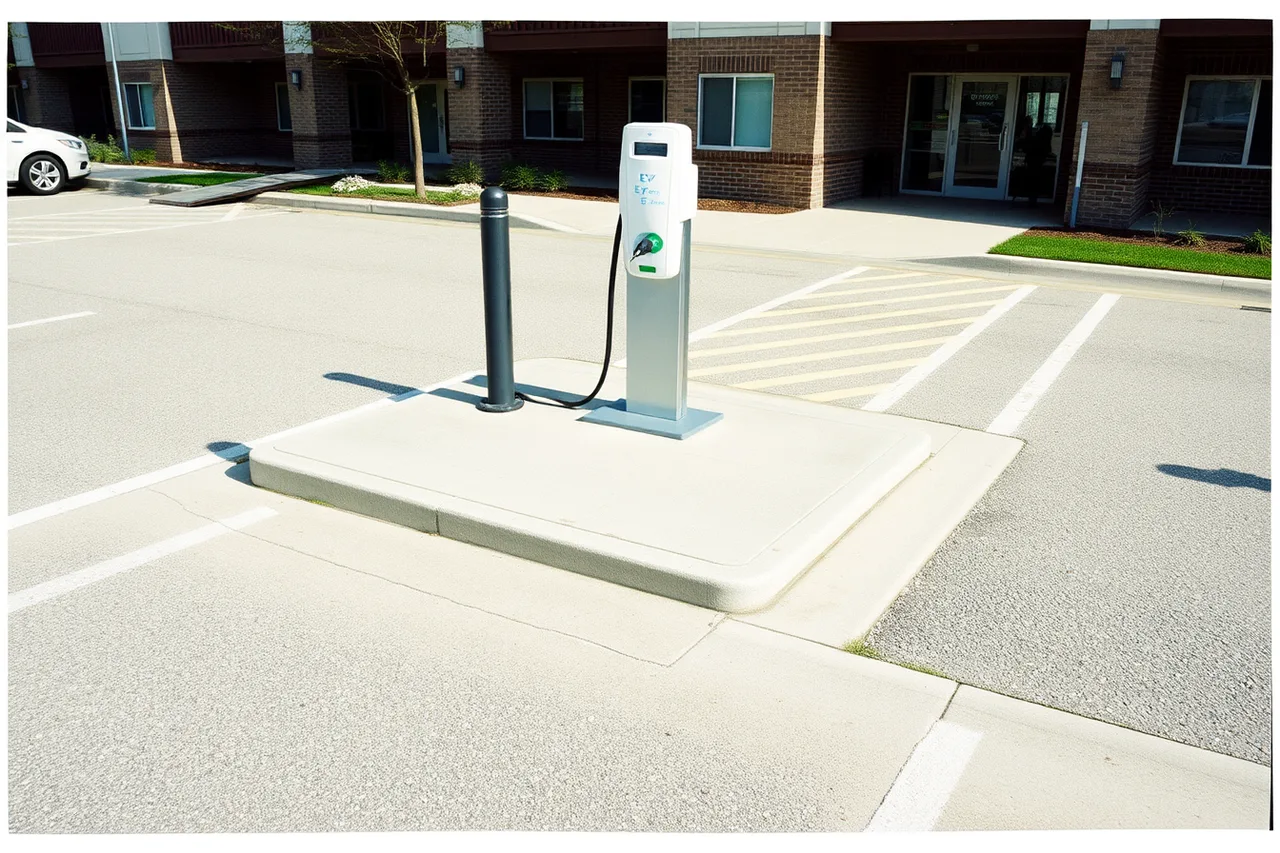
Accessibility is the part people retrofit and regret. The U.S. Access Board publishes design recommendations for accessible charging stations covering space dimensions, access aisles, slopes, reach ranges, cable management and the route back to the building. Read it before the layout is fixed. Moving a bollard on paper is free; moving it after it is set in concrete is not.
Commission it, then pilot it
Commissioning proves the installed system matches the approved design. Test every connector, credential, price rule, network link, load-management response and support path. Record serial numbers, circuit IDs, breaker locations, firmware versions, warranty terms and contractor contacts in one place, while the installer is still on site.
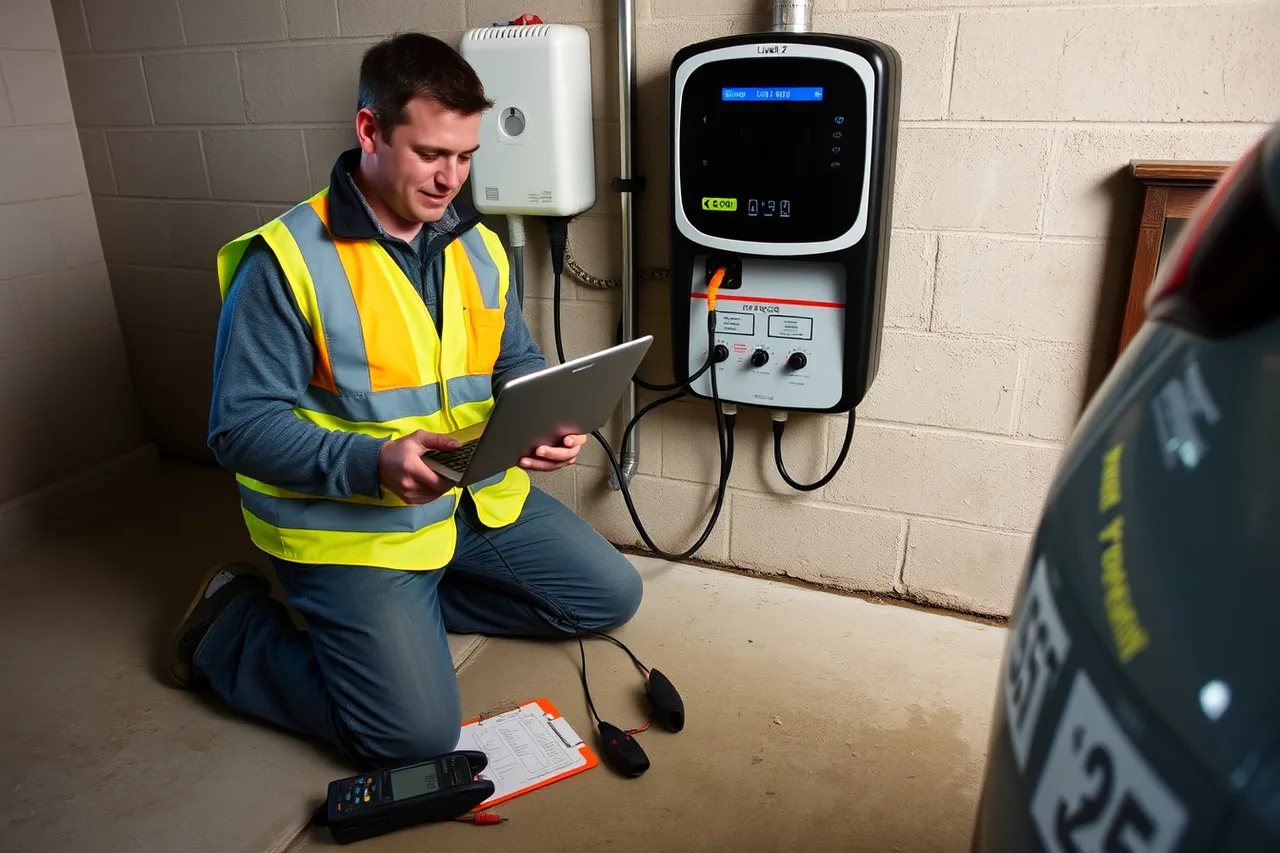
Open a handful of ports to real residents for a week or two before full launch. Pilots surface what drawings cannot: unreadable signs, dead cellular coverage in a basement garage, a payment flow that fails on one carrier, cars parked across an access aisle.
Fix those, write a one-page guide, then open the rest. Walk the installation sequence itself before you commit to a date.
Keep records so phase two is easier
Track uptime, sessions, energy delivered, failed starts, support tickets, repair time, electricity cost and parking complaints. Review them on a schedule. Those numbers tell you whether to add ports, change prices, tighten the rules, or reserve more capacity.
Keep the drawings, permits, inspection sign-offs, warranties, network contract, utility correspondence and invoices together. The next expansion should start from verified facts about your building rather than a fresh investigation of the same questions. If you are still shaping the numbers, where the money actually goes is the place to start.
One meeting decides whether you are ready
Close the discovery stage with a short meeting: whoever can approve spending, the property manager, the electrical lead, and whoever controls parking and talks to residents. Review the verified site facts, the open utility questions, the expected users, the accessibility requirements, the ownership options and the budget range.
Do not use that meeting to pick a charger off a slide. Assign every unknown to a named person with a date. The output is a written decision to investigate, design, pilot, phase, or stop.
Here is the test. If nobody in the room can say who authorizes electrical work, who controls the parking, who signs a utility agreement and who operates the service afterward, the project is not ready to go out to bid.
Common questions
How many chargers should we start with? Fewer than the survey suggests, with conduit and panel space held for more. Oversizing on day one is the most common way these budgets come apart.
Can residents just install their own? In several states an association cannot flatly refuse a charger at an owner's assigned space, though it can set reasonable conditions. Check your state law and your governing documents before you answer anyone.
Do we have to let guests charge? No, and most buildings do not at first. Opening access later is easy. Taking it away is not.
What if the panel is already full? Load management often gets you further than a service upgrade, at a fraction of the cost. Ask the designer to price both before assuming you need new service.
In this guide
- How to compare specs for multifamily EV charging in 2027Charger spec sheets hide the number that matters. How to compare power, connectors, load sharing and service on the same basis before you buy.
- Multifamily EV charging costs for homes and shared buildingsMultifamily EV charging costs sit in construction, not hardware. What each budget line covers, what moves it, and what you pay every month after.
- How to test the everyday value of multifamily EV chargingEnergized is not working. A test plan for multifamily EV charging covering access, billing accuracy, power sharing, network recovery and support.