
Guides
Part of Getting started with multifamily EV charging across the U.S.
Multifamily EV charging: installation steps
How a multifamily EV charging project actually runs, from ownership and utility contact through permits, build, commissioning and the resident pilot.
What to take away
- This is a small infrastructure project, not a purchase. Treating it as a purchase is how scope goes missing.
- Utility contact belongs near the front. Its lead times are the longest and the least negotiable.
- Permit requirements vary by jurisdiction, so ask your inspector what they want before drawings are finished.
- Commission and pilot before you open every port. A week of real sessions finds what drawings never will.
- Record serial numbers, firmware versions and warranty dates on the day of commissioning, not later.
Most delays trace back to work done out of sequence. Hardware bought before the panel was surveyed. Drawings finished before the utility was called. Ports opened before anyone tested a payment on a phone in a basement garage.
Worked example: the order a stalled project should have used
A 60-unit building ordered twelve chargers in March, then discovered in June that the feeder had no spare capacity. The equipment sat in a storage room for a season while the utility studied the service upgrade. The same project run in the right order looks like this:
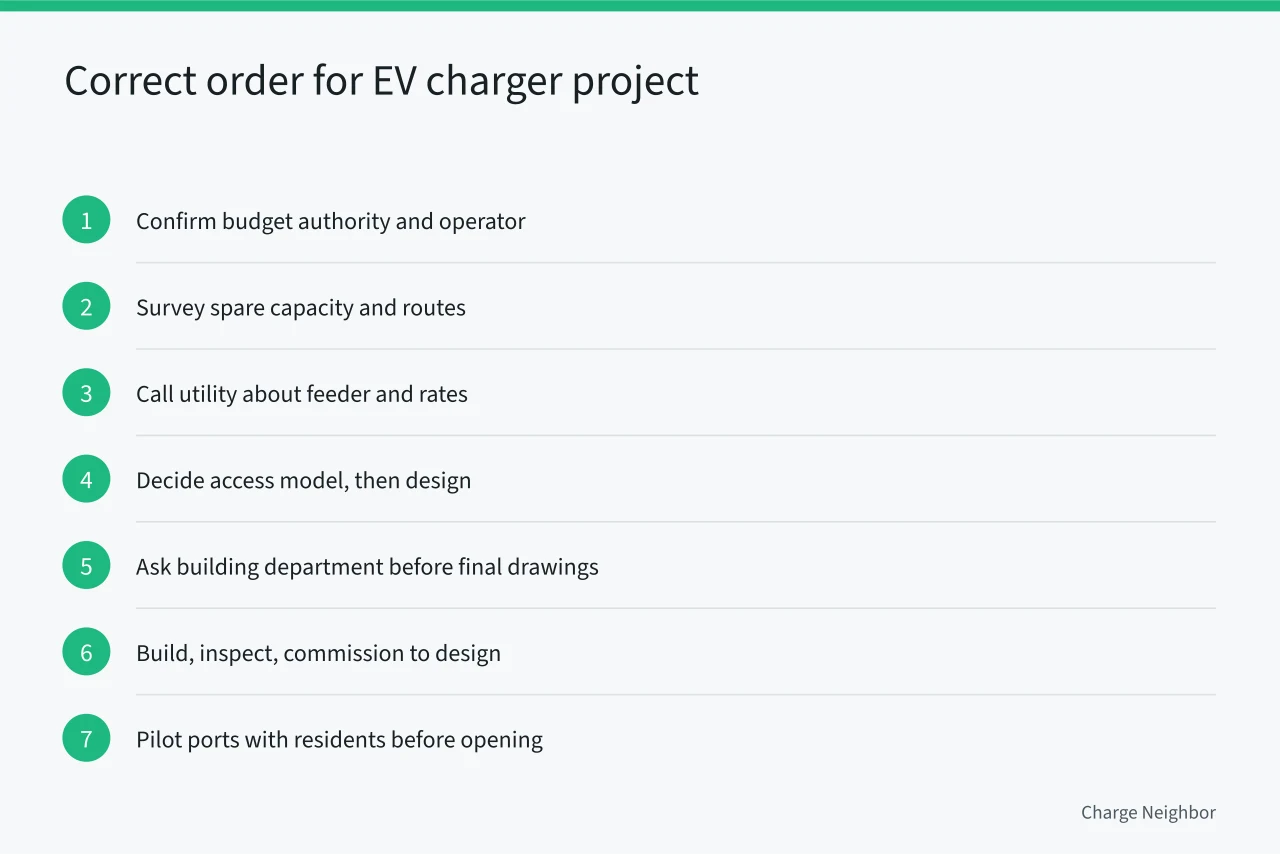
Steps two and three cost weeks. Skipping them costs months.
Settle who decides and who operates
Name the owner, the person with budget authority, and whoever will run the system once it exists. Those are frequently three different people, and the third is often nobody.
A condo association should read its governing documents and check state law first, because the parking rights question sits ahead of the electrical one. Some states limit what an association may refuse at an owner's assigned space, and your documents may add architectural review on top.
A rental property has a simpler question but still must answer it. Is charging an amenity, a resident-paid service, or something a third party owns and operates on your lot?
Survey the electrical reality
Get a licensed electrical contractor or engineer to record what capacity is genuinely spare, the condition of the existing gear, workable circuit routes, and where the load would be metered. Spare capacity on paper and spare capacity in practice are different numbers.
This survey decides your budget more than any other document. Do not skip it to save a few hundred dollars at the start.
Call the utility early
Earlier than feels necessary. The utility knows what the feeder can carry, which rate the account lands on, whether a make-ready program covers trenching, and what work happens on its side of the meter.
Utility work carries the longest lead times in the project and the least flexibility. A design finalized without that conversation gets redrawn.
Fix the access model and the rules
Dedicated ports, a shared pool, or a mix, set against each other on access and electrical allocation. Who may charge, how they identify themselves, what it costs, whether guests are allowed, what happens to a car left plugged in overnight after it finishes.
These are not details to sort out later. They determine whether you need a network, a payment system, new signage and a change to the resident agreement. All of that is cheaper to decide than to retrofit.
Design, then take it to the permit office
Now the drawings: circuit routes, panel work, mounting positions, protection, accessible spaces and the route back to the building.
Permitting and inspection procedures differ from one jurisdiction to the next, and the federal guidance on permitting processes for charging infrastructure is a good primer on what is typically asked for. It is a primer, not a substitute for asking your own building department which drawings, calculations and product certifications they want to see.
Ask before the drawings are final. A plan check comment is cheap; a redesign after award is not. Award is also roughly where a budget stops being reversible.
Build to the code edition your jurisdiction adopted
Electrical work must follow the code your jurisdiction adopted, not always the newest edition. Charging equipment counts as a continuous load, which changes circuit sizing, and rules have shifted across editions.
The NFPA has written about why the code edition in force matters for charger installations. An installer following old habits can build something that fails inspection.
Use a licensed contractor and confirm which edition your inspector is enforcing before rough-in.
Commission against the approved design
Commissioning proves what was built matches what was approved. Test every connector, credential, price rule, network connection, load-management response and support path.
While the installer is still on site, record:
- Charger serial numbers and model revisions
- Circuit identifiers and breaker locations
- Firmware versions as installed
- Warranty start dates and terms
- Network account details and who holds the admin credentials
- Contractor and vendor contacts for faults
That record is worth more in year three than anyone expects on the day.
Pilot with real residents
Open a few ports to actual residents for a week or two.
Pilots reveal what drawings miss. Signage nobody reads. Cellular coverage dying below grade. A payment flow failing on one carrier. A cable that will not reach a car parked slightly off center. An access aisle blocked by a charging vehicle.
Fix those, write a one-page guide for residents, then open the rest.
Start measuring immediately
From day one, track these metrics:
- Uptime
- Sessions
- Energy delivered
- Failed starts
- Support tickets
- Repair times Phase two should be argued from your own numbers rather than a vendor's projection.
Before you get here, the questions worth asking a vendor will shape what you end up installing, and the planning order behind all of this explains why the sequence runs the way it does.
Common questions
How long does a multifamily installation take?
The construction is usually short. The waiting is not. Utility coordination, permit review and lead times on switchgear set the schedule, and any of them can run months.
Do we need a permit for a single charger?
Almost always, because it is electrical work. Ask your building department rather than assuming a small scope is exempt.
Can we install now and add load management later?
Sometimes, but it is much cheaper to design for it at the start. Retrofitting control onto circuits laid out without it often means new wiring.
Who signs off at the end?
Your local inspector for code compliance, and your own commissioning check for whether the system does what you bought. They are different questions and you need both.