
Reviews
Part of Getting started with multifamily EV charging across the U.S.
How to compare specs for multifamily EV charging in 2027
Charger spec sheets hide the number that matters. How to compare power, connectors, load sharing and service on the same basis before you buy.
What to take away
- The headline kilowatt figure describes one port with nothing else running. It is not what residents will get.
- Ask for the guaranteed minimum per car when every port is busy. Vendors rarely volunteer it.
- Connector and cable length decide whether a car can physically reach the unit, which no amount of output fixes.
- Compare warranty, parts availability and after-hours support as seriously as electrical specs, because that is what you live with.
Two chargers advertising the same output can behave completely differently once four cars plug in, the network drops, and somebody needs help at eleven at night. Spec sheets are written to make that hard to see.
So compare on the service a resident actually receives, not on the largest number in the brochure.
Tell vendors what you need before they tell you what they have
Send every bidder the same brief: how many spaces now, how many later, how long cars typically sit, and how much power the charging system as a whole can draw. That last figure comes from your electrical designer, not from the vendor.
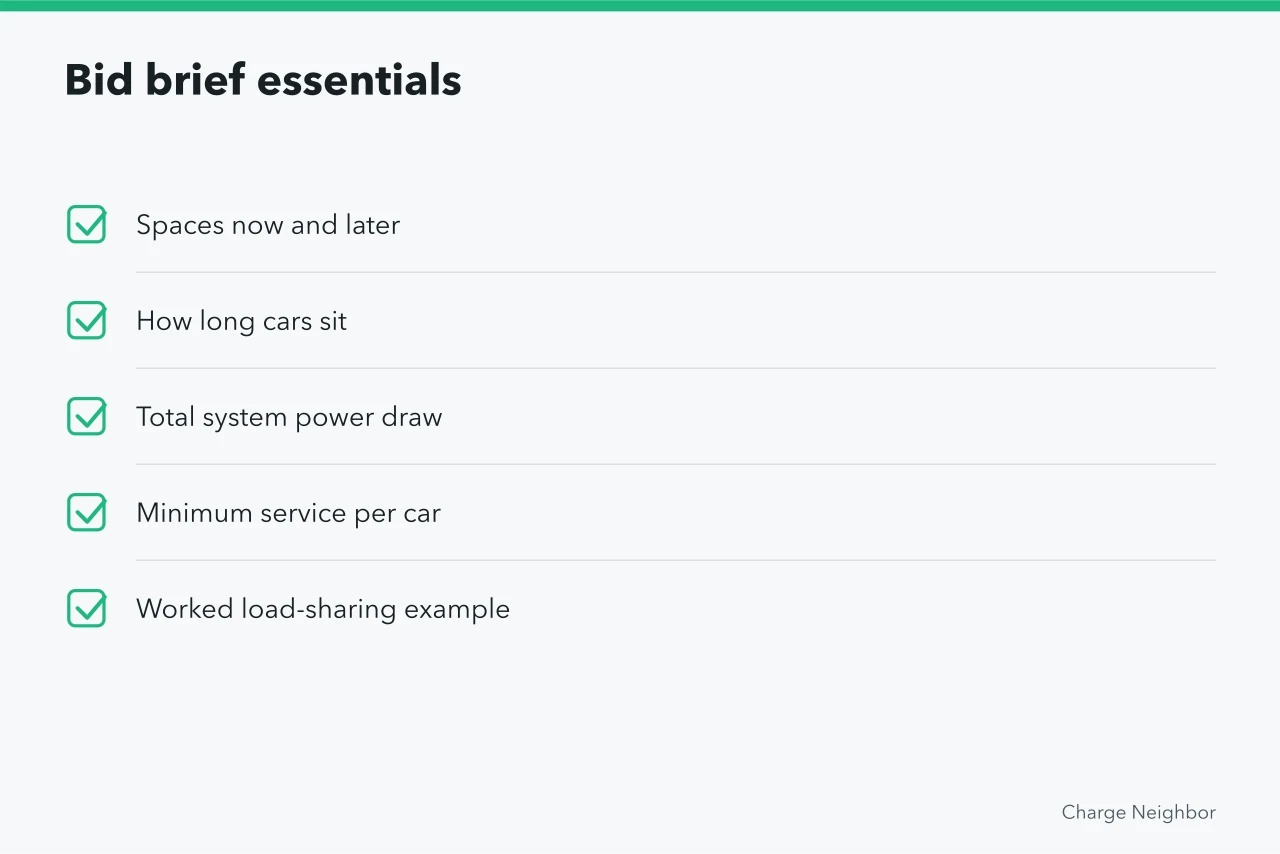
Then state the minimum service you expect per connected car during a busy evening. This is the single most useful line in the whole document, and it turns vague proposals into comparable ones.
If a design uses load sharing, ask for a worked example at light load and at full occupancy. A vendor who cannot produce one has not modeled your site, and filling every port at once on commissioning day is how you find out whether the example was honest.
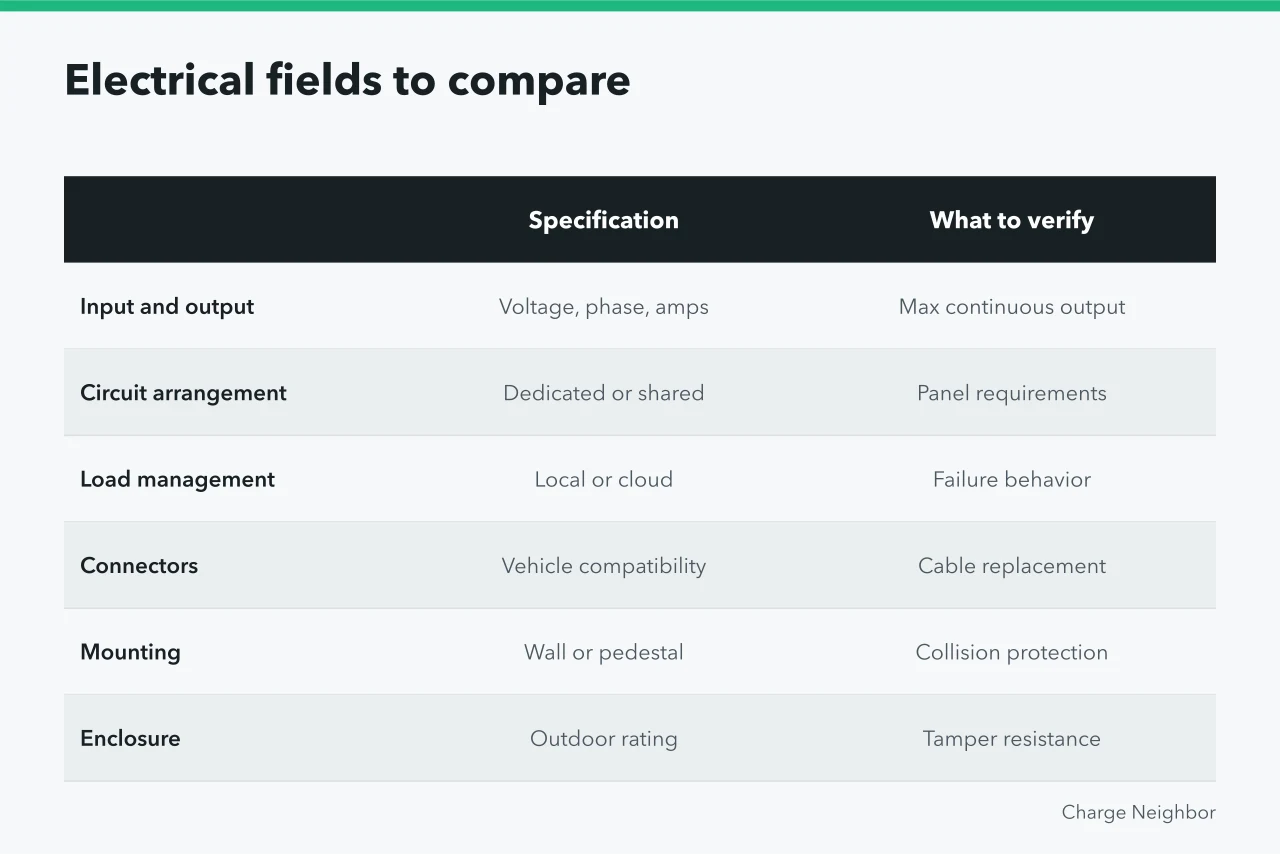
Put the electrical fields side by side
| Specification | What to verify |
|---|---|
| Input and output | Voltage, phase, amperage, and maximum continuous output |
| Circuit arrangement | Dedicated or shared circuits, and what the panel must provide |
| Load management | Local or cloud control, what happens on failure, expansion ceiling |
| Connectors | Vehicle compatibility, cable length, how a damaged cable is replaced |
| Mounting | Wall or pedestal, cord storage, collision protection |
| Enclosure | Outdoor rating, temperature range, resistance to tampering |
Never assume maximum output is continuous, or that it is available to every port at the same time. Both assumptions are usually wrong, and both are usually left unstated rather than denied.
The federal reference on charging equipment and power levels is a useful sanity check here: it sets out what Level 1 and Level 2 equipment actually deliver, which makes an inflated claim easier to spot.
Check the connector question properly
Connector standards have been moving, and a building installed today will still be there when the mix of cars in the lot has changed. The Joint Office maintains a plain summary of where the connector standards stand, which is worth reading before you commit to hardware for the next decade.
Two practical points get missed. Cable length decides whether a car parked nose-in on the far side of a space can reach the unit at all, and drivers park inconsistently. And adapters are not a neutral solution: they introduce a failure point and a safety question, so ask what the vendor supports rather than assuming.
Separate the things that fail from the things that impress
Most of what goes wrong in year two is not electrical, and the upkeep those parts actually need is worth pricing while you are still choosing between units.
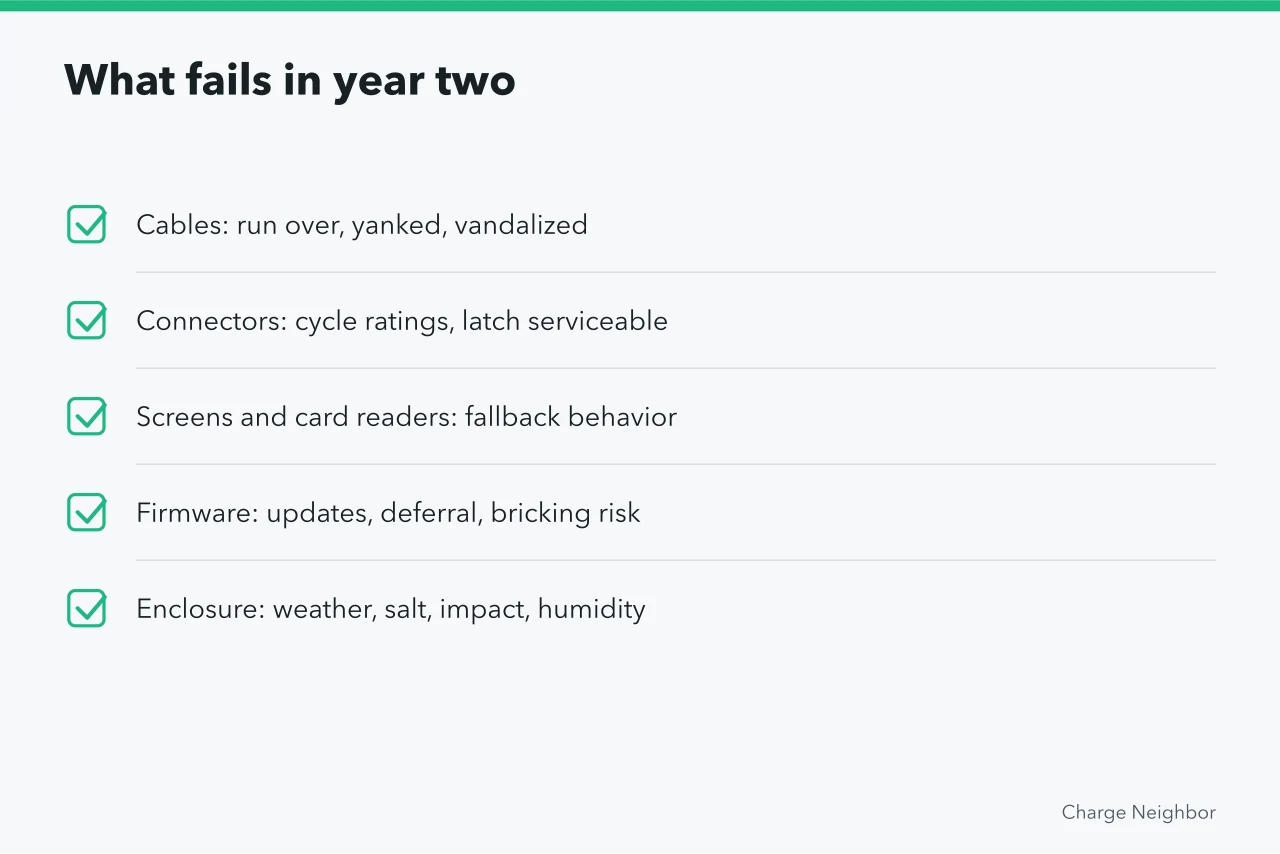
- Cables. They get run over, yanked and vandalized. Ask whether a cable can be replaced on site, by whom, and what it costs.
- Connectors. Ask about cycle ratings and whether the latch is a serviceable part.
- Screens and card readers. The most exposed components and often the first to fail. Ask what the unit does when the reader dies. Does charging stop, or does it fall back to open access?
- Firmware. Ask how updates arrive, whether they can be deferred, and whether a failed update can brick the unit.
- Enclosure. In a lot, a unit is exposed to weather, salt and impact. In a garage, to humidity and the occasional bumper.
Read the support terms as carefully as the specs
A warranty that covers parts but not labor, at a site four hours from the nearest technician, is not much of a warranty.
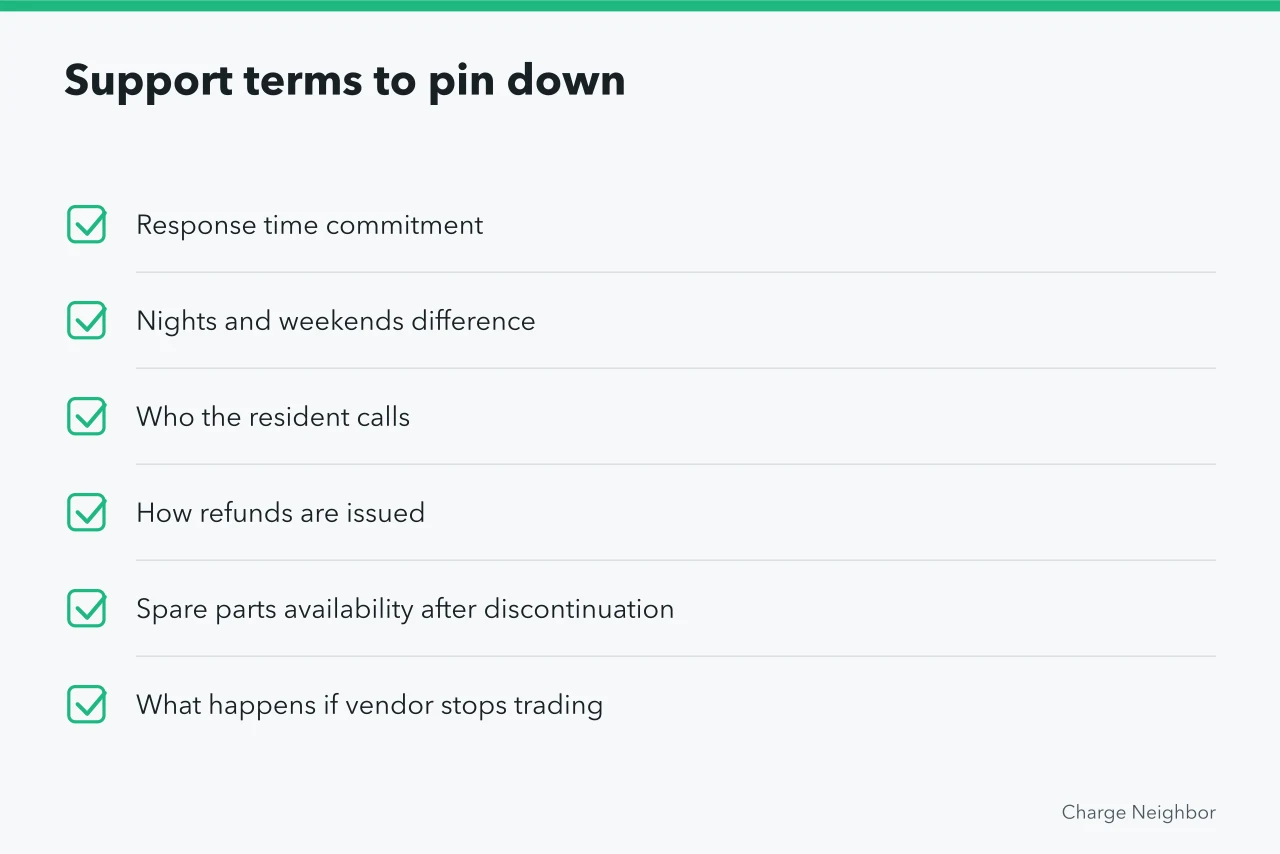
Ask for response time commitment, whether it differs nights and weekends, who the resident calls when a session fails, and how a refund is issued.
Ask how long spare parts remain available after a model is discontinued and what happens to the units if the vendor stops trading. Get answers written into the proposal, not described on a call.
Score them on one sheet
Build a single table with a row per bidder and a column per criterion, and fill it in yourself rather than accepting each vendor's own summary. Anything a vendor will not answer goes in as unknown, and unknowns count against them. Some refusals go further than that: there are four answers that should end a conversation outright.
Then weight by what your building actually cares about. A property where residents park twelve hours a night should weight guaranteed minimum power and cable durability far above peak output. A property with visitor parking has a different set of priorities entirely.
Once the shortlist is real, what each option costs to build and run is the next comparison, and the one that usually reorders the list. If you have not yet settled the access model, that decision comes before the spec sheets.
Common questions
Is a higher kilowatt rating always better? No. Cars parked overnight cannot use it, and paying for output you never draw means paying for electrical capacity you did not need.
Do we need a networked charger? Only if you need to authenticate users, bill them, or manage load. If the association absorbs the electricity and access is simple, a plain unit avoids a subscription.
How long should the cable be? Long enough for the worst-parked car in the space it serves. Measure the actual bay before choosing, and remember that a longer cable is heavier to handle and easier to damage.
What if a vendor will not give a guaranteed minimum power figure? Treat that as the answer. It means the number is low enough to lose them the bid.