Costs
Part of Getting started with multifamily EV charging across the U.S.
Multifamily EV charging costs for homes and shared buildings
Multifamily EV charging costs sit in construction, not hardware. What each budget line covers, what moves it, and what you pay every month after.
What to take away
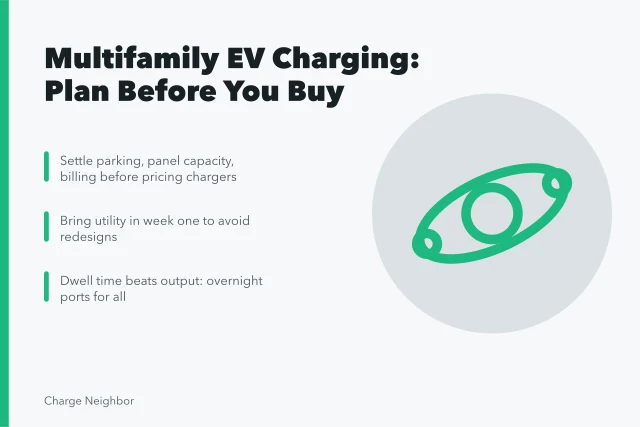
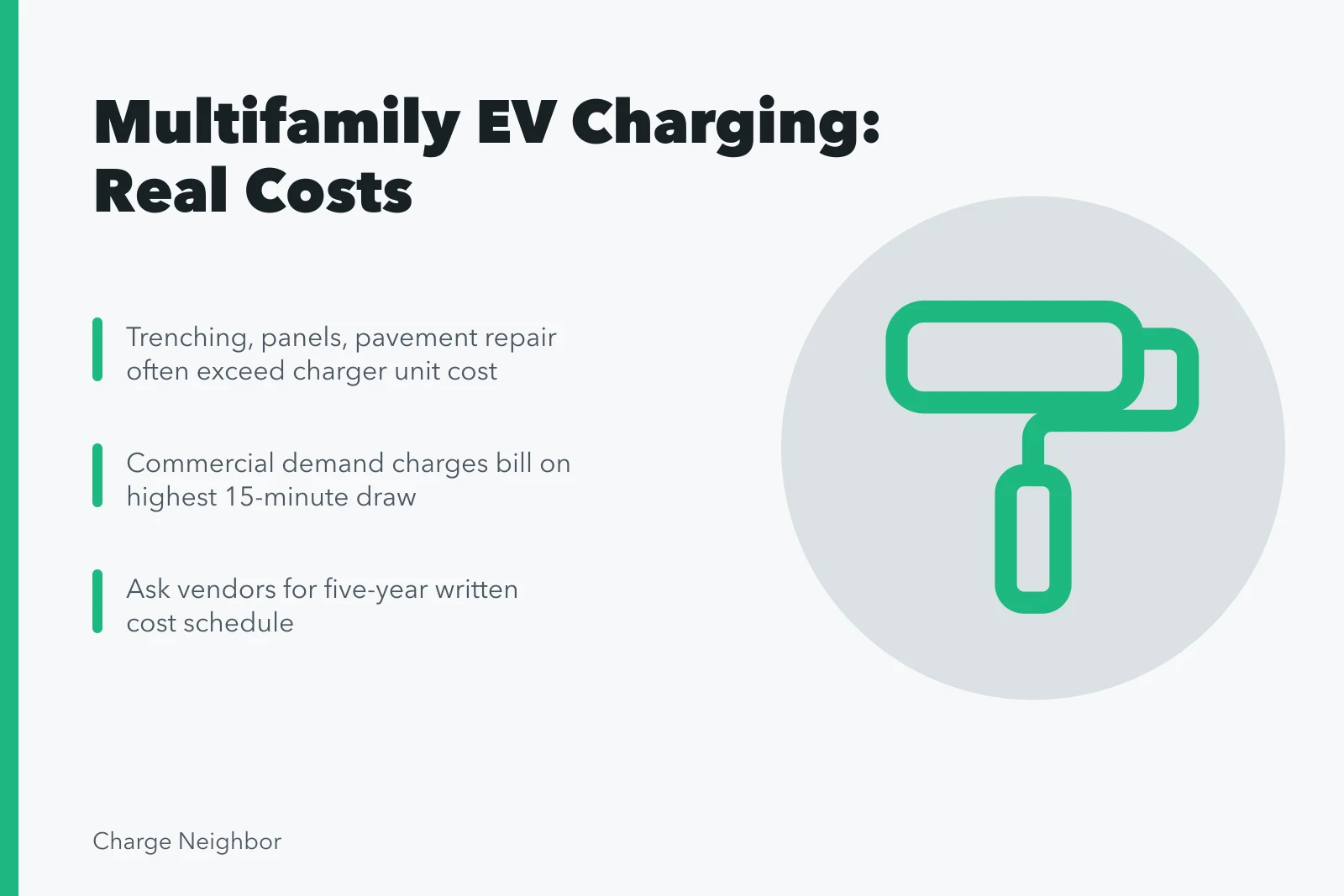
- The charger is rarely the expensive part. Trenching, panel work and pavement repair usually cost more than the units.
- Two buildings on the same street can differ by an order of magnitude, so a per-port number from the internet tells you nothing about yours.
- Budget the monthly costs separately and name who pays them, because somebody will be paying them for years.
- Treat every incentive as unconfirmed until you have eligibility in writing for your address and ownership type.
Ask three vendors what multifamily charging costs and you will get three numbers that do not overlap. That is not evasion. A wall-mounted unit ten feet from a modern electrical room and a lot installation that needs a trench, new switchgear, a utility upgrade and repaved asphalt are different projects that happen to end in the same piece of hardware.
Which means the useful question is never "what does a charger cost." It is "what does this building make me do before a charger can work."
Split the budget in two, then split it again
Equipment and construction behave differently. Equipment prices are knowable in advance and roughly the same wherever you are. Construction prices depend entirely on your site, and they are where projects overrun.
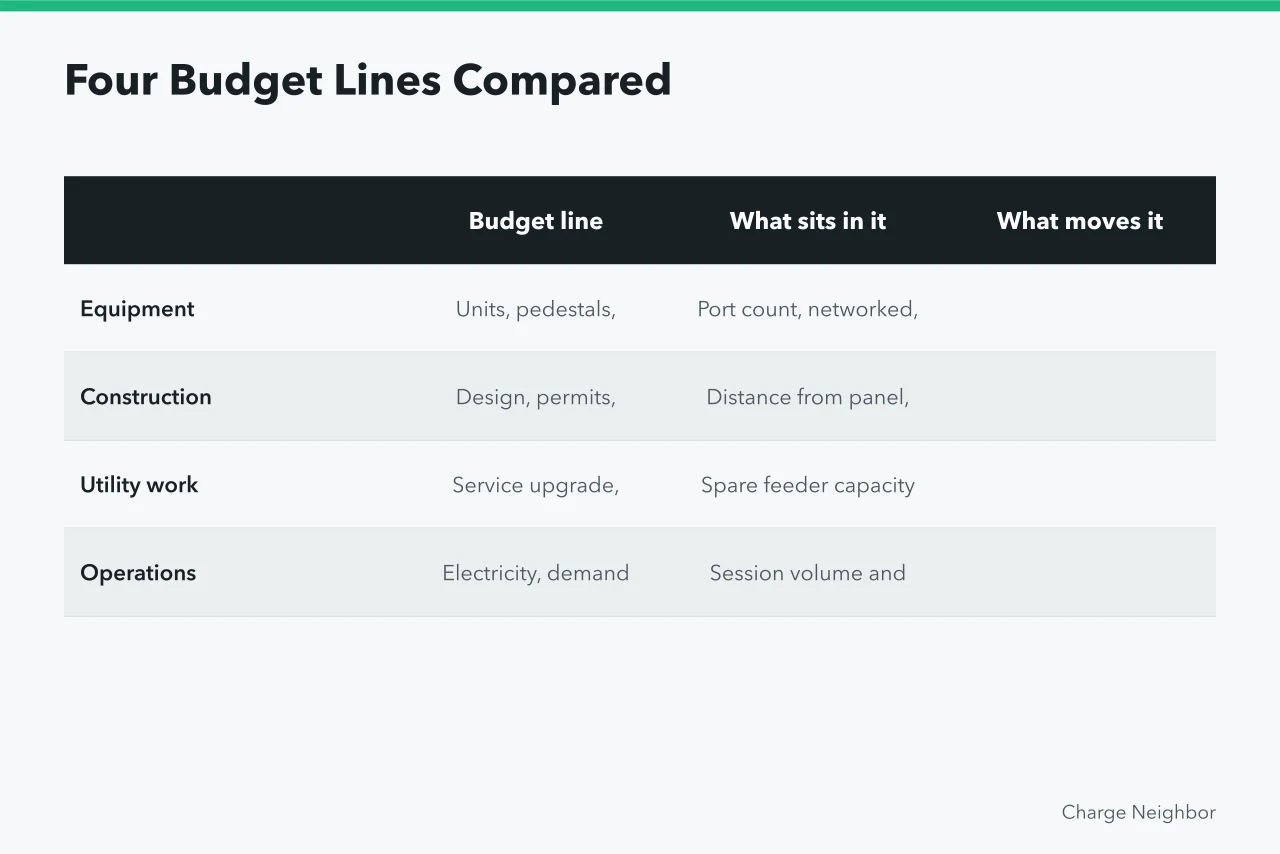
| Budget line | What sits in it | What moves it |
|---|---|---|
| Equipment | Units, pedestals, cable management, bollards, signs, comms hardware, spare parts | Port count, networked or not, outdoor rating |
| Construction | Design, permits, panels, conduit, conductors, trenching, concrete, repaving, accessible routes | Distance from the panel, whether you dig, what the inspector wants |
| Utility work | Service upgrade, transformer, new meter, make-ready | Spare feeder capacity, which is a fact about your street |
| Operations | Electricity, demand charges, network fees, payment processing, support, repairs | Session volume and your rate structure |
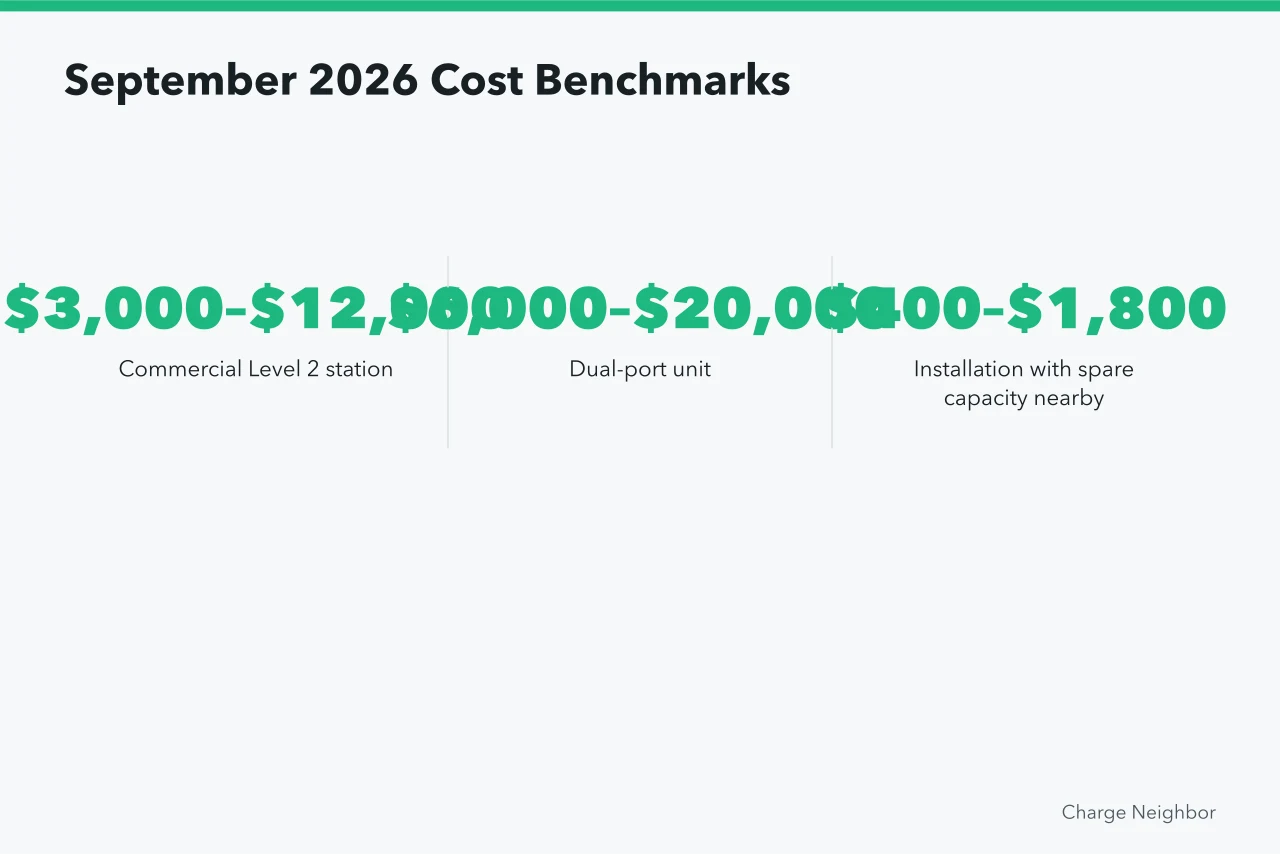
Those lines have rough sizes, and knowing them before the first quote arrives is worth more than any negotiating tactic. In September 2026 a commercial Level 2 station ran $3,000 to $12,000, a dual-port unit $6,000 to $20,000, and installation on its own $400 to $1,800 where spare capacity already sat nearby.
| Budget line | Rough size on a small deployment |
|---|---|
| Equipment | $3,000 to $20,000 a unit, by port count and networking |
| Construction | $400 to $1,800 with capacity nearby, several times that if you dig |
| Utility work | Nothing, or the largest number on the page |
| Operations | Recurring, and the line nobody budgets |
Read the utility row as bimodal rather than as a range. Either your street has spare feeder capacity or it does not, and that one fact decides whether this is a weekend of conduit or a year of coordination.
Then get the electrical team to price the specific conditions most likely to blow the estimate:
- a service, transformer, panel or switchgear upgrade
- long conduit runs, or any route through finished space
- trenching and the pavement restoration that follows it
- an electrical room with no physical room left in it
- separate metering or billing hardware
- pulling cellular or wired communications to the parking area
- changes to accessible parking and the route back to the door
- phased work that brings a crew back a second and third time
A load-managed design can shrink or remove the capacity upgrade, often the single largest line. Decide it early: the moments when money actually leaves arrive sooner than most boards expect.
The trade: lower guaranteed power per car at busy times, and a software dependency for the life of the system.
Do not skip the paperwork line
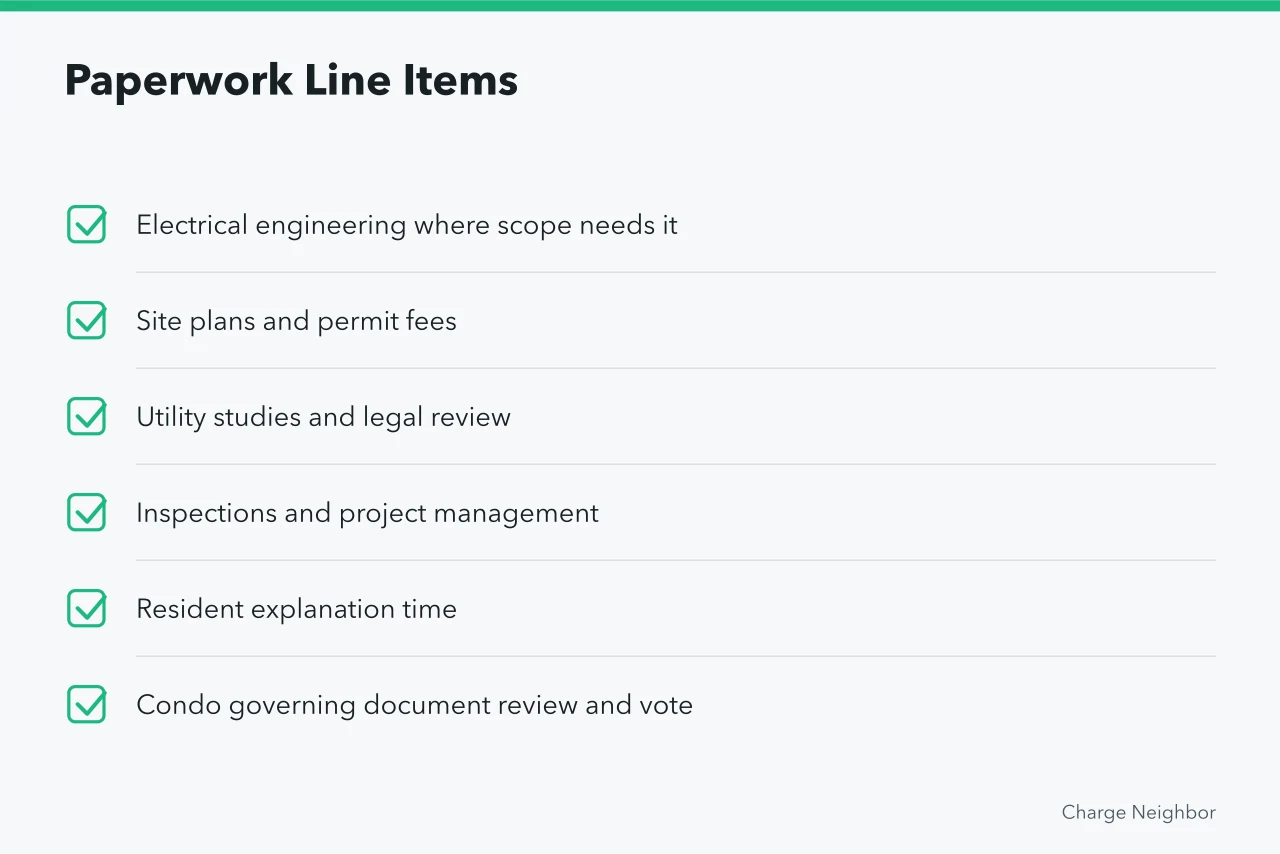
Design and approval cost real money and get left out of early estimates constantly. Electrical engineering where the scope needs it, site plans, permit fees, utility studies, legal review, inspections, project management, and the time somebody spends explaining all of it to residents.
Condominiums carry more. Governing documents may need review, owners may need to vote, and somebody has to draft the agreement that says who owns the equipment, who maintains it, and who pays when it breaks. That is a board process in itself, and running it before the quotes arrive stops the legal time being spent twice.
Set the contingency after the site assessment rather than before it. Older buildings hide undocumented circuits, damaged raceways and conditions nobody finds until a wall is open.
Budget the monthly bill, not just the build
The build is one conversation. The operating cost is a conversation every year.
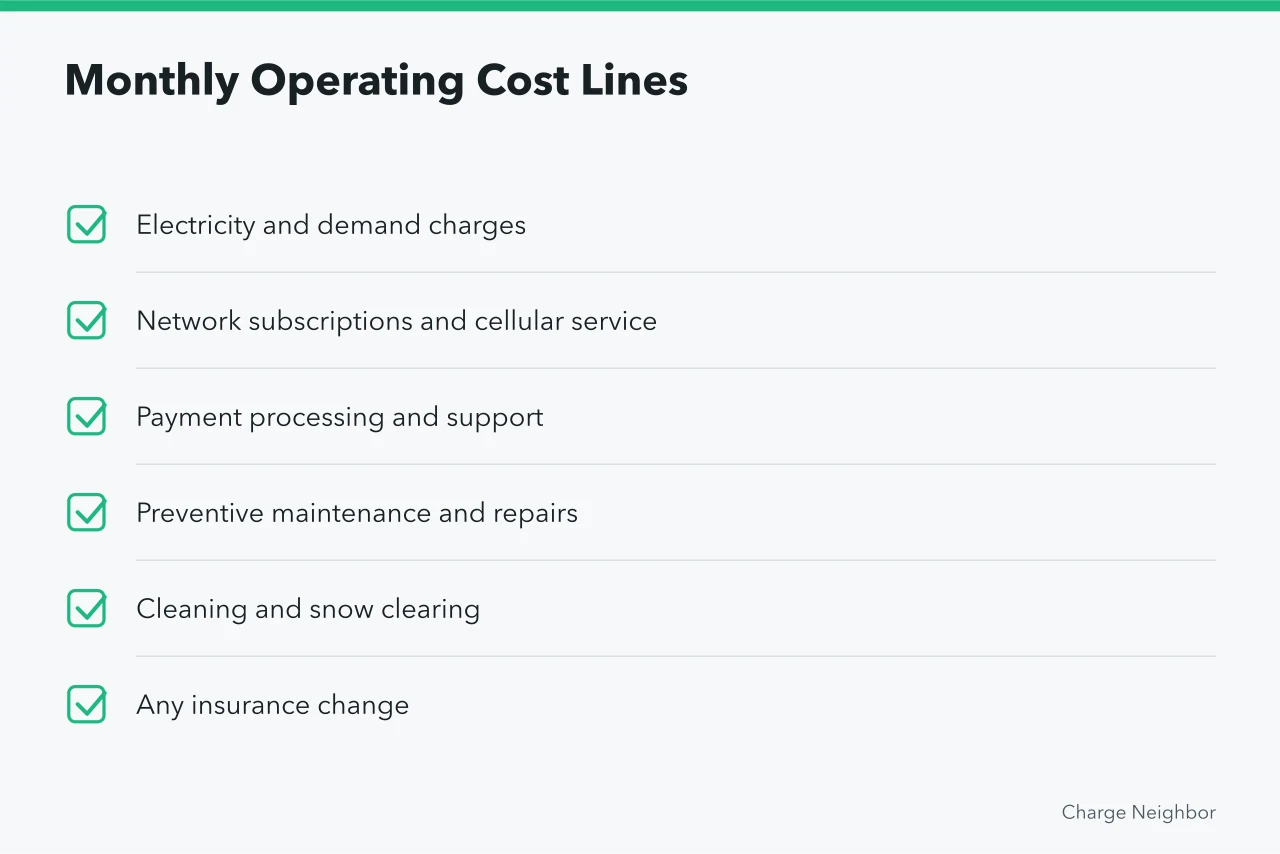
Electricity is the obvious line, but demand charges catch people out: some commercial rates bill on your highest fifteen-minute draw, so four cars starting at once can cost more than the energy they take. Add network subscriptions, cellular service, payment processing, support, preventive maintenance, repairs, cleaning, snow clearing and any insurance change.
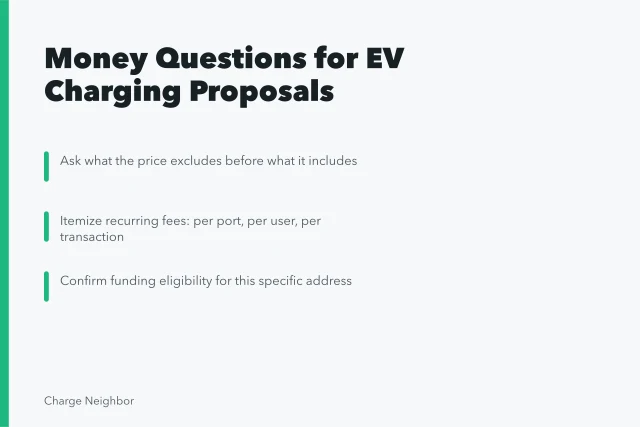
Ask any vendor for a five-year schedule with written assumptions. Separate flat fees from fees that scale with ports, users or transactions.
Then answer the question that decides whether this works: if collected fees do not cover the utility bill and the service contract, who absorbs the difference? It belongs on the list of money questions that go out with the brief, answered in writing before anyone signs.
Treat incentives as conditional until they are not
Programs exist at federal, state, utility and sometimes city level, and several target multifamily buildings specifically because they are harder to serve than houses. Some utilities run a rebate aimed squarely at multifamily properties, and several states run grant programs for chargers at multifamily housing.
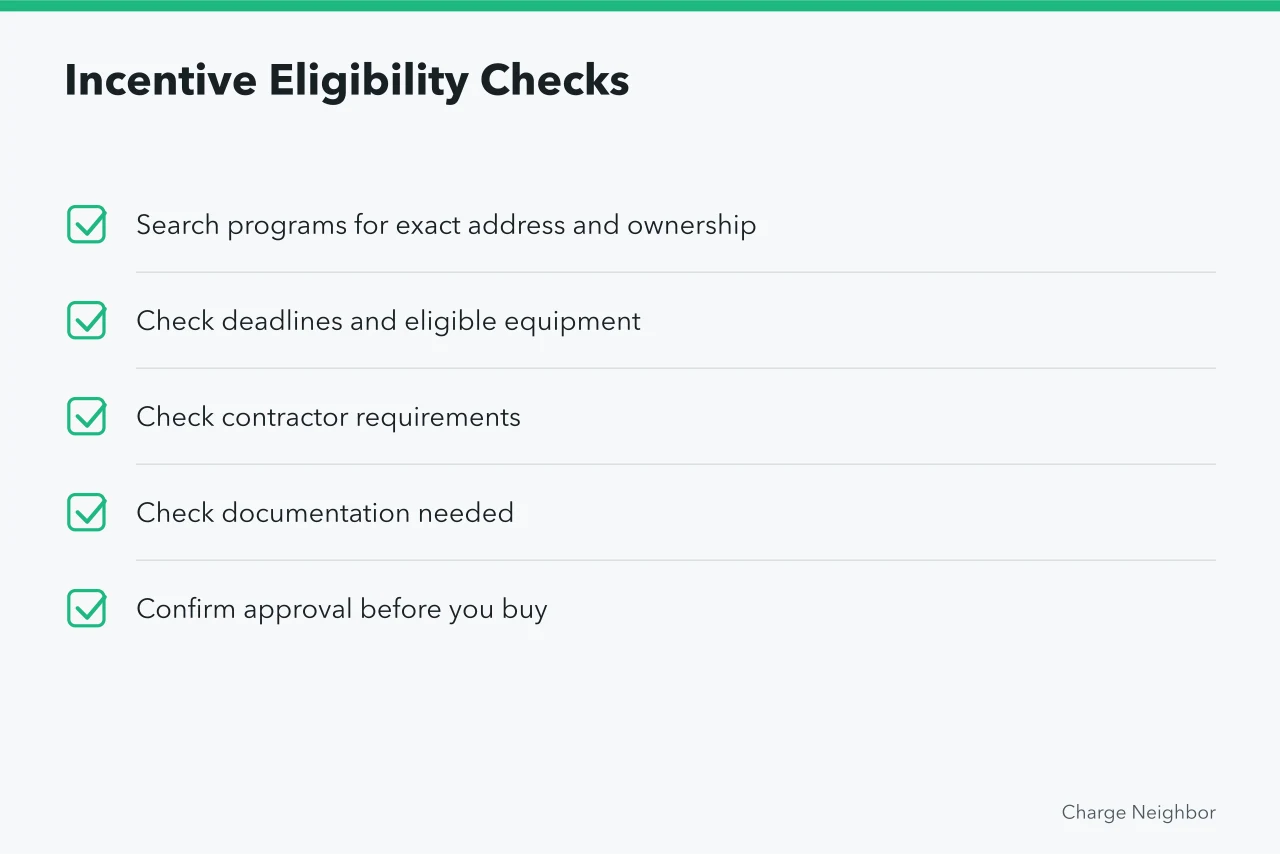
That is the good news. Search current programs for your exact address and ownership type, then check deadlines, eligible equipment, contractor requirements, documentation, and whether you need approval before you buy, not after.
Programs close and rules change mid-year. A credit assumed at the board vote and lost at filing turns a funded project into an assessment.
Do not reduce an approved budget by an expected incentive until eligibility is confirmed in writing.
Compare cost per outcome, not cost per port
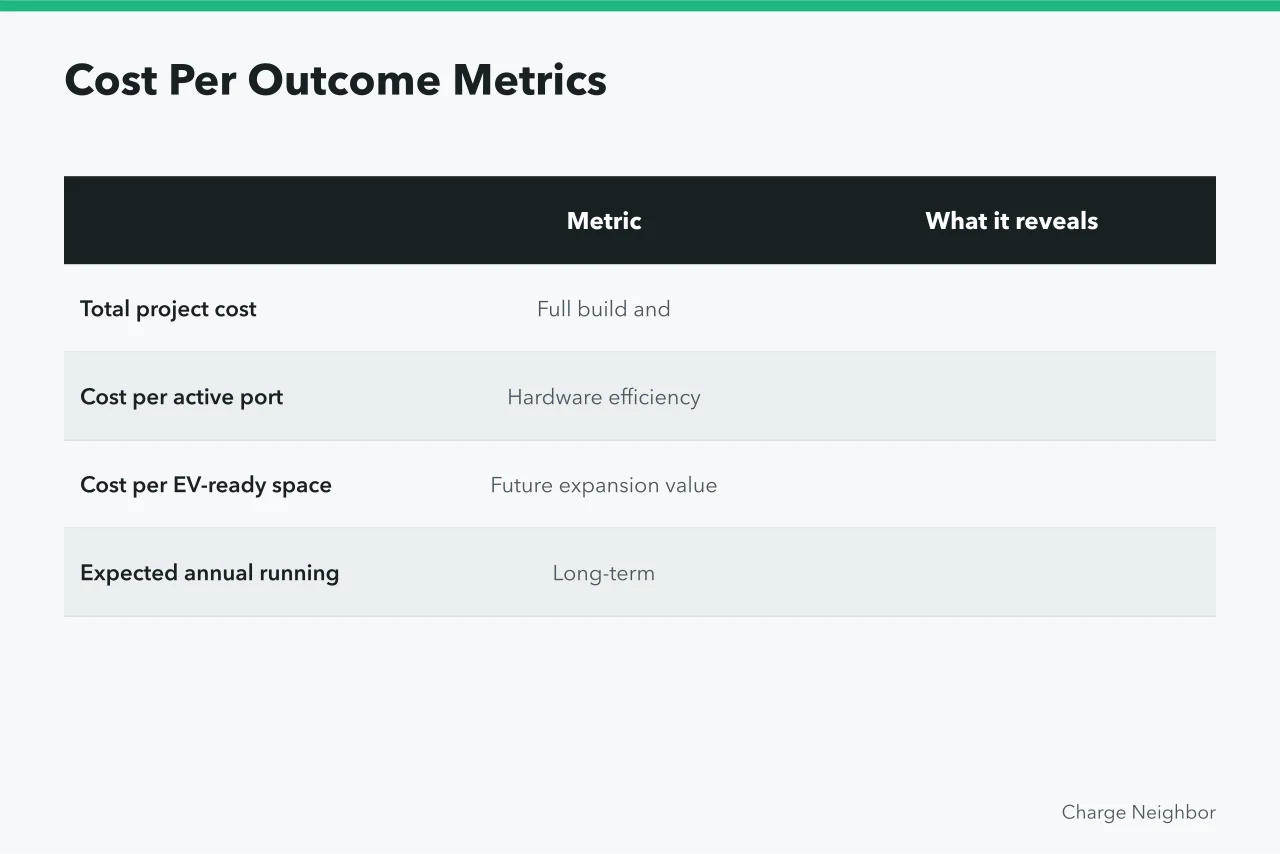
Once you have real quotes, work out total project cost, cost per active port, cost per EV-ready space, and expected annual running cost. Then set those against what each design actually delivers: dedicated or shared access, guaranteed minimum power, billing, data, support, and room to grow.
The cheapest first phase is frequently the one with no expansion path. Paying now for conduit, panel space or managed capacity, while buying only the chargers you currently need, usually beats a bargain installation that has to be torn out to add a fifth port.
If you are still at the stage of deciding what the project is for, start with the building rather than the hardware. And once you have quotes in hand, reading them against each other is a different skill from reading them one at a time.
Common questions
Why will nobody give me a price over the phone? Because the answer depends on your panel, your parking layout and the distance between them. Anyone who quotes without seeing those is guessing, and the guess will not hold.
Is it cheaper to install more ports at once? Usually yes, because mobilization, trenching and design are shared across them. That is the argument for running conduit for more ports than you populate on day one.
Can we pass the cost to residents? Often, though how depends on state law, your governing documents and your rate structure. Decide it before installation, not after the first bill arrives.
What is the most commonly underestimated line? Trenching and repaving, followed by anything involving the utility. Both are outside your control and both have long lead times.