Maintenance
Part of HOA charging solutions compared for value, upkeep and fit
A practical maintenance plan for HOA charging solutions
A maintenance plan for HOA charging solutions starts with who owns what, then sets the checks, records and reserve lines the association actually controls.
What to take away
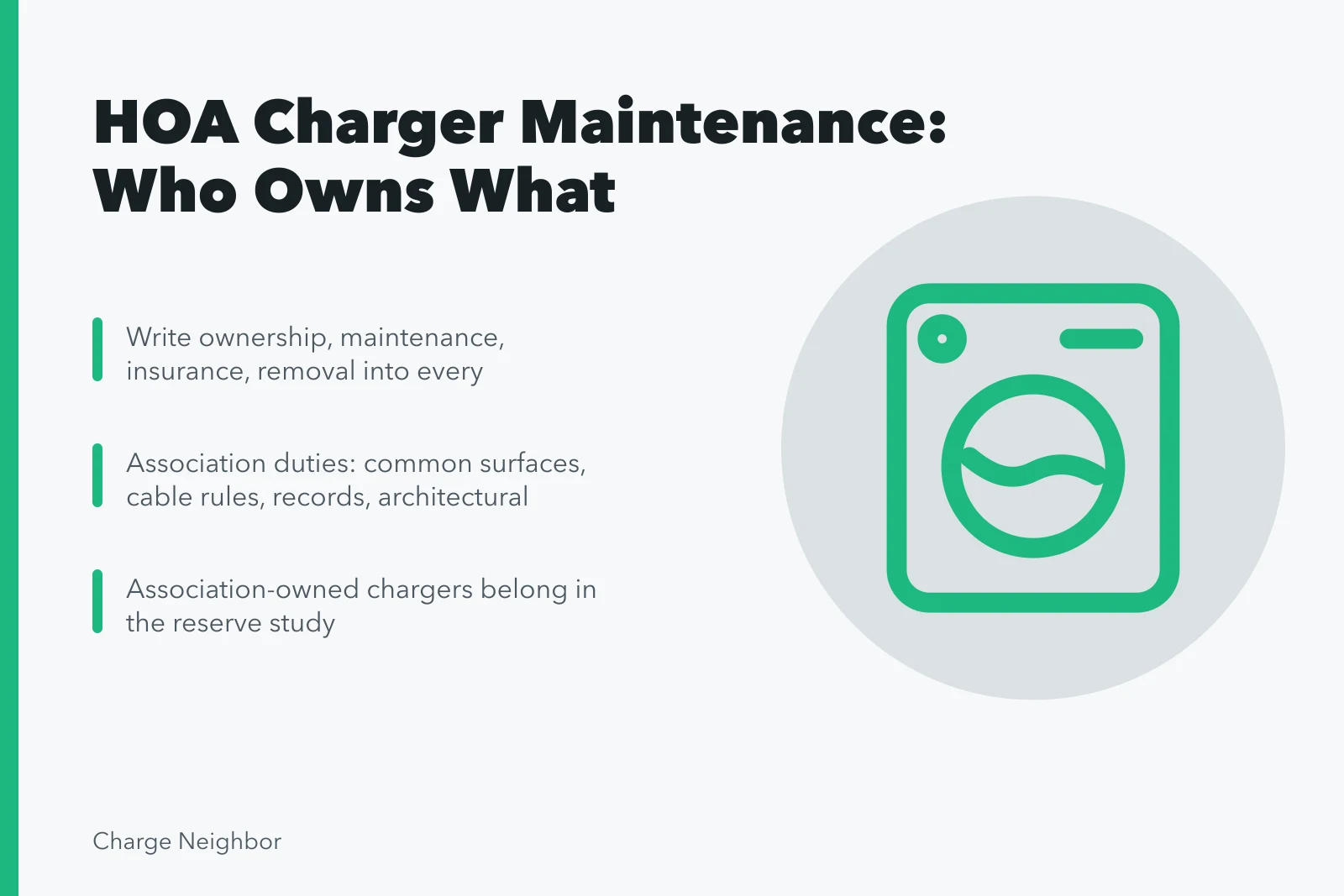
- Write the maintenance boundary into each approval: who owns the charger, who services it, who insures it, who removes it.
- An owner's charger on an owner's circuit behind an owner's meter is the owner's cost, and the association should not absorb it by habit.
- Association-owned chargers belong in the reserve study, because cables, connectors and screens wear out long before the housing does.
- Keep one turnover file: approvals, permits, inspection sign-offs, insurance certificates, serial numbers, warranty terms and service contacts.
- Review the architectural standard every couple of years, since state law on what an association may require keeps moving.
A maintenance plan for HOA charging solutions is mostly a record-keeping job. The equipment is simple. What goes wrong is the boundary around it.
Most charging in a planned community sits in owners' garages, on owners' circuits, behind owners' meters. The association has no duty there, and the cheapest way to keep it that way is to never act as though it does.
What the association does maintain is narrow: what it installed, what attaches to common area, and the rules covering both. A practical maintenance plan for condo EV charging turns on that same split.
Four questions per installation
Every approval should answer four things in writing.
Who owns the equipment. Who maintains it. Who insures it. Who removes it, and by when.
For a garage installation the answer to all four is the owner. That reads as too obvious to bother writing. Write it anyway, because the argument arrives at resale, when a buyer asks whether the charger conveys and who pays if it fails.
For anything crossing or mounted on common area, the answers need real thought, and they belong in the approval itself rather than in a general policy adopted years later.
What the association actually maintains
If the association installed nothing, the list is short.
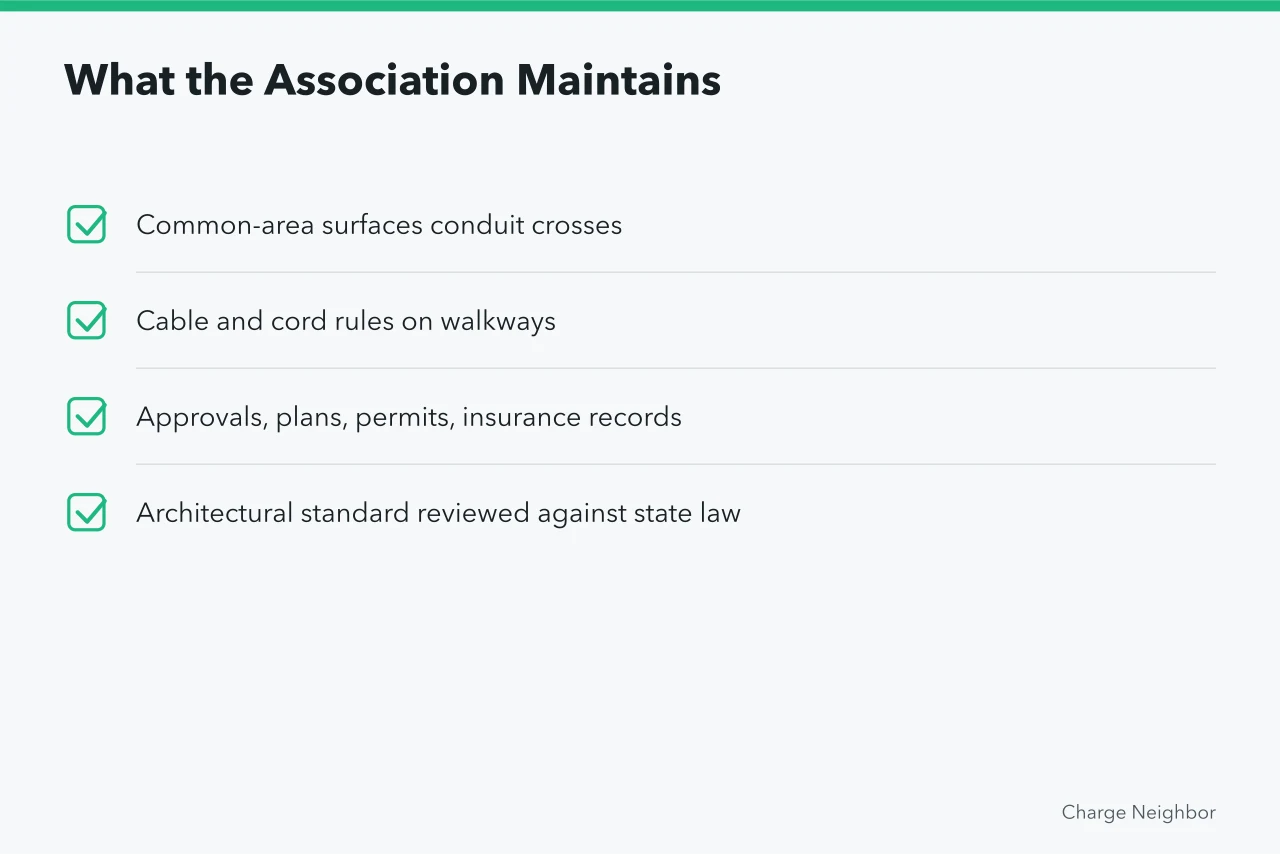
That last item gets skipped, and it is the one that ages worst. A standard written five years ago may now require something the association is no longer permitted to require. Comparing it every couple of years against the record of state charging station policies for associations costs an afternoon.
When the association owns amenity charging
Now the association operates equipment, and the plan has to name who does what, and how fast.
| Task | Who | How often |
|---|---|---|
| Cable, connector, holster and screen inspection | Staff or site contractor | Monthly |
| Enclosure cleaning, pedestal drainage, snow-route check, lighting test | Grounds contractor | Seasonally |
| Torque checks, protective device testing, ground continuity, firmware review | Licensed electrician | Annually |
| Cable and connector replacement | Service contractor | On wear |
| Firmware support review and replacement decision | Board, with the network provider | Before end of support |
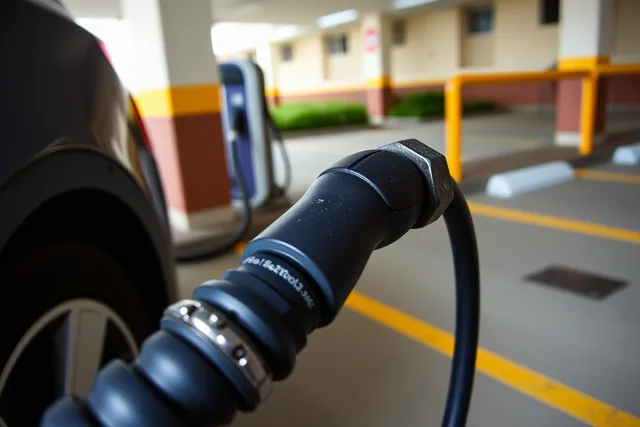
Cables and connectors are consumables. Screens and payment hardware outlive their own support sooner than the units around them. Networked chargers eventually lose firmware updates, and that date, not the housing, usually sets replacement.
The Plug-In Electric Vehicle Handbook for Electrical Contractors is worth handing to a maintenance contractor who has not serviced charging equipment before. It covers installation and inspection fundamentals rather than one manufacturer's product line.
Reserves, not surprises
Association-owned chargers belong in the reserve study. They wear out faster than almost anything else the association maintains, and paying for each failure out of the operating budget produces the pattern reserves exist to prevent.
Ask the supplier two questions and put both answers in the study: expected service life, and how long parts stay available after the model is discontinued. The second usually sets the replacement date. Both belong on the criteria list before you buy an amenity port, not after.
The file that survives turnover
Boards turn over. Managers leave. Keep one file. Include every approval with its plan, permits and inspection sign-offs. Include insurance certificates. Include the architectural standard and its revision dates. For association-owned equipment include the serial numbers, circuit identifiers, warranty terms and service contacts.
Without it, a new board inherits equipment of unknown provenance and approvals nobody can produce. Turnover is also when administrator logins stay with people who have left the board.
Where the line between owner and association falls is covered in the comparison of HOA charging situations, and the contractor relationship that keeps this serviceable is worth building before you need it.
Common questions
An owner's charger failed and they want us to fix it. Do we?
No, unless your governing documents say otherwise. This is exactly why the boundary belongs in the approval, signed, at the time the charger goes in.
Who repairs common-area paving an owner's conduit crossed?
The owner, if the approval said so. If it did not, the association usually absorbs the cost, which is the argument for saying so in advance.
Do we need a service contract for amenity chargers?
For networked equipment, yes. Agree it while the installer is still engaged rather than calling a stranger when a cable fails in January.
How often should the architectural standard be reviewed?
Every couple of years, and any time your state legislature acts on the subject. Standards go stale quietly, and the conflict surfaces during a dispute.