
Reviews
Part of Apartment EV charging: cost guide for 2027
Apartment EV charging budgets: how to test
Stress-test a charging budget before you approve it: five scenarios, the demand charge exposure, and the four numbers to track after opening.
What to take away
- A budget that only works at the expected level of use is not a budget, it is a hope.
- Run it at both extremes. Very low use breaks a paid service; very high use breaks a free amenity.
- Demand charges are the exposure most apartment budgets miss entirely.
- After opening, four numbers tell you within a quarter whether the model is holding.
Nearly every charging budget presented to a board is a single scenario at expected adoption. That scenario is the least likely thing to happen.
Testing means asking what the same project does when the assumptions are wrong, and the useful discovery is usually that low use and high use break different models.
Five scenarios to run before approving
Half the expected adoption. A paid service now spreads fixed costs across fewer sessions. Network fees, payment processing and maintenance do not fall with usage. Does the price still cover them, and if not, who funds the gap?
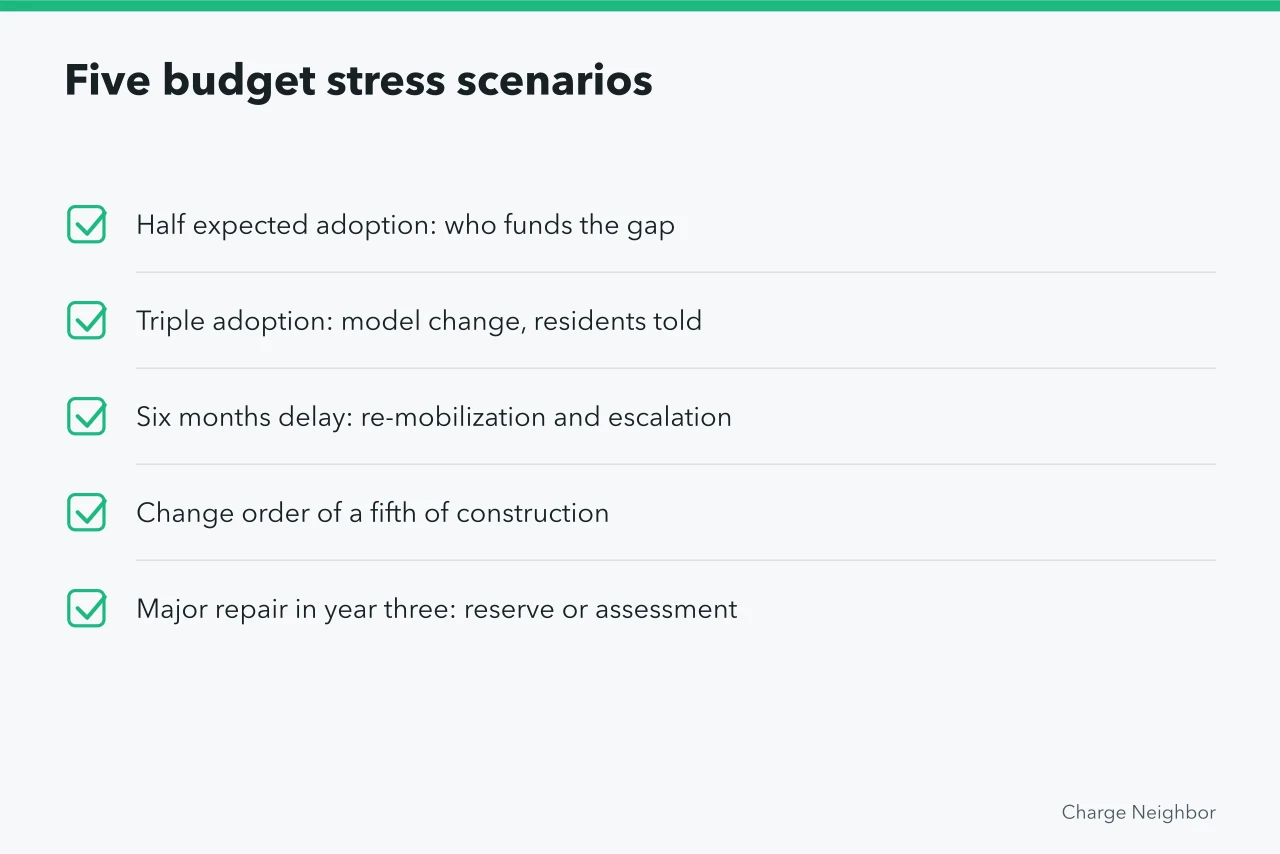
Triple the expected adoption. A free amenity now has three times the electricity bill, and the guaranteed power per car drops. At what point does the model change, and have residents been told?
Six months of delay. Utility work and permits slip. What does that cost in re-mobilization, price escalation and any funding deadline you were counting on?
A change order of a fifth of the construction cost. Something is found behind a wall or under the paving. Where does that money come from, and who can approve it without another vote?
A major repair in year three. A pedestal is hit, or a run of cables needs replacing. Is there a reserve line for this, or is it an assessment? Cables and readers are consumables, which is why the replacement intervals belong in the reserve study.
If any scenario has no answer, that is the actual finding, and it is better found now.
The exposure most budgets miss
Commercial electricity rates frequently include a demand charge, billed on the highest power draw in a short window rather than on total energy used.
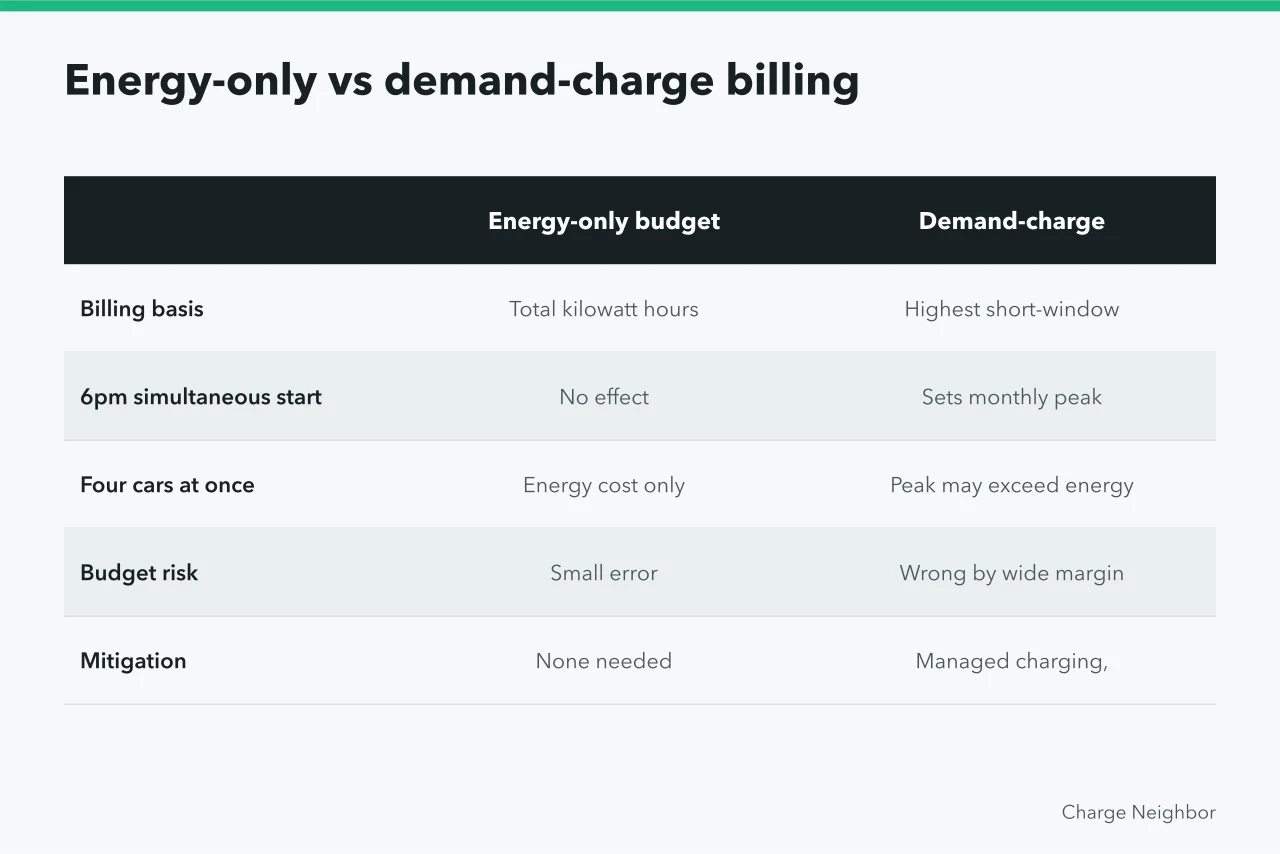
That structure interacts badly with charging. Four cars starting together at 6pm can set a monthly peak that costs more than all the energy those cars consumed. A budget that models electricity as cents per kilowatt hour and stops there can be wrong by a wide margin.
Before approving, ask three things: is this account on a demand rate, what is the charge per kilowatt, and what would a simultaneous start of every port do to it.
Then ask whether managed charging or a time-based rate would reduce it. The Department of Energy's overview of demand response and time-variable pricing programs explains the mechanisms these rates use. That lets you ask your utility a specific question rather than a general one.
Test the funding assumptions too
Every funding line in the budget should be tested for the condition that could void it.
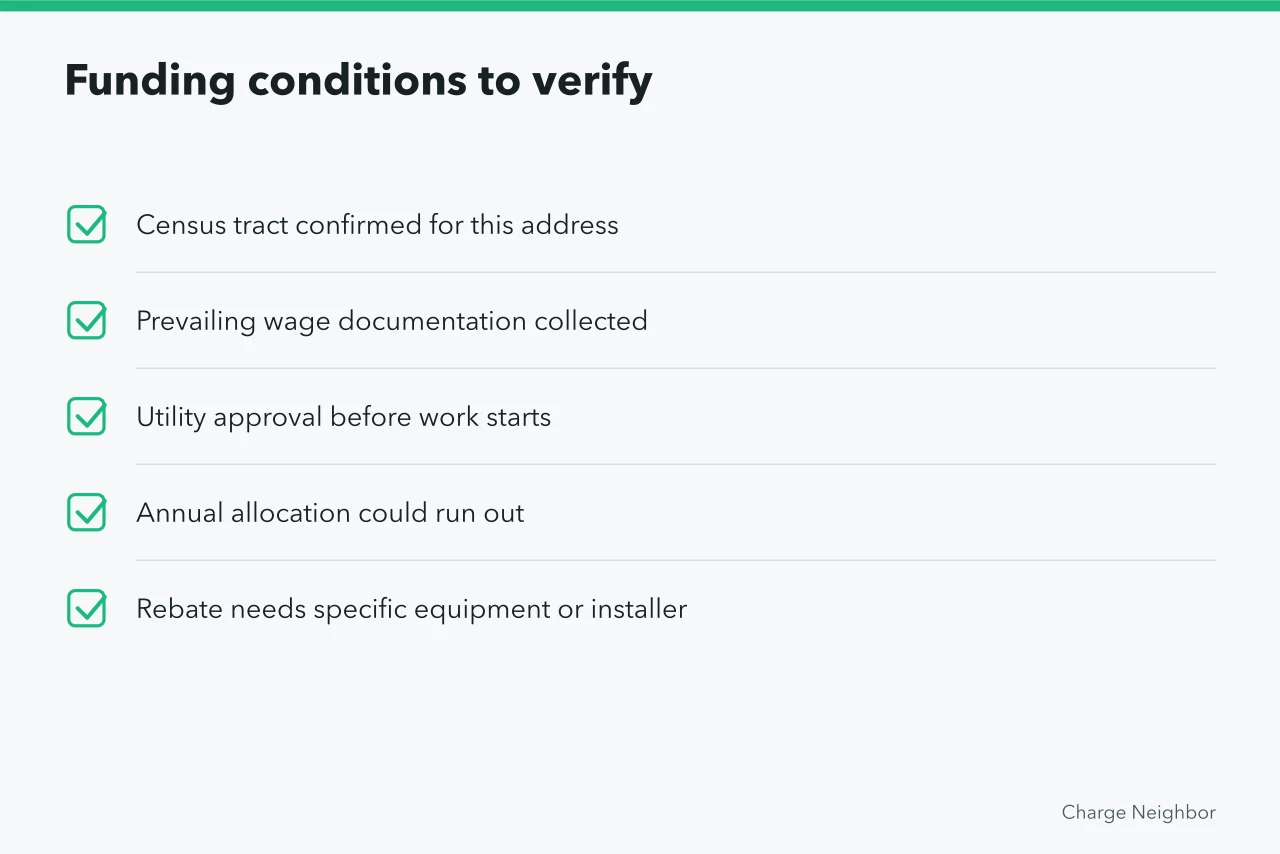
Utility programs in particular carry requirements that are easy to fail administratively rather than technically, so map the funding deadlines onto the build schedule on a single page. Some jurisdictions publish detailed requirements for commercial charger programs, and the pattern to notice is how many conditions attach to the money rather than to the equipment.
After opening: four numbers
Once it is running, you do not need a dashboard. You need four figures, monthly at first, and the commissioning tests that establish a baseline are what make the first month readable at all.
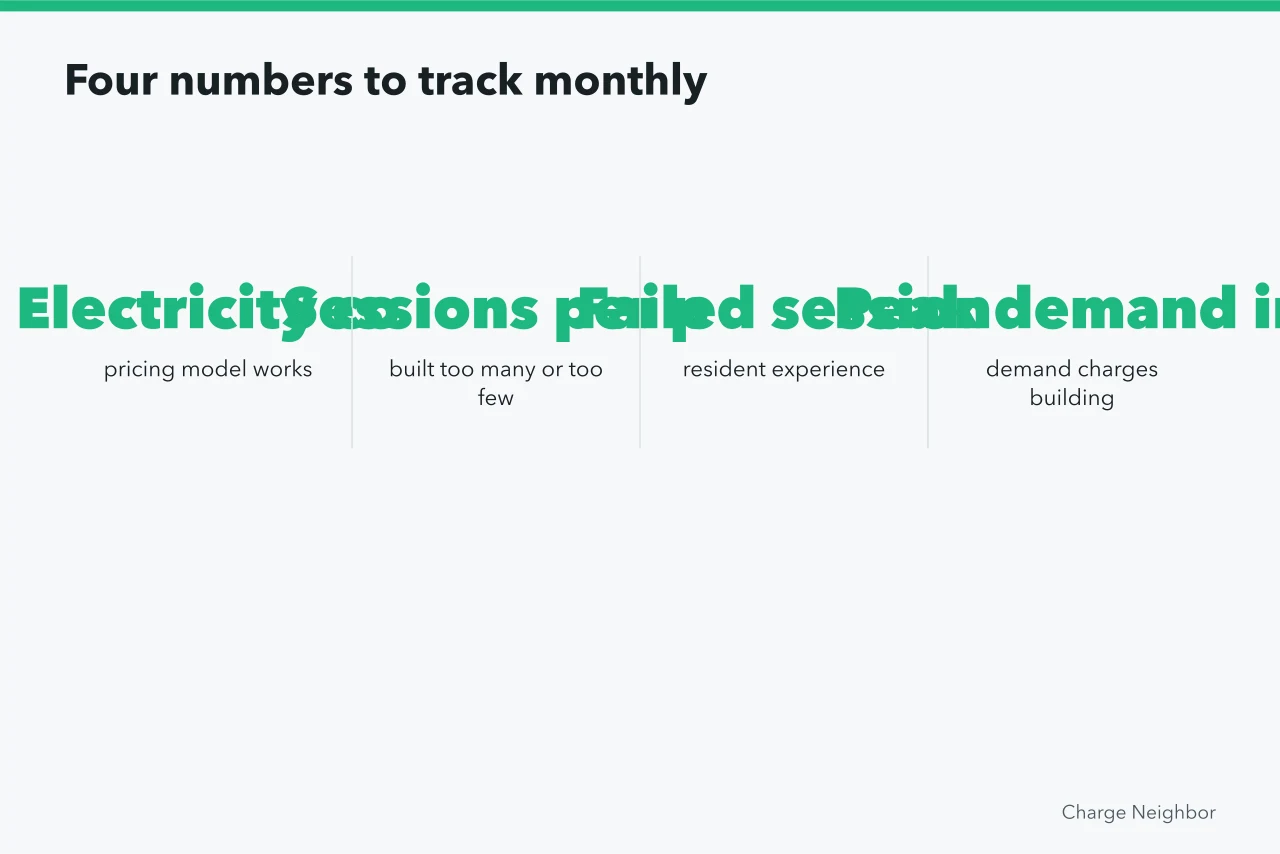
Three months of those tells you more than any projection did. If fees are under costs, you have a pricing decision. If sessions per port are very low, you overbuilt and should stop at this phase. If peak demand is climbing, managed charging has become worth the money.
Write down the trigger points now
The most useful thing a budget test produces is a set of thresholds agreed in advance.
At what utilization do you add ports. At what shortfall do you change the price. At what demand charge do you install load management. At what point does free charging stop being free.
Deciding those while nobody is affected is straightforward. Deciding them in the meeting where residents are affected is not.
The models these numbers test are compared in the budget choices, and the funding routes they depend on are set out in the cost guide.
Common questions
How long before we know if the budget was right? One quarter for the pricing question, a full year for seasonal effects and demand charges.
What if we are on a residential rather than commercial rate? Then demand charges may not apply, but adding load can change your rate class. Ask the utility before installing rather than after.
Should we price to cover costs exactly? Price slightly above, because maintenance and replacement are lumpy. Exactly covering costs means the first repair is unfunded.
Is low usage a failure? Not in year one. It is a signal to stop at this phase rather than build the next one, which is exactly what testing is for.