Reviews
Part of Apartment EV charging: cost guide for 2027
Questions to ask before buying apartment EV charging budgets
Ask what a charging proposal excludes, what utility upgrades recur for ten years, and who absorbs the shortfall before your board signs anything.
What to take away
- Ask what a proposal excludes before you ask what it includes. Exclusions are where the surprises live.
- Get every recurring fee itemized and totaled over ten years, not just the capital figure.
- A funding line needs a written eligibility answer for your address and ownership type, not a general statement that a program exists.
- Establish who absorbs a shortfall before anyone signs, because somebody will.
- Mark every unanswered question as unknown and let unknowns count against the bidder.
These are money questions, not technical ones. A proposal can be electrically sound and financially unworkable, and boards scrutinize the first far harder than the second. The technical set goes out alongside these, and a bidder should answer both.
Send them in writing. Verbal answers cannot be compared across bidders and do not survive a staff change on either side.
About what is in the number
- What does this price exclude? List it.
- Does it include trenching, core drilling, fire-stopping and pavement restoration?
- Does it include design, permit fees and plan check response?
- Does it assume any utility work, and has the utility confirmed that assumption?
- What contingency is included, and what is it for?
- What happens to the price if the panel has less spare capacity than assumed?
- Is equipment priced at today's cost, and for how long is that held?
- What are the payment milestones, and how much is retention?
Question 6 is the one that moves a budget most. Panel headroom is measured by a licensed electrician or professional engineer, and the authority having jurisdiction decides what the installation must satisfy. A bidder who guesses at capacity is guessing with your money.
About the money that never stops
- Itemize every recurring fee: subscription, per port, per user, per transaction.
- Which of those are fixed and which scale with use?
- What is the payment processing rate, and who receives the funds?
- What does support cost, and does that change outside business hours?
- What is the assumed annual maintenance cost, and what does it cover?
- Give a ten-year total for all of the above, with assumptions stated.
That last one reframes most proposals. Recurring costs across a decade regularly exceed what the hardware cost, and a proposal that only presents the capital figure has answered the smaller question. Which product decisions drive those fees is worth understanding before you shortlist.
About the funding
- Which credits and programs is this budget assuming?
- Has eligibility been confirmed for this specific address and ownership type?
- Does any program require approval before work starts?
- Does the higher federal credit rate depend on prevailing wage and apprenticeship compliance, and who collects that documentation?
Question 16 matters most. A tax-exempt association takes a different route than a taxable owner. The Internal Revenue Service sets out a separate mechanism for tax-exempt entities claiming the refueling property credit, using elective pay instead of a reduction in tax owed.
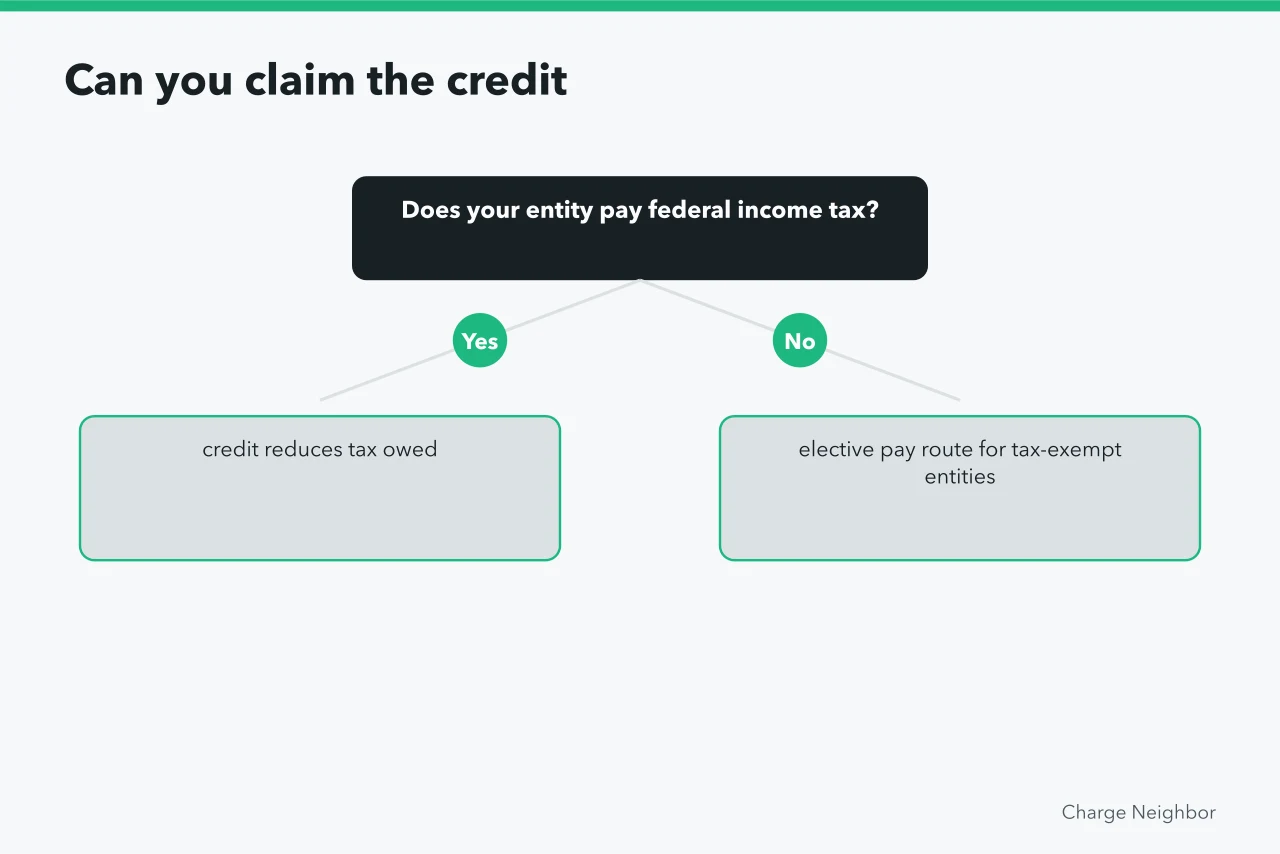
If your entity pays no federal income tax, a proposal that simply subtracts a credit from the budget may describe something you cannot claim as assumed.
The credit also depends on where the property is placed in service. The eligibility test is a census tract test, and the IRS maintains detailed guidance on eligible census tracts for the 30C credit, including which identifier applies to which placed-in-service dates.
Confirm the tract before the credit enters an approved budget, and confirm eligibility with a CPA or tax adviser.
About who carries the risk
- If collected fees do not cover electricity, fees and maintenance, who absorbs the difference?
- Who can change resident pricing, on what notice, and with whose approval?
Question 19 decides whether the association is buying a service or underwriting one. Question 20 decides whether residents see a rate the board approved or one the operator set.
Four answers that should stop the process
"The incentives will cover most of it." Eligibility is your risk. Ask for it in writing for your address.
"We'll sort the panel out during installation." Unpriced scope is scope you will pay for twice, and a quote that stops at the equipment is the most common version of it.
"That fee is standard." Standard is not an answer. Ask for the number and the term.
"Most properties don't need that." Possibly true and not about your property.
Turn it into a comparison
Bidders in columns, questions in rows, filled in from written answers rather than from your impression of the meeting. Mark anything unanswered as unknown and let unknowns count against the bidder.
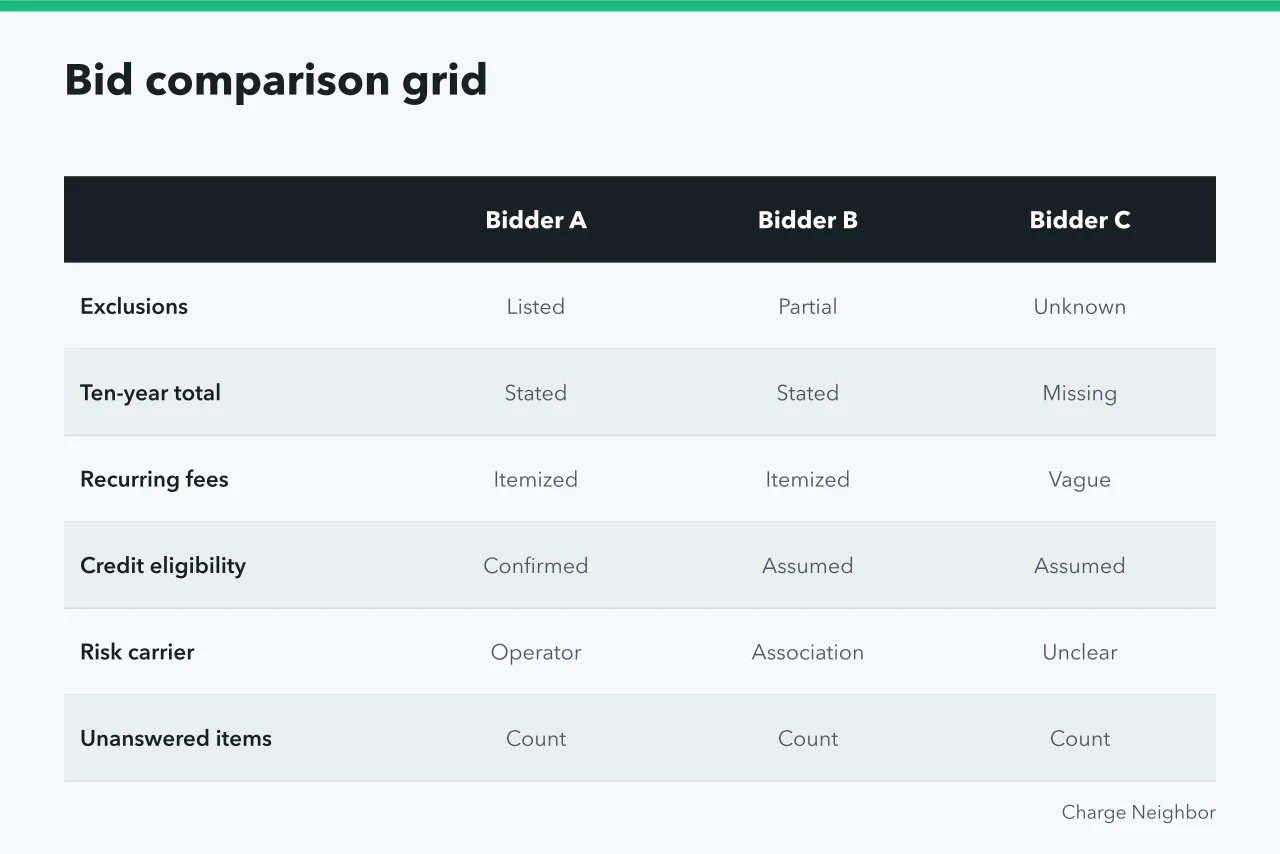
Then read it twice. Once for the ten-year total, once for who carries each risk. Those two readings often produce different winners, and the second is usually the one to follow.
The funding routes these questions probe are set out in the cost guide, and stress-testing the answers you get is what turns a proposal into a defensible decision.
Common questions
How many bidders should we invite?
Three is enough to expose the assumptions. Beyond that the comparison work outgrows the value.
Should we share our electrical assessment with bidders?
Yes. Withholding it produces cheap quotes built on optimistic guesses, which helps nobody. Have the assessment done by a licensed electrician or professional engineer and hand over the same document to every bidder.
What if a bidder will not answer the ten-year question?
Treat that as the answer. It is the question that most affects the decision and the easiest one to compute.
Do we need a tax adviser for this?
For anything relying on the federal credit, yes. Entity type and census tract both change the outcome, and neither is a vendor's judgment to make.