Reviews
Part of Apartment EV charging: cost guide for 2027
Apartment EV charging budgets: choices compared
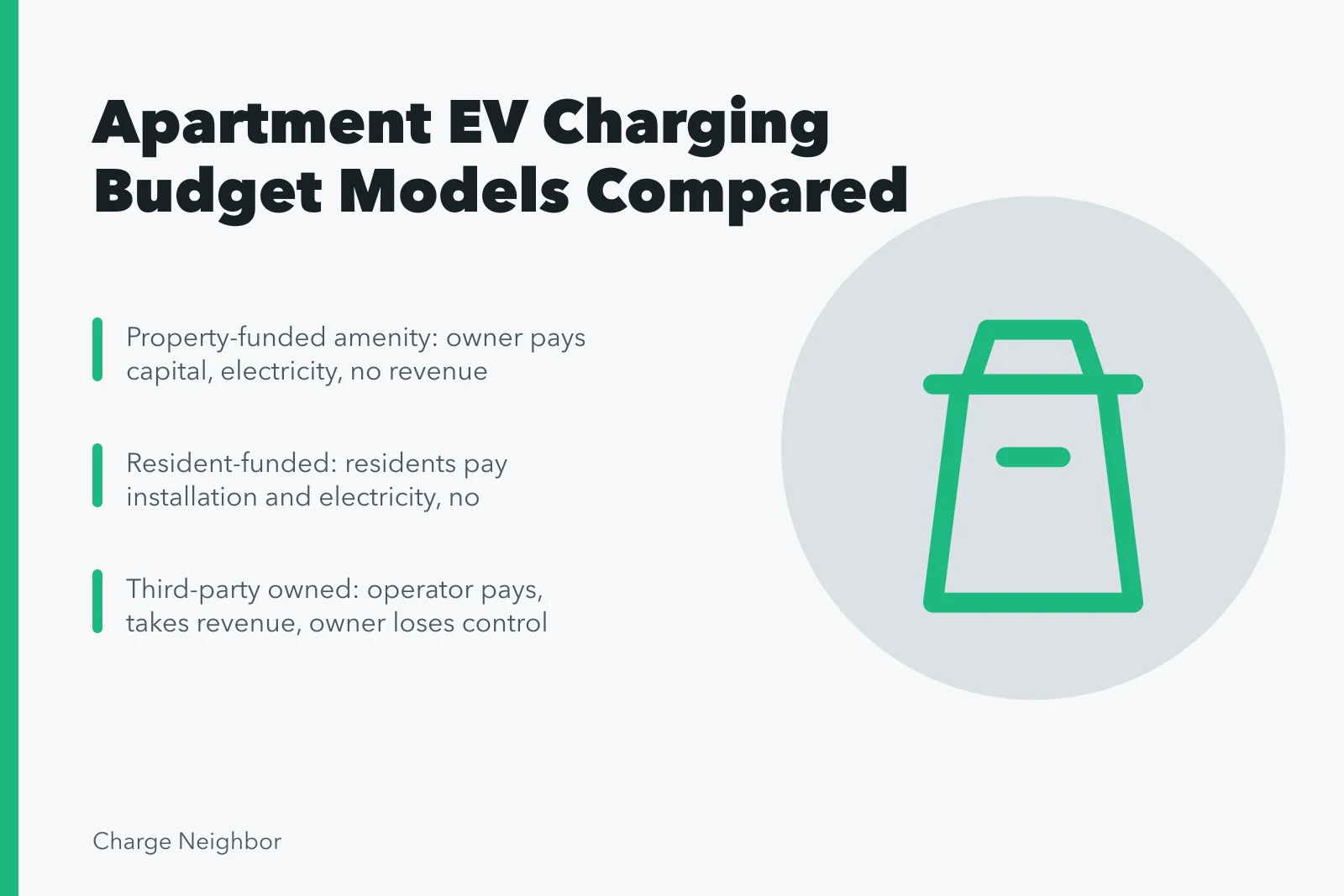
Apartment ev charging budget models: property-funded, resident-funded, third-party and phased charging budgets set against each other on who pays.
What to take away
- Four funding models, and the choice is really about who carries risk rather than who pays.
- Third-party ownership removes the capital cost and hands over control of your parking for years.
- Resident-funded works until capacity runs out, and then it produces the hardest conversation on the property.
- Managed charging is the one decision that reduces cost in every model at once.
Every apartment charging budget resolves to a question about risk. Somebody has to carry the capital cost, the utility bill, the maintenance, and the chance that adoption is slower or faster than expected. The four models below just distribute those differently.
The four models
Property-funded amenity. The owner pays, charging is free or bundled into rent, and it is marketed as a feature.
Resident-funded. Individual residents pay for installation at their own space, and pay for their own electricity.
Property-funded service. The owner pays to build, then charges residents to use it, aiming to recover costs over time.
Third-party owned. An operator installs and runs everything at their cost, taking the revenue.
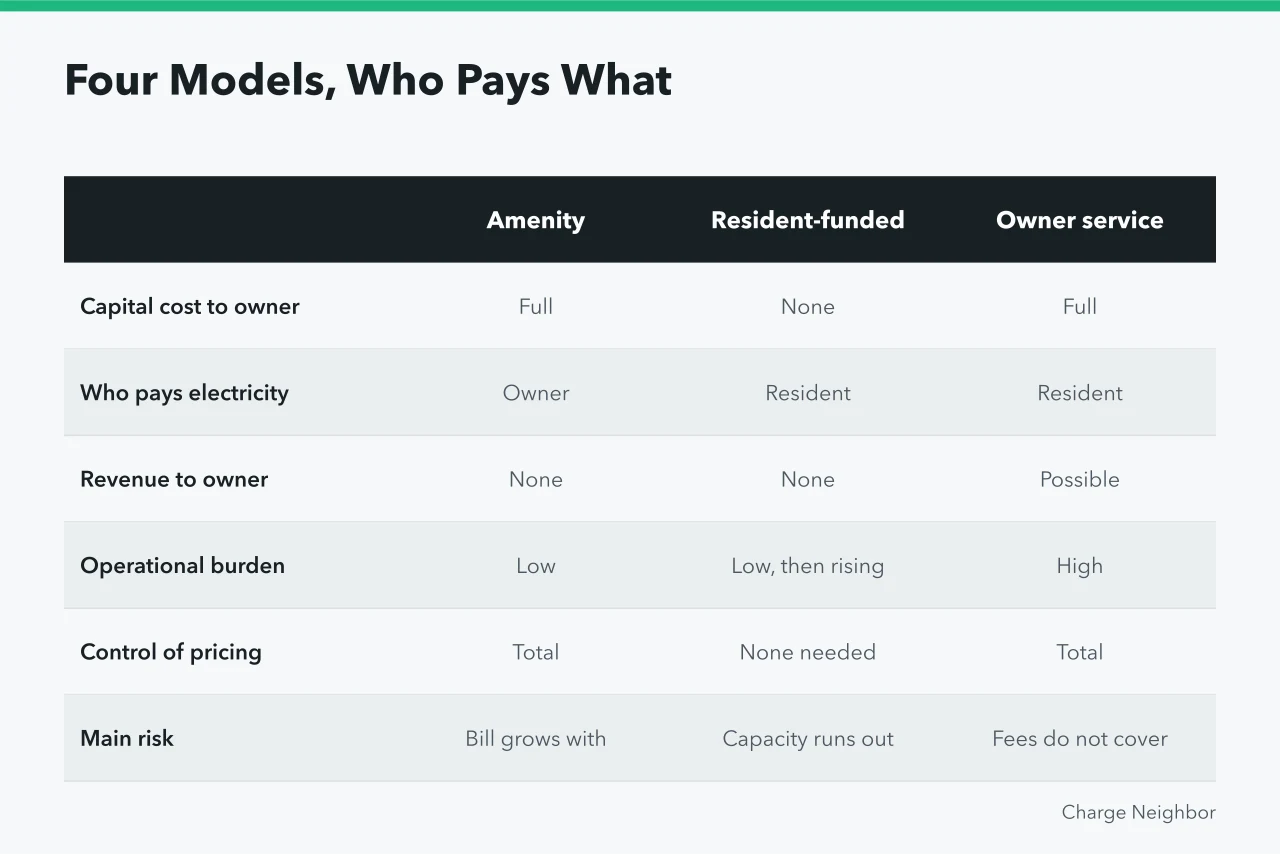
Set against each other
| Amenity | Resident-funded | Owner service | Third-party | |
|---|---|---|---|---|
| Capital cost to owner | Full | None | Full | None |
| Who pays electricity | Owner | Resident | Resident | Resident |
| Revenue to owner | None | None | Possible | Little or none |
| Operational burden | Low | Low, then rising | High | None |
| Control of pricing | Total | None needed | Total | Contractual |
| Main risk | Adoption grows, so does the bill | Capacity runs out | Fees do not cover costs | Long contract on your parking |
| Suits | Rentals competing on amenities | Low early demand | Larger properties | Owners unwilling to run a service |
| Model | What the owner puts in up front |
|---|---|
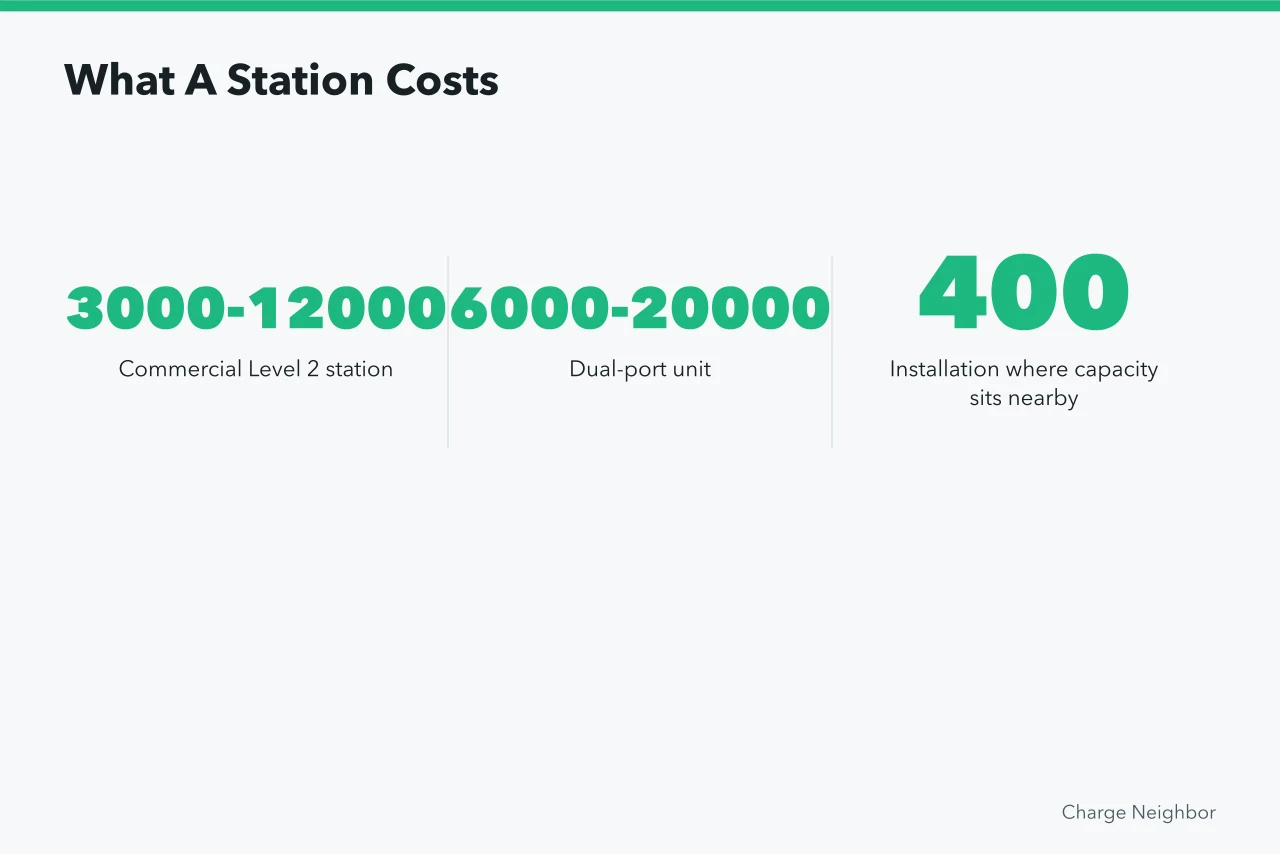
| Amenity | Full equipment and construction, so $3,000 to $20,000 a unit plus the work |
| Resident-funded | Nothing, and no say in what gets installed |
| Owner service | Everything the amenity model costs, plus metering, billing and support |
| Third-party | Nothing, against a long contract on your parking |
Two of those columns cost nothing today and something later. That is the choice being made, whether or not anyone writes it down that way.
Where each one breaks
The amenity model breaks on success. It is comfortable at low adoption and becomes a visible budget line as more residents switch. Decide in advance at what point it stops being free, and tell residents that now rather than later.
Resident-funded breaks at the panel. Everything is straightforward until the building runs out of capacity, at which point the owner has to refuse a request they granted seven times before. That is a policy problem created years earlier by not doing a whole-building assessment, and it is the costliest mistake in this whole subject precisely because each individual approval looked reasonable.
The owner service model breaks on arithmetic. If the price does not cover electricity, demand charges, network fees and maintenance, the shortfall is real and recurring. Model it before setting the price, not after the first quarter.
Third-party breaks on the contract. No capital cost is genuinely attractive. The trade is a long agreement governing spaces you own, with terms on pricing, exclusivity, termination and what happens to the equipment at the end. Read those clauses first, and put what you own afterwards in writing before signing.
The decision that helps every model
Managed charging reduces cost in all four, because it attacks the two largest lines at once: the capacity upgrade you might otherwise need, and the demand charges you will otherwise pay.
The Department of Energy's material on smart charge management and its benefits is written for federal fleets, but the mechanism is identical in an apartment garage: shifting and shaping when vehicles draw power reduces peak demand, and peak demand is what expensive infrastructure and commercial rates are both priced on.
For cars parked overnight the trade is close to invisible to residents, which is what makes it the easiest saving available.
Do the funding check before you choose
Each model interacts differently with the available funding. A third-party operator claims the credits, not you. A resident-funded installation may fall under the individual credit rather than the business one. An owner-funded project has to meet the census tract test and decide about prevailing wage.
The Alternative Fuels Data Center maintains a consolidated view of tax credits for electric vehicles and charging infrastructure, which is the quickest way to see the federal picture alongside what your state offers before you commit to a model that forfeits one of them.
How to choose in one sitting
Answer three questions honestly.
Can you fund the capital? If no, it is third-party or resident-funded.
Will anyone actually operate this? If nobody on the property has the time, it is third-party or an unnetworked amenity. The management work each access model creates never appears in a quote and always lands on somebody.
Is demand growing? If yes, resident-funded will hit the capacity wall, so plan the shared infrastructure now even if residents pay for their own ports.
The funding routes behind all of this are set out in the cost guide, and testing whether the money actually works is what tells you within a quarter whether the model you picked is holding.
Common questions
Can we change models later? Between amenity and paid service, yes, though residents accustomed to free charging will object. Out of a third-party contract, only on its terms.
Does charging residents make money? Rarely, at apartment scale. Aim to cover costs and treat retention as the return.
Who claims the tax credit under third-party ownership? Generally the party that owns the property and places it in service, which is the operator. That is part of the trade for zero capital cost.
Is a mixed model workable? Yes. Owner-funded shared ports plus resident-funded dedicated ones is common. Keep one hardware standard across both.