Reviews
Part of Shared charging station designs in 2027: 19 to consider
Shared charging station designs: options compared
Dedicated, shared, managed and phased charging layouts set against each other on access, electrical allocation and how much work each creates.
What to take away
- The real differences are access, electrical allocation and management work. Enclosures and screens are noise.
- Every option below is right somewhere. The question is which problem your building actually has.
- Management work is the cost nobody prices. Somebody administers reservations, disputes and idle cars.
- No option solves parking scarcity. If there are not enough spaces, charging design cannot fix that.
Comparisons of charging layouts usually turn into comparisons of hardware, which is the least interesting axis. Two buildings can install identical units and end up with completely different systems, because what differs is who may use them, how power is divided, and who does the work of running it.
The four that matter
Dedicated ports. One connector per owner, at their own space.
Shared first-come. A pool of ports anybody authorized may use, no booking.
Shared with reservations. The same pool, booked in advance.
Phased or EV-ready. Conduit and capacity now, units added as demand appears.
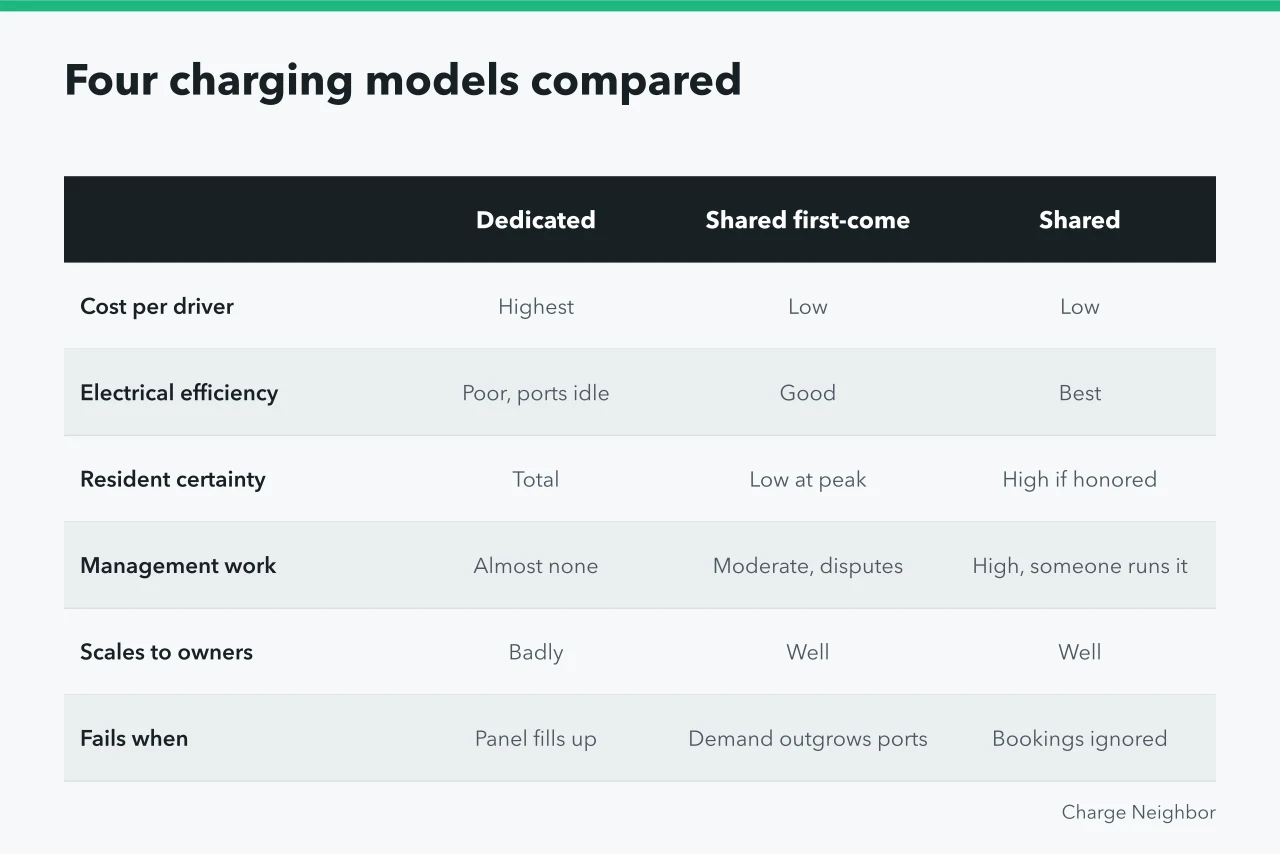
Set against each other
| Dedicated | Shared first-come | Shared with reservations | Phased | |
|---|---|---|---|---|
| Cost per served driver | Highest | Low | Low | Lowest up front |
| Electrical efficiency | Poor, most ports idle | Good | Best | Depends on final build |
| Resident certainty | Total | Low at peak | High if honored | None until built |
| Management work | Almost none | Moderate, disputes | High, someone runs it | Low, then rises |
| Scales to more owners | Badly | Well | Well | By design |
| Fails when | Panel fills up | Demand outgrows ports | People ignore bookings | Demand arrives faster than budget |
Read the bottom row twice. Every option has a failure mode, and choosing well is mostly about picking the failure you can live with.
Where each one is genuinely right
Dedicated suits buildings with deeded spaces, few EV owners, and owners willing to pay for their own installation, which makes how each space is legally held the first thing to establish. It is the least work for the board and the worst use of electrical capacity, because eight connectors sit idle so that eight people never have to think about it.
Shared first-come suits common parking and moderate demand. It is simple to explain, and it survives only as long as ports outnumber the people who want them at 7pm. Add idle fees before you need them, not after the first argument.
Shared with reservations suits high demand and constrained capacity. It genuinely serves more drivers per port than anything else. It also requires a person to administer it, and a rule for no-shows that somebody will have to enforce against a neighbor.
Phased suits nearly everyone as a hedge, and it is the option most often skipped because its benefit arrives later than its cost. Set it against the other ways of paying for the same ports before dismissing it. Conduit and panel space are cheap during construction and expensive afterward.
The comparison people skip
Management work. It never appears in a quote and it lands on a volunteer board or an already busy property manager.
Ask, for each option: who resolves a dispute about a blocked port, who chases a car left plugged in overnight, who administers accounts when a resident moves out, who answers the call at 11pm, and who reviews whether the pricing still covers the electricity. The monthly, seasonal and annual work behind those questions is real, and somebody is doing it.
If the honest answer to most of those is "nobody yet," pick the option that generates the fewest of those situations rather than the one that looks most capable.
The Joint Office's session on the state of practice in charging station site design is a useful counterweight to vendor material here, because it deals with layout and operations together rather than treating the hardware as the project.
Two constraints that override the comparison
Accessibility is not one option among several. Whichever model you choose, accessible charging requirements apply, and they shape the layout rather than fitting into it. The Access Board's material on electric vehicle charging stations sets out what has to be true regardless of your access model.
Parking scarcity is not a charging problem. If your building has fewer spaces than cars, no layout on this page fixes it. Charging design decides who charges, not who parks, and conflating the two is how a technical decision turns into a political one.
Once you have chosen a model, the planning steps that turn it into a permitted job come next, and the nineteen layout patterns show the physical forms each model can take.
Common questions
Can we start dedicated and move to shared later? Rarely without rework, because dedicated layouts run circuits to scattered spaces. Going the other way is easier.
Which option do most buildings end up with? A mix, usually: a few dedicated ports for owners who paid, plus a small shared pool. Just keep one hardware standard across both.
Do reservations actually work? When somebody administers them and no-shows have a consequence. Without both, they degrade into first-come with extra steps.
How many shared ports per EV? There is no general ratio worth quoting. It depends on dwell time and how much of the night each car needs, which your own session data will tell you within a month of opening.