
Costs
Part of Apartment EV charging: cost guide for 2027
Apartment EV charging costs for homes and shared buildings
A home charger and an apartment port use the same hardware and cost very different amounts. The six reasons, and which ones you can influence.
What to take away
- The same charger costs far more per port in a shared building, and the hardware is not why.
- Six things drive the gap. Four are fixed by your building; two you can actually influence.
- Comparing a home quote to an apartment quote is comparing different scopes, not different prices.
- Shared installations get cheaper per port as you add ports. Home installations do not.
Somebody on the board finds a charger online for a few hundred dollars, sees a quote for a six-port apartment installation, and asks a reasonable question: why is this so much more per space?
The honest answer is that you are not buying the same thing. A home installation is a short circuit from an existing panel to a wall ten feet away, in a building with one owner and no shared parking. Almost none of that is true in an apartment.
Where the money actually goes differently
Distance. A house panel is usually near the garage. In an apartment building the electrical room and the parking spaces are frequently at opposite ends of the structure, and every additional foot is conduit, conductor and labor.
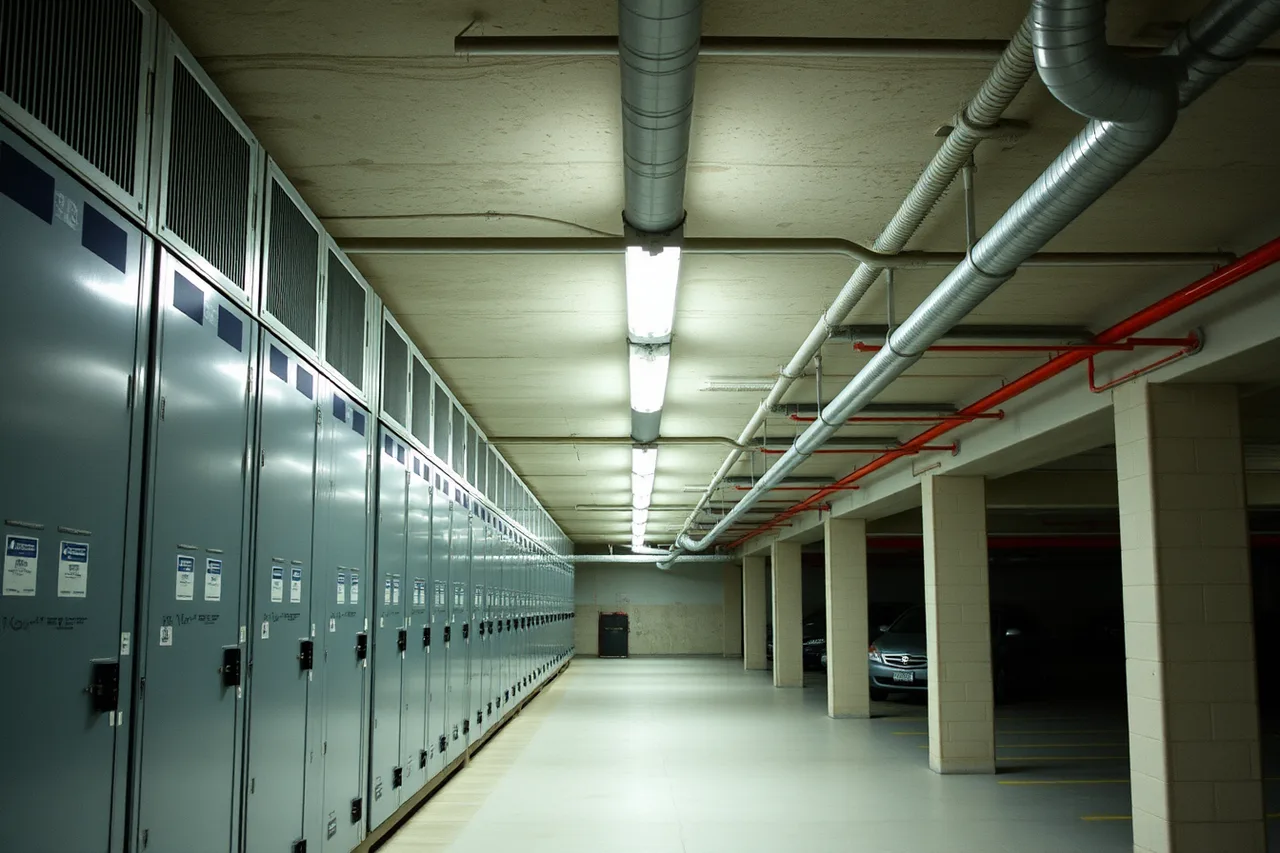
What the route passes through. A home run goes through a stud wall. An apartment run goes through fire-rated assemblies, finished ceilings, structural slabs or, outdoors, under paving. Fire-stopping, core drilling and pavement restoration are real line items that simply do not exist at a house.
Capacity. A house needing more power upgrades one service. A shared building sizing for six or twelve ports at once may need new switchgear or a utility transformer, which is a different order of expense.
Design and permitting. A single home charger is often a simple permit. A multi-port shared installation may need drawings, load calculations, an accessibility review and a plan check, all of which are professional time.
Accessibility. A shared parking facility has accessible space requirements a private garage does not. That constrains layout, sometimes adds signage and pavement work, and cannot be value-engineered away. It is also only one of several authorities with a say in the same installation.
Shared use. Home charging serves one car and needs no access control, no billing, no signage and no rules. Every one of those adds cost in a shared building, whether as hardware, software or somebody's time.
Four are fixed, two are yours
You cannot change where your electrical room is, what the route passes through, what accessibility requires, or that the parking is shared.
You can change two things, and they are the ones worth spending attention on.
Whether you dig once or twice. Trenching and repaving are a large fixed cost. Doing it once, with conduit for more ports than you populate, is the single most effective decision available, and several layouts are built specifically around it. Doing it twice is the most expensive avoidable mistake in this subject.
Whether you need new capacity at all. Load management often serves the same number of cars without a service upgrade. It trades a lower guaranteed power per vehicle for a much lower capital cost, and for cars parked overnight that trade is usually easy. Ask for the guaranteed minimum per car when every port is busy, because that is the number residents actually feel.
Why per-port cost falls as ports rise
This is the part that reframes the whole comparison.
At a house, adding a second charger roughly doubles the work. In a shared building it does not, because the expensive parts are shared: the trench, the conduit run, the design, the permit, the mobilization. Adding a port to an existing run costs a fraction of the first one.
So the useful question is not "what does a port cost." It is "what does the first port cost, and what does each one after that cost." A quote that gives you only a per-port average hides the answer, and the answer is what tells you how many to build now.
The federal credit reinforces this, because it is capped per item of property rather than per project. Individuals installing at a principal residence claim under the refueling property credit for individuals, on different terms from the business route a property owner uses, which is another reason a home number and an apartment number are not comparable.
What those lines cost in practice
Figures move with the building, but a quote well outside these bands deserves a second question. These were the going rates in September 2026.
| Item | Typical range |
|---|---|
| Hard-wired Level 2 unit, residential | $400 to $700 |
| Licensed electrician | $80 to $150 an hour |
| Simple run, panel to wall, two to four hours | $160 to $600 of labor |
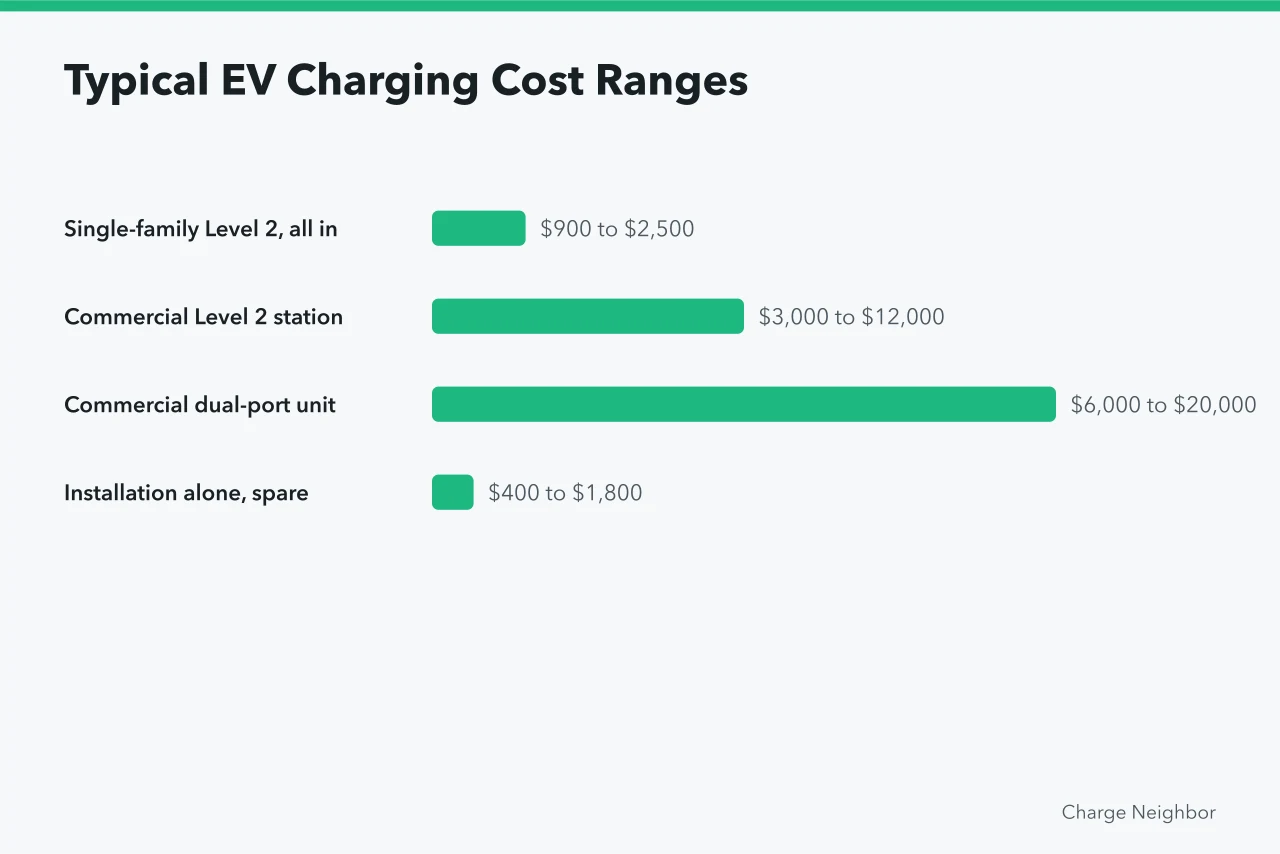
The distance between the fourth row and the fifth is what this article is about. The same nameplate charger costs several times more once it hangs in a shared garage, and almost none of that difference is hardware. It is conduit, permits, the accessible route, and the fact that the panel is rarely anywhere near the cars.
Comparing quotes fairly
If you want to compare a home figure to an apartment figure, normalize the scope first:
- Strip out trenching and pavement work, or add an equivalent to the home number
- Strip out design, permit and accessibility work
- Strip out access control, billing and signage
- Compare the first port separately from subsequent ports
- Check whether either figure includes a capacity upgrade
What is usually left is the equipment cost, which is roughly comparable, and which is the smallest part of the apartment number.
The federal infrastructure credit is tracked alongside other programs in the Alternative Fuels Data Center's record of the alternative fuel infrastructure tax credit, which is worth reading in parallel with the IRS pages because it shows how the federal credit sits next to state and utility programs.
For where the funding comes from in the first place, the cost guide covers the four sources, and how each design decision moves the number is where a budget actually gets shaped.
Common questions
Can we just let owners install their own and avoid all this? Sometimes, and it moves the cost rather than removing it. You still need a policy, an electrical assessment and a rule for when capacity runs out.
Is a per-port average ever useful? Only for comparing two proposals for the same building. Across buildings it means very little.
Why did our neighbor's building pay half what we were quoted? Almost always distance, route or capacity. Ask your contractor which of the six drivers applies to you and by how much.
Does going bigger always lower the per-port cost? Up to the point where you need new capacity. Crossing that threshold adds a large step, so the cheapest sizing is often just below it.