Maintenance
Part of How to plan condo EV charging from start to finish
Condo EV charging mistakes that lead to extra costs
The condo charging mistakes that cost real money: approving one at a time, ignoring capacity, and the errors that stay invisible for a year.
What to take away
- The expensive mistakes happen before anything is installed, in board meetings rather than parking garages.
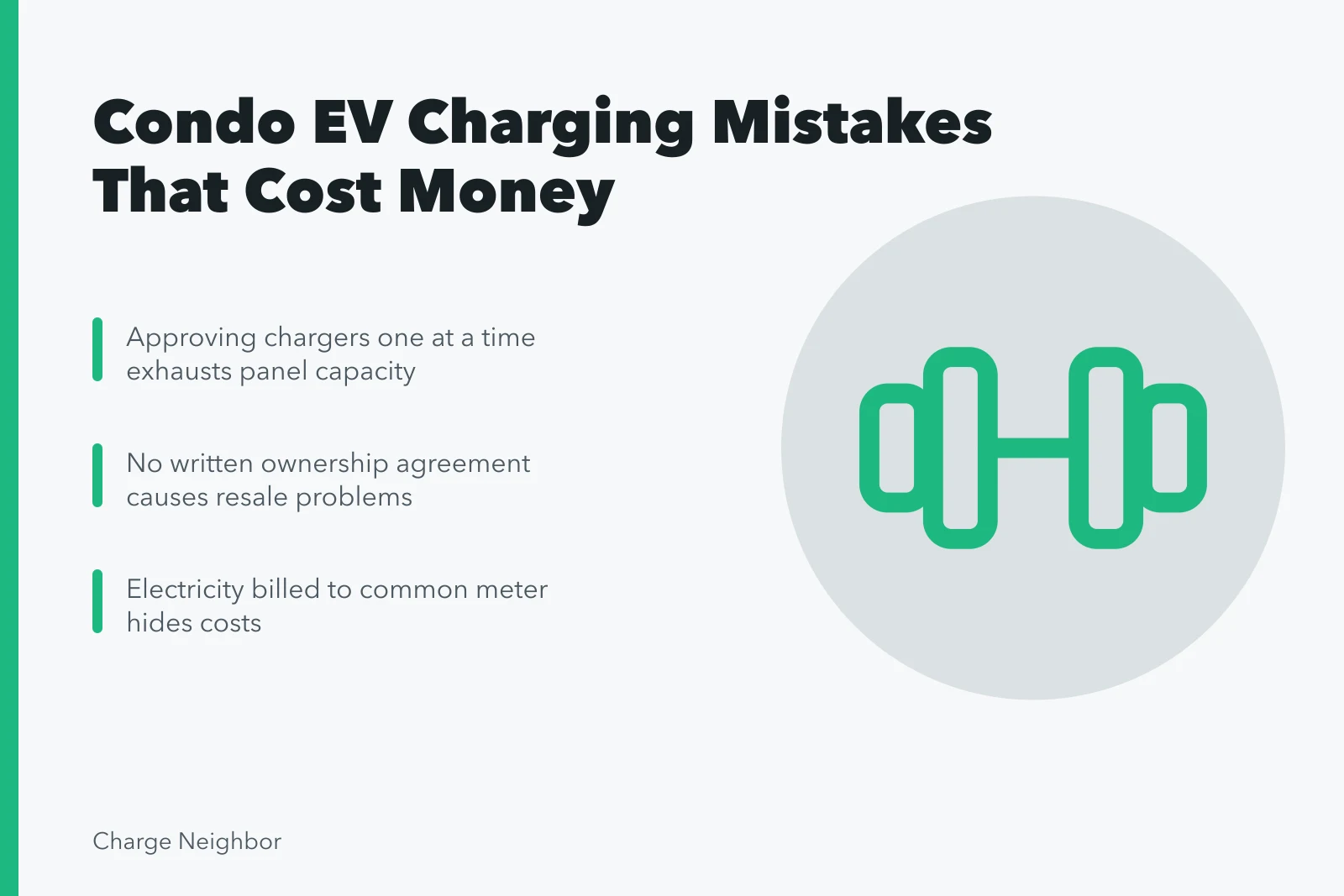
- Approving requests one at a time without a capacity plan is the single costliest error, and it looks reasonable at the time.
- Some mistakes stay invisible for a year, then arrive as a failed inspection or a resale problem.
- Almost all of them come from the same root: treating charging as a purchase instead of shared infrastructure.
The one that costs the most
A board approves the first owner's charger. It is a small request, the owner is paying, and refusing seems unreasonable. So the board approves it, and then the second, and the fourth.
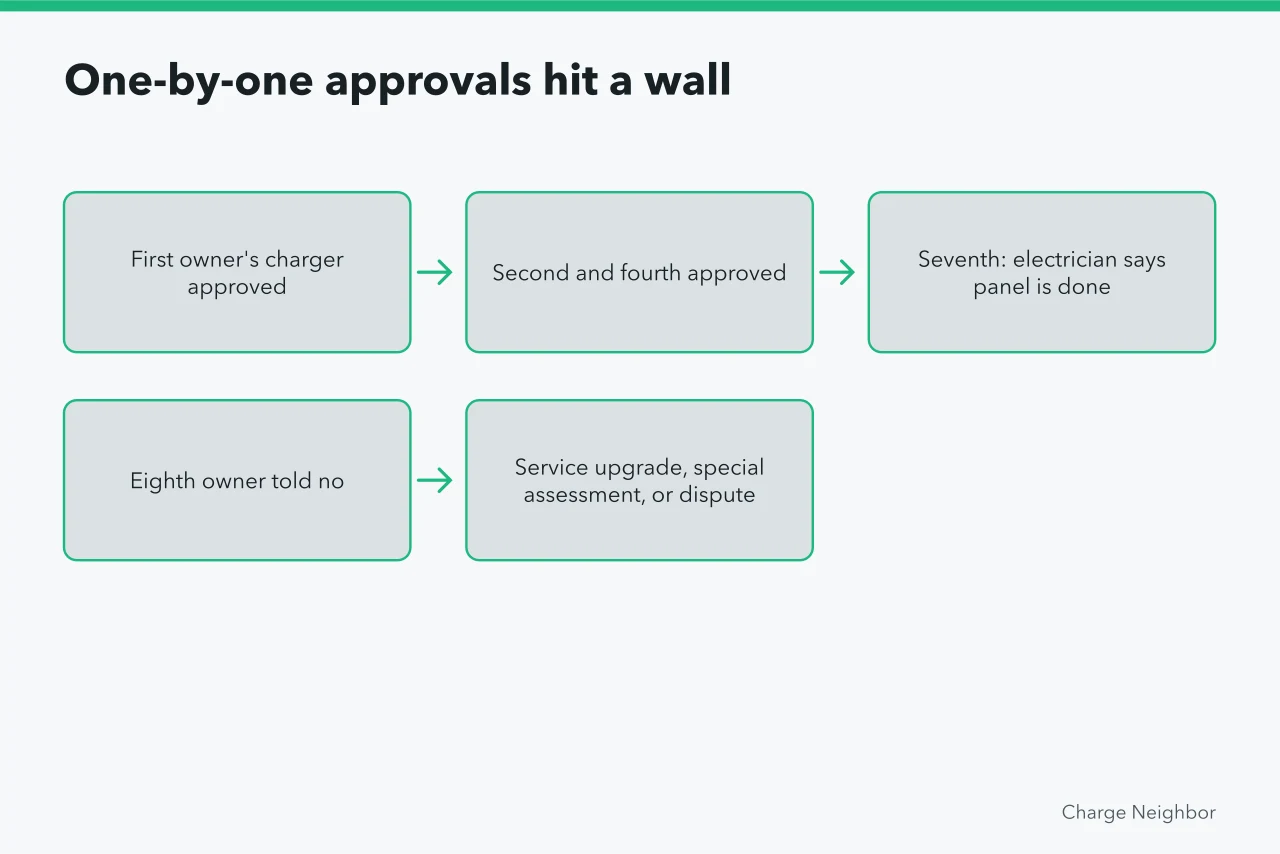
Somewhere around the seventh, an electrician says the panel is done. Now the board has to tell owner eight that the answer is no, having said yes seven times on identical facts. The options at that point are a service upgrade nobody budgeted, a special assessment, or a dispute.
Nothing about any individual approval was wrong. The mistake was approving anything before knowing how many the building could support in total, and that question costs a few hundred dollars to answer at the start.
The fix is unexciting. Get one whole-building electrical assessment, decide the total capacity, then set the rule for what happens when it runs out, before you approve anyone.
The ones that look fine at first
Assuming Level 2 is always the right answer. A condo car sits for eleven hours. In many buildings, a lower-powered circuit serves the same driver equally well and takes a fraction of the capacity, which means more owners can be served from the same panel. The federal guidance on charging an electric vehicle at home is clear that the useful comparison is what a car needs overnight, not what the equipment can deliver at peak. Reading a spec sheet that way is a different exercise from reading it for the biggest number.
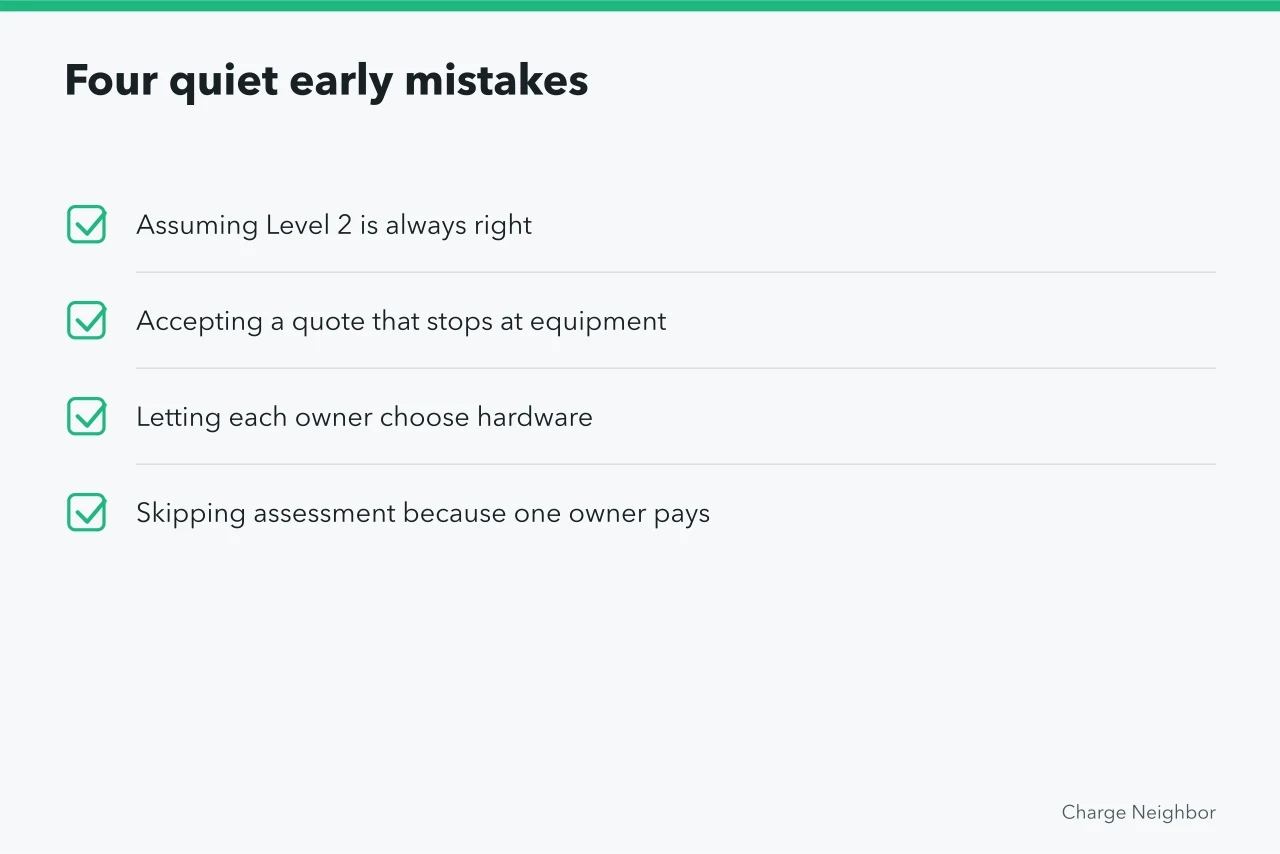
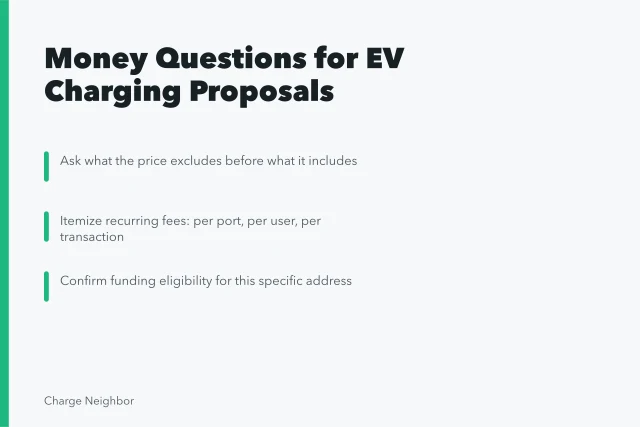
Accepting a quote that stops at the equipment. Trenching, core drilling, fire-stopping, pavement repair and the electrician's return visit are often excluded and rarely highlighted. Ask what is not in the number.
Letting each owner choose their own hardware. Five brands means five apps, five support numbers and five sets of spare parts. It costs nothing to standardize at the start and a great deal to standardize later.
Skipping the assessment because one owner offered to pay. The owner is paying for their installation. The board is accepting a permanent change to shared electrical infrastructure. Those are not the same transaction, and public programs increasingly require a proper multifamily charger deployment assessment before funding work, for exactly this reason.
The ones that surface a year later
No written ownership agreement. The unit sells, and nobody can say whether the charger conveys, who maintains it, or what happens if the buyer does not own an EV. This is cheap to prevent and genuinely difficult to fix afterward.
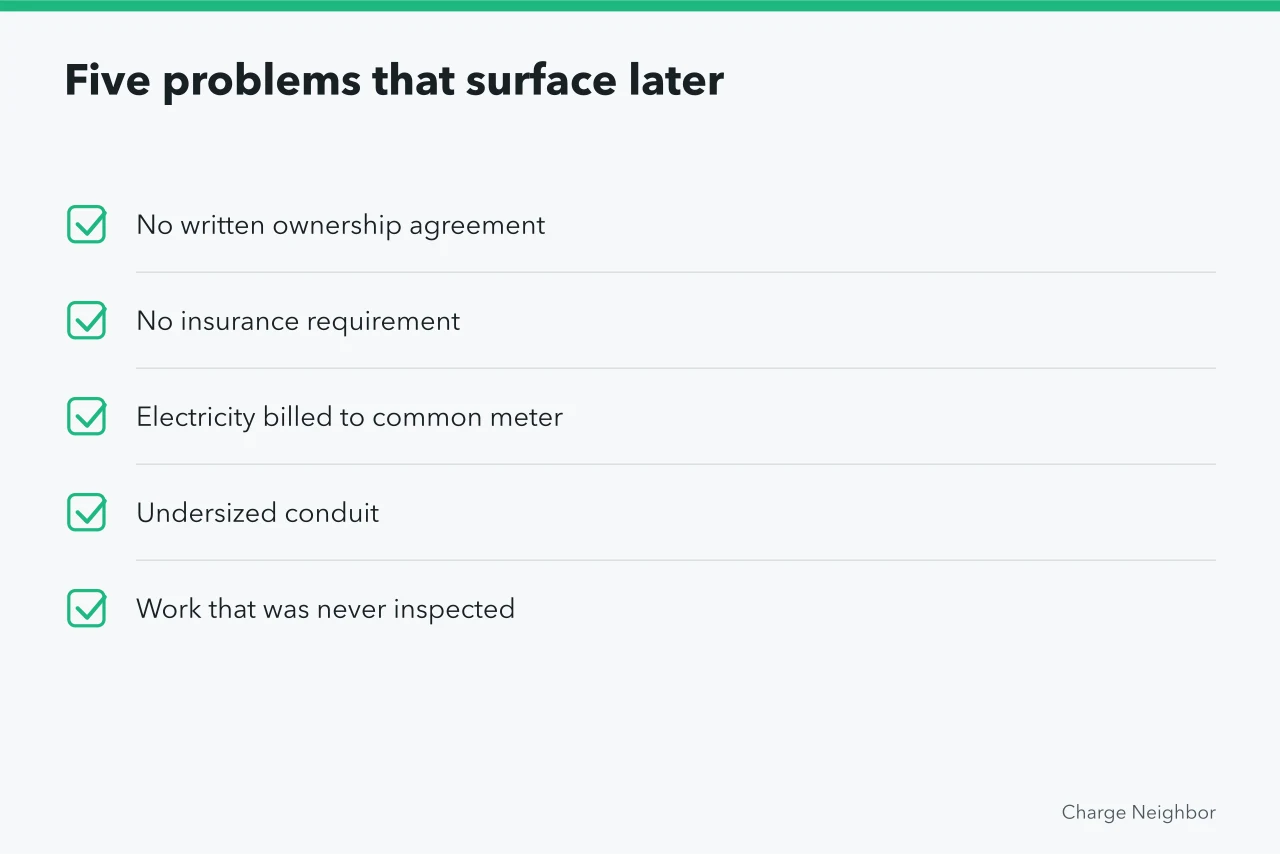
No insurance requirement. Equipment attached to common property, installed by a contractor the association never vetted, with no certificate on file. The first claim finds this out.
Electricity billed to the common meter. It seems minor when one owner charges. At six owners it is a visible line in the budget, and reallocating it means telling people who have been charging free that they now pay. Who absorbs that gap is one of the money questions to settle at purchase, not at the sixth application.
Undersized conduit. A pull that fits today's single circuit and nothing else. Adding capacity later means opening the same trench twice, which is the most avoidable expense on this list and the budget line that most often outgrows the hardware.
Work that was never inspected. Some installations get done quickly and quietly by an owner's own contractor. It surfaces at a subsequent permit, an insurance inspection or a sale. Unverified electrical work in a shared building is a risk to everyone in it, not only to the person who paid for it, and an association that never asked for the inspection certificate has no way to show otherwise.
What they have in common
Every mistake on this page comes from treating a charger as a product somebody buys rather than infrastructure the building acquires.
A product decision can be made once, by one person, for one space. Infrastructure decisions bind future boards, future owners and the electrical capacity of a building that will still be standing in forty years. The costs land on people who were not in the room.
That is why the boring steps pay. One assessment, one policy, one standard, one file. None of it is difficult. It is just easy to skip when the first request looks small.
Before approving anything, the full planning sequence sets out the order these decisions should be made in. And once equipment is in the ground, the maintenance obligations that come with it are a cost most boards have not budgeted.
Common questions
Is it really cheaper to plan for more ports than we need? For anything involving digging or core drilling, yes, substantially. Conduit is cheap. Opening the same trench twice is not.
An owner wants to use their own electrician. Is that a problem? Only if you have no standards. Require licensing, permits, inspection and insurance, and it is fine. Accept it without those and you have adopted their risk.
We already approved four chargers with no policy. What now? Get the assessment, adopt the policy for future requests, and document the four you have. You cannot easily apply new rules backward, but you can stop the pattern.
Who pays when the capacity runs out? Whoever your policy says, decided in advance. Deciding it at the moment it happens guarantees the conversation goes badly.