Reviews
Part of How to plan condo EV charging from start to finish
Condo EV charging products worth comparing in 2027
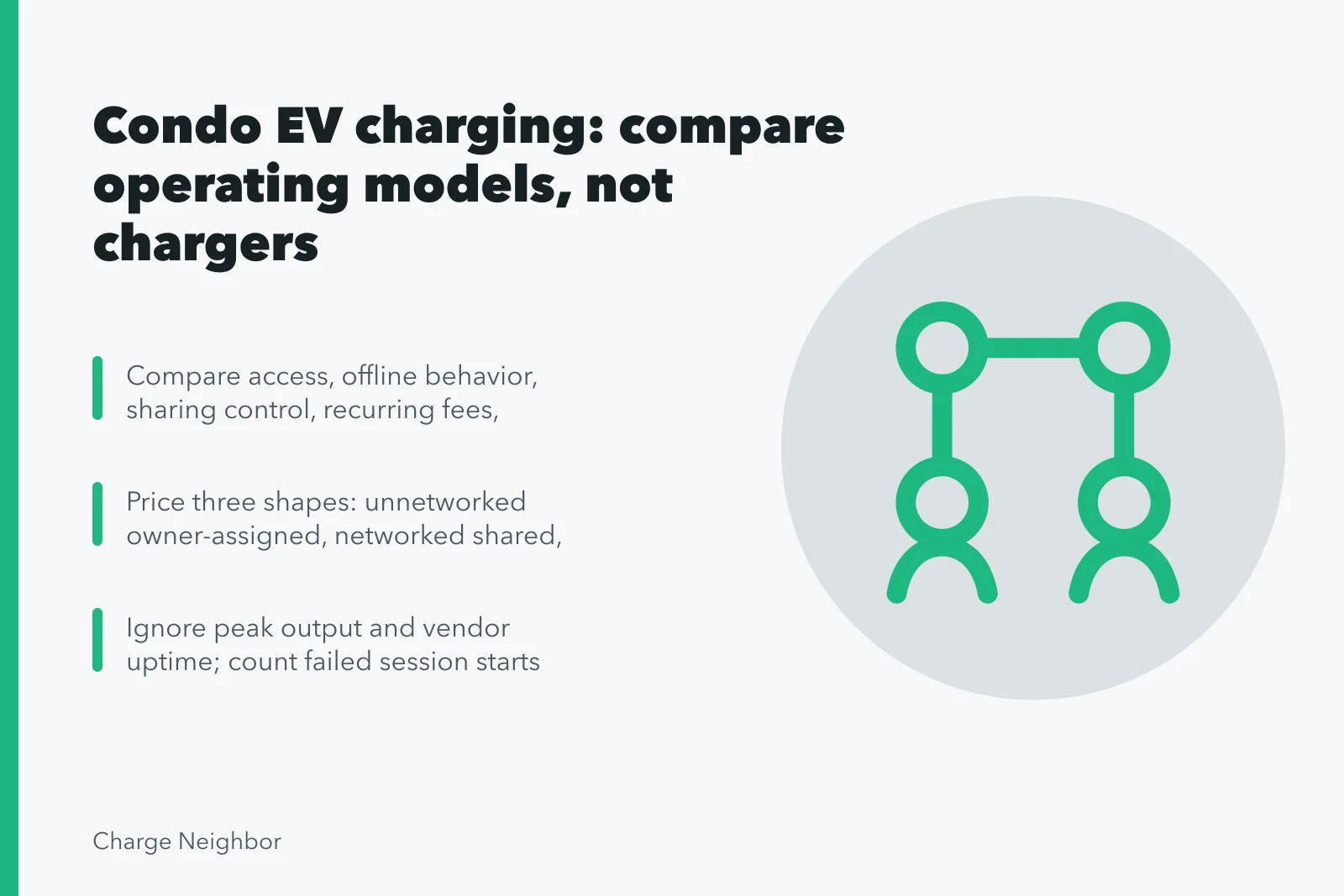
Compare condo EV charging products on access, power sharing, recurring fees and whether another operator could run them later, rather than on peak output.
What to take away
- ChargePoint, Enel X Way, Blink, Wallbox and Driivz all sell condo charging systems, but they differ most in who operates the network after installation.
- The clause that decides your next decade is whether another operator can take over the hardware if you leave the vendor.
- Per-port subscriptions and transaction fees, not the charger price, set the ten-year cost in a condominium.
- Ask which standard a specific model is listed to, and by which laboratory, before you compare anything else.
A condo board is not buying a charger. It is buying an access system, a billing arrangement, a support contract and a dependency, with a box on the wall attached.
That is why output is a poor axis to compare on. It is the number every vendor volunteers and close to the least useful for choosing between them.
The products worth pricing
ChargePoint runs the largest shared-port network in North America and sells both the hardware and the subscription that runs it. Its CP6000 and CP4000 are commercial Level 2 units common in multifamily garages.
Public list prices for comparable networked units typically run $3,000 to $7,000 per port as of 2026, with per-port network fees often $15 to $40 a month. Suits boards that want one vendor for hardware, billing and support.
Enel X Way (formerly eMotorWerks) sells the JuiceBox line and a commercial management platform. The JuiceBox Pro 40 is a 40-amp Level 2 unit. Enel X Way announced in 2024 it was winding down its North American charging business, so ask for warranty, network and data-transfer terms in writing.
It is strongest where a utility demand-response program pays for enrolled capacity. Suits buildings in states with active managed-charging incentives.
Blink sells networked Level 2 units and its own billing network, with a mix of equipment sale and revenue-share contracts. The Blink IQ 200 is an 80-amp Level 2 commercial charger.
Host-owned, hybrid and Blink-owned contracts are the three common shapes. Revenue-share terms typically run five to ten years and split gross session revenue with the host. Suits boards that want the operator to carry the capital cost.
Wallbox makes the Pulsar Plus and Commander 2, with local load management through its Power Boost and Power Sharing features. Pulsar Plus is a 48-amp Level 2 unit; US list prices typically run $649 to $799 as of 2026.
Commander 2 is a commercial unit with RFID and dynamic load management, typically $1,300 to $1,800. Power Boost uses a current transformer at the service panel to cap total draw. Suits smaller buildings where panel capacity, not network features, is the binding constraint.
Driivz is software, not hardware. It manages chargers from multiple manufacturers under one OCPP-compliant platform, with support for OCPP 1.6 and 2.0.1. It typically licenses per port per month or under an annual contract. Suits associations that already own hardware and want to change operators without replacing it.
The table below compares the named products on access, power sharing, recurring fees and portability. Terms vary by contract, so confirm each cell in writing.
| Product | Access methods | Power sharing | Recurring fees | Portability to another operator |
|---|---|---|---|---|
| ChargePoint | ChargePoint app, RFID card, or both; some public ports open | Cloud-based load management across ports | Per-port monthly network fee, typically $15 to $40 | Depends on contract; some models support OCPP, and exit terms govern |
| Enel X Way | JuiceBox app and RFID on commercial units | Enel X platform controls sharing | Per-port subscription and transaction fees | Uncertain after 2024 North American wind-down; confirm OCPP and data export |
| Blink | Blink app and RFID | Blink Network manages sharing | Host-owned, hybrid or revenue-share; revenue-share often five to ten years | Depends on exit terms and OCPP profile |
| Wallbox | myWallbox app and RFID on Commander 2 | Local Power Boost and Power Sharing at the panel | Per-port subscription for commercial features | OCPP 1.6J on Commander 2 supports switching with operator cooperation |
| Driivz | No hardware; access depends on the charger | Software controls power across mixed brands | Per-port license, monthly or annual | Built for operator switching without replacing hardware |
Open standards matter here. The federal summary of charger open access requirements shows where the rules are heading, and it is a fair standard to hold a vendor to whether or not you take public money.
What actually differs between them
How residents get access. App only, RFID card, both, or an open port with no authentication. App-only sounds modern until you meet a resident without a smartphone, or a garage with no signal. Ask what the fallback is, and ask what the app collects while it sits on a resident phone.
Where power sharing lives. In the unit, in a local controller, or in the cloud. A system that stops charging when the internet drops is a different product from one that falls back to a fixed allocation. Pulling the network cable on purpose at commissioning is the only way to learn which one you bought.
What keeps costing money. Per-port subscriptions, per-user fees, transaction percentages, support tiers and firmware maintenance. These compound quietly across a decade.
Whether anyone else can operate it. If your relationship with the vendor ends, can another operator take over the hardware, or does it become a paperweight? This is the single question that separates the products above.
What it is certified to. Shared-building charging equipment is subject to building standards and product listings. The summary of charger building standards is a starting point for the question to put to your inspector and your vendor: which standard, which model, listed by which laboratory.
The comparison table to fill in yourself
Do not accept a vendor's own chart. Build one and complete it from written answers.
| Criterion | Why it decides things |
|---|---|
| Access methods offered | Whether every resident can actually use it |
| Offline behavior | What happens on the night the link drops |
| Sharing control location | Cloud dependency versus local resilience |
| Guaranteed minimum per car at full occupancy | The number residents will feel |
| Recurring fees, itemized | The real ten-year cost |
| Portability to another operator | Whether you are locked in |
| Cable replaceable on site | Your most common failure, and its downtime |
| Parts availability after discontinuation | Whether year eight is a repair or a replacement |
| Data export format and cost | Whether your history is yours |
| Support hours and response commitment | What a resident gets at 11pm |
Anything a vendor leaves blank counts as a no.
Three configurations worth pricing
Unnetworked units at owner-assigned spaces. Cheapest to buy and run, no subscription, no data. Typical installed cost runs $1,500 to $3,000 per port. Works when owners pay their own electricity through a submeter or an agreed flat rate. Fails the moment you need shared access or per-resident billing.
Networked shared ports owned by the association. Full control of standards and pricing, real capacity management, and the board becomes an operator with residents as customers. Typical installed cost runs $3,000 to $8,000 per port, plus $15 to $40 per port each month. Budget for the subscription and somebody's time.
Third-party owned and operated. No capital cost, no operational burden, and a long contract that governs your parking for years. Typical host revenue share runs 10% to 30% of gross session revenue under a five to ten year contract. Read the termination terms first, not last, and set the whole shape against the other ways of funding the same ports.
Two things not to compare on
Peak output. Cars sit overnight. Paying for output nobody is awake to use means paying for electrical capacity you did not need, which is the most expensive line in the project.
The vendor's uptime figure. Uptime definitions vary and often exclude network faults or maintenance windows. Your own count of failed session starts is the number residents experience.
Once the shortlist is real, the mistakes that make these projects expensive are worth reading before signing, and the planning order explains why the access model should be settled before any of this.
Common questions
Should every owner use the same product?
In a shared building, yes. Five brands means five apps, five support paths and five spare-part inventories, at no benefit to anyone. Pick one operator and one standard.
Is an unnetworked charger ever the right answer?
Often, in small buildings where owners pay their own electricity and access is not shared. It removes a subscription and a data problem at once. It stops working the day the board wants per-session billing.
How long should we expect the hardware to last?
Ask the vendor for the expected service life and the parts-availability commitment, in writing. Treat cables and readers as consumables regardless of the answer. Your maintenance log, not the datasheet, tells you when to replace.
What if the vendor is acquired?
Your contract governs. Check what happens to pricing, support and your data on a change of control before you sign. Driivz-style OCPP platforms exist precisely so a change of owner does not strand the hardware.