Guides
How to plan condo EV charging from start to finish
Condo EV charging is a parking rights problem before it is an electrical one. A board process covering ownership, policy, cost allocation and approvals.
What to take away
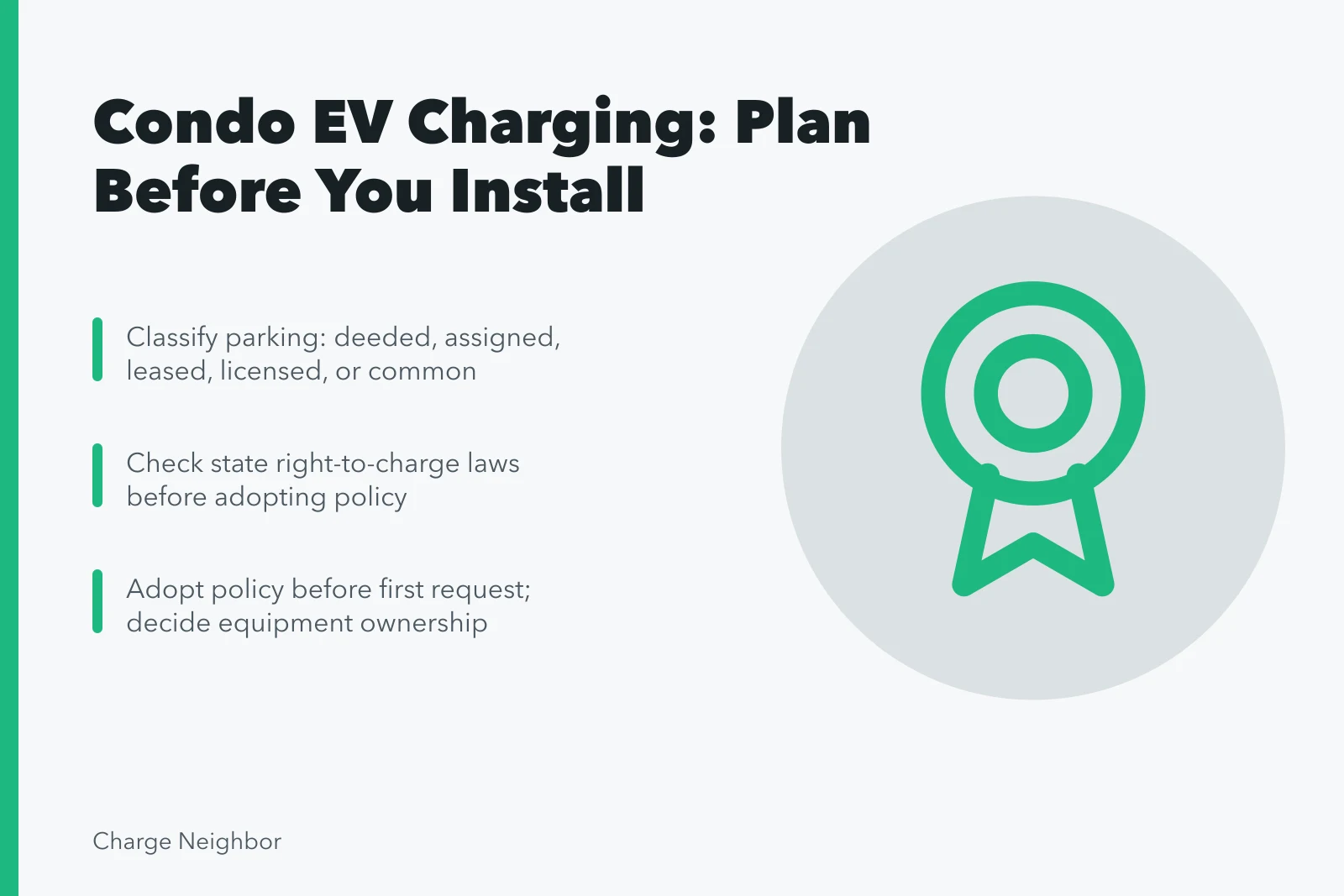
- Classify every parking space before anything else. Who may approve work depends entirely on how the space is held.
- Several states limit what a board may refuse at an owner's assigned space. Find out where yours stands before you write a policy.
- Adopt the policy before the first request arrives. Writing rules for a specific owner is how boards end up in disputes.
- Decide who owns the equipment. That single answer determines maintenance, insurance and what happens when a unit sells.
A condo charging project is not really an electrical project. It becomes one eventually, but it starts as a property rights question, and boards that skip that part end up rewriting their decision twice.
In a house, the person who wants the charger owns the parking, the panel and the wall. In a condominium those three things can belong to three different parties, and the board sits in the middle of all of them.
Classify the parking first
Every space involved needs a label, because the label decides who approves the work.
A space might be part of a unit, assigned for exclusive use, leased, licensed, or plain common property. An owner with a deeded space has different standing from one with a revocable license, and the association's control over each differs accordingly.
Draw a parking plan showing space numbers, walls, columns, accessible spaces, electrical rooms, meters, fire lanes and plausible conduit routes. Alongside it, collect who charges today, which spaces are workable and what power sits near them.
Then resist the obvious assumption: that an owner may run a circuit from the nearest panel to their own space. Almost every part of that route is common property, and using it is a decision the board has to make deliberately rather than by default.
Find out what your state actually says
This is the step boards most often skip, and it is the one that can invalidate a policy after it is adopted.
Several states have passed "right to charge" provisions. Typically, an association cannot flatly ban an owner from installing a charger in their own assigned space.
It may set reasonable conditions: a licensed contractor, architectural standards, insurance, paying for electricity, and responsibility for maintenance and removal. The federal summary of charger policies for condominiums is a reasonable place to see the pattern and find whether your state is listed.
It is a starting point, not legal advice. Your association's attorney reads the current statute against your actual governing documents, because the two can conflict and the resolution is not always obvious.
Write the policy before the first request
A board that writes rules in response to one owner's application will be accused of writing rules about that owner. Adopt the policy while nothing is pending.
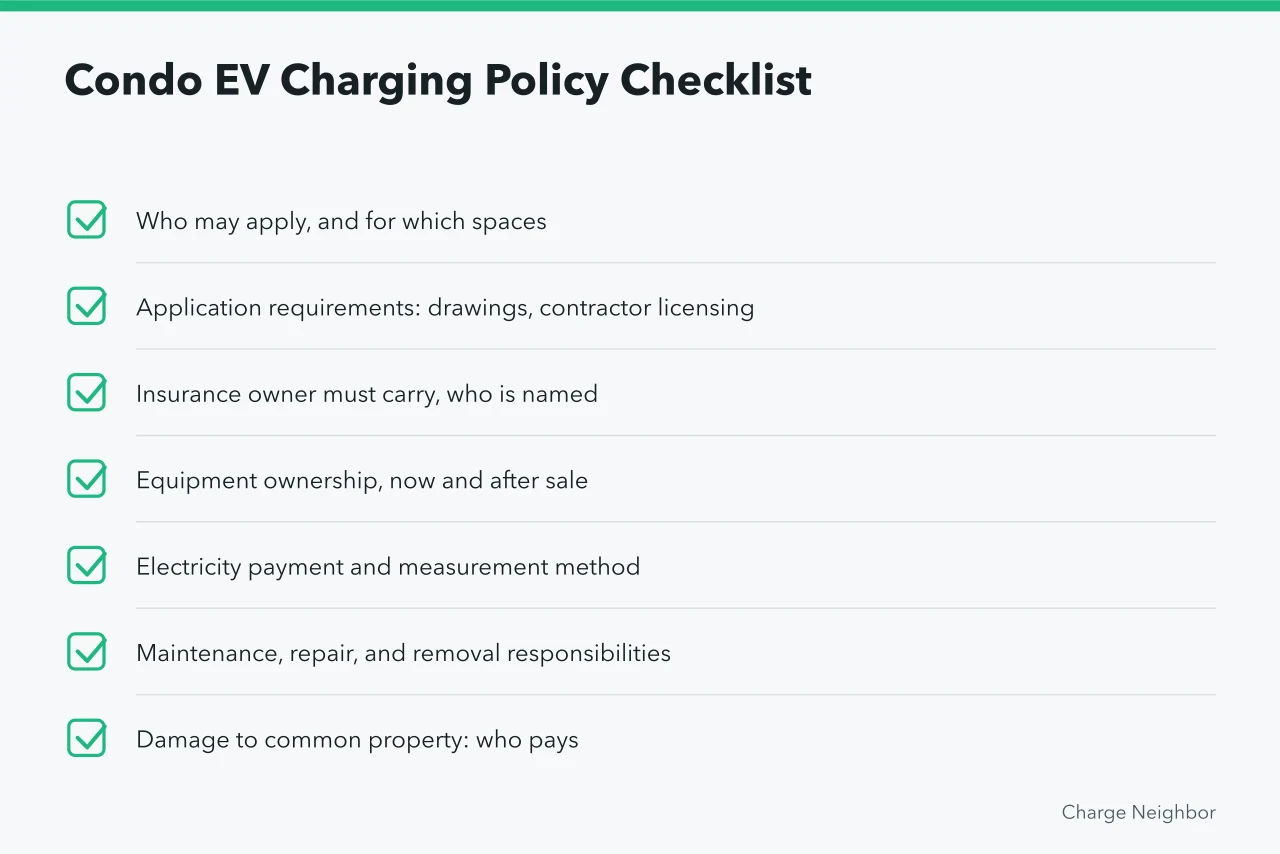
That last one is worth real thought. Early applicants get straightforward approvals. At some point the panel is full, and the board needs a rule decided in advance rather than a queue argued in a meeting.
Decide the ownership model
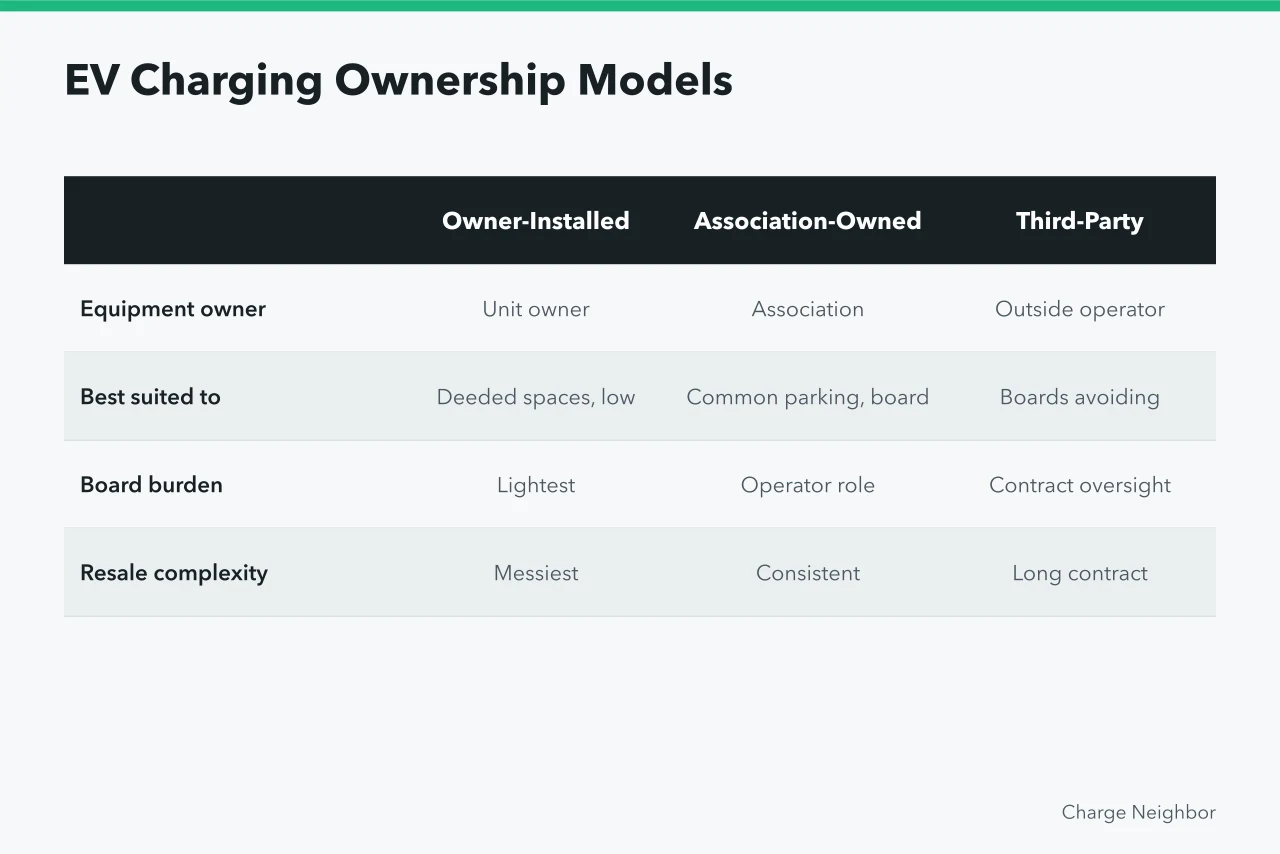
Three models cover most condominiums, and they behave very differently over time.
| Model | Who owns the equipment | Best suited to |
|---|---|---|
| Owner-installed at an assigned space | The unit owner | Buildings with deeded or exclusive-use spaces and low early demand |
| Association-owned shared ports | The association | Common parking, or where the board wants control of standards |
| Third-party owned and operated | An outside operator | Boards unwilling to run a service or carry the capital cost |
Owner-installed is the lightest for the board and the messiest at resale, because equipment attached to common property has to have its status written down. Association-owned gives consistency and a maintenance budget line, but the association becomes an operator with residents as customers. Third-party removes the capital cost and adds a long contract that somebody must read closely.
Get an electrical assessment for the whole building
Not for one space. The panel that serves the first applicant will also serve the tenth. Approving requests one at a time without a capacity plan is how a board ends up telling owner eleven that the answer is now no.
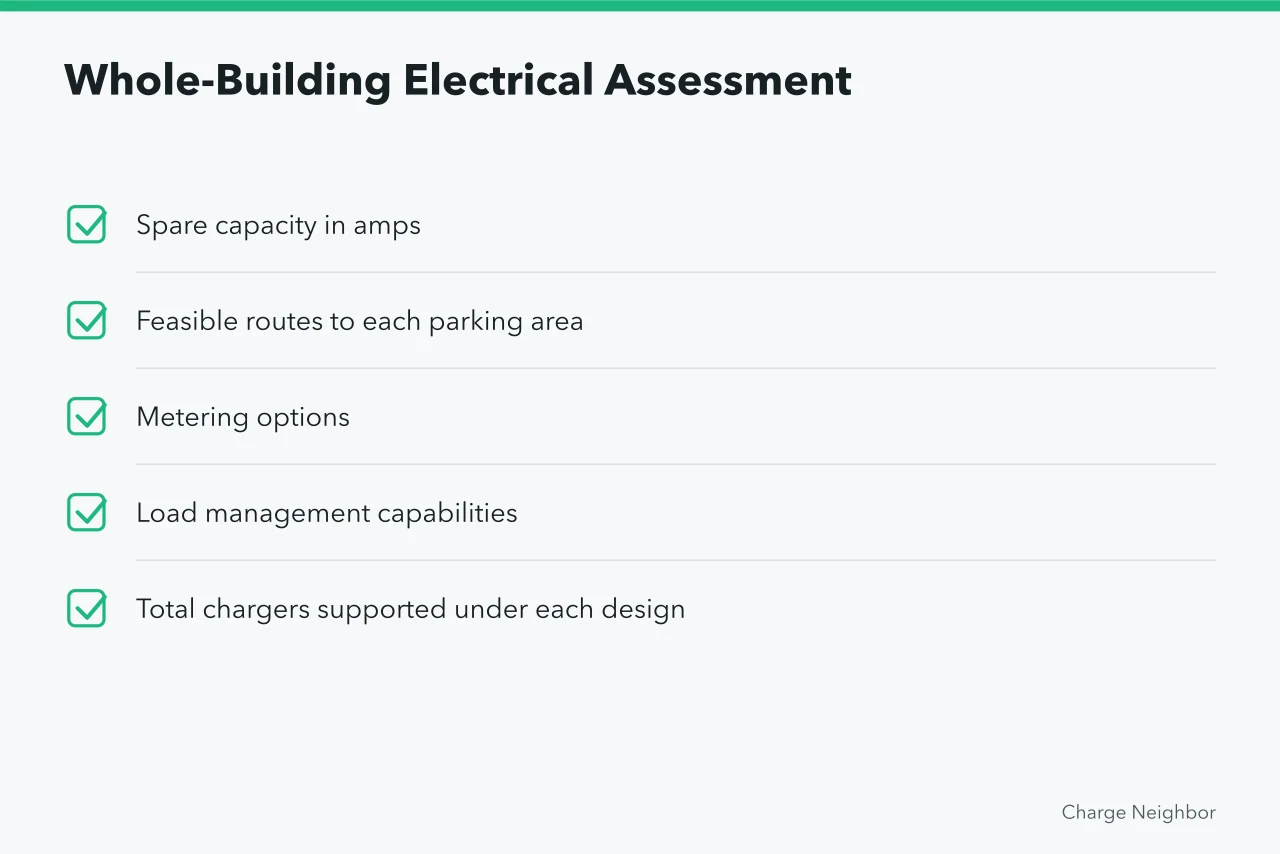
Ask the engineer for spare capacity in amps, feasible routes to each parking area, metering options, and what load management would allow. The contractor who would do the work belongs in that talk, because routing through the building often costs more than capacity.
Check codes and the approvals you will need
Local building codes, parking ordinances and zoning rules all bear on where equipment can go and what has to be shown on a drawing. The federal overview of building codes, parking and zoning ordinances for charging covers the categories to ask your building department about.
Also confirm what your own documents require. Many associations need architectural committee review for anything attached to a common element, and some require an owner vote for work of a certain scale. Finding that out after approval is expensive.
Handle the money explicitly
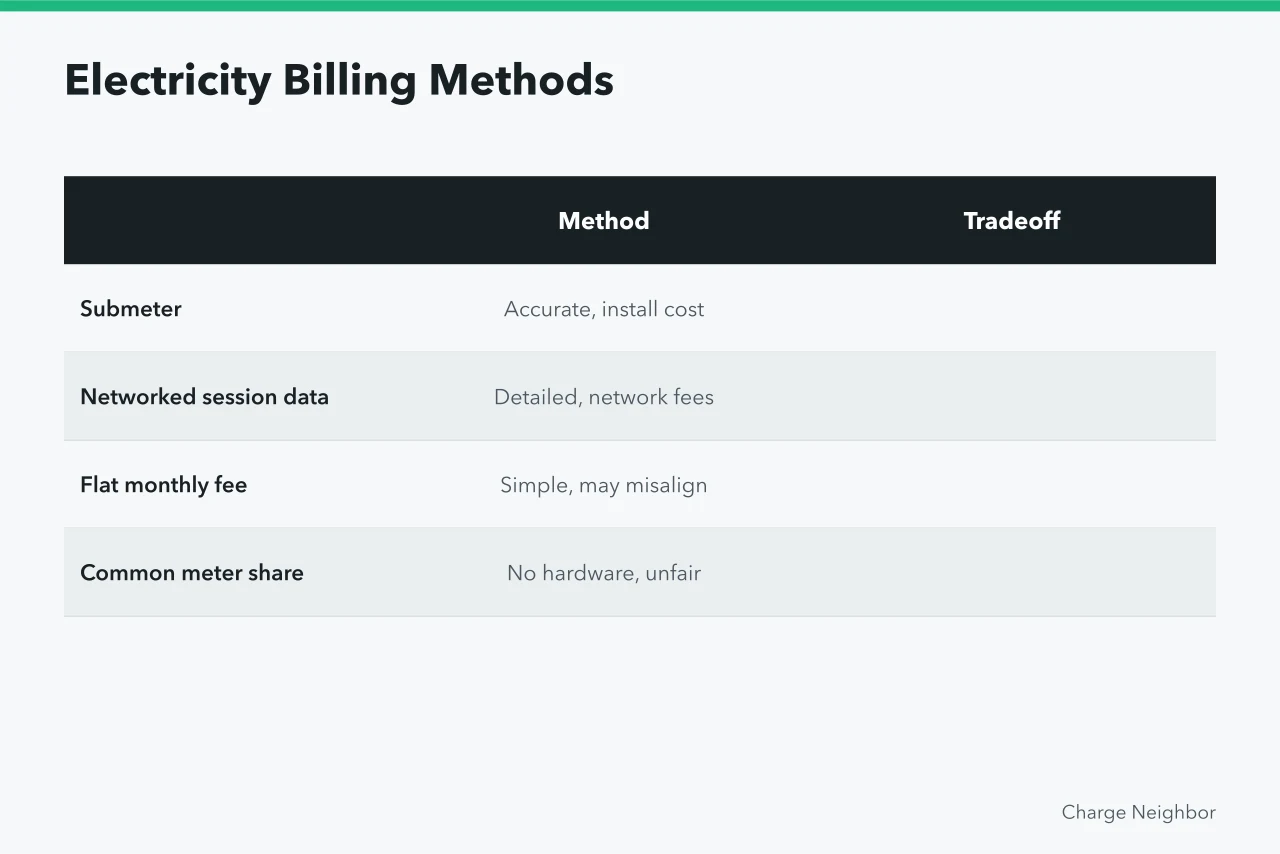
Decide how electricity is measured and billed, and write it down. Submeter, a networked charger's session data, a flat monthly fee, or a share of a common meter each have tradeoffs, and each needs a rule for what happens when the utility rate changes.
Decide who pays for shared infrastructure. If the association runs conduit and panel capacity ten future owners will use, the board should set that cost allocation once and record it. Don't argue it each time someone connects.
The funding models differ mostly in who profits and who carries the risk, which is the comparison worth having before the vote.
Approve, install, then keep the file
When the board approves, it should approve a specific drawing, a specific contractor, and a specific set of conditions, all in the minutes.
Keep the application, drawings, permit, inspection sign-off, insurance certificate, warranty and the signed agreement together. When a unit sells or the board turns over, that file is the only thing that establishes what was agreed.
From there, what tends to go wrong and what it costs is worth reading before you approve the first application, and the maintenance obligations you are creating should be understood before you decide who owns the equipment.
Common questions
Can our board just say no? In some states, not to an owner's own assigned space, though you can impose reasonable conditions. In others you have more discretion. Ask your attorney rather than assuming either way.
Who pays if the installation damages common property? The owner, if your policy says so and their insurance covers it. That is exactly why the insurance requirement belongs in the policy rather than in a later argument.
What happens when the owner sells? Whatever your agreement says. Without one, you have equipment of uncertain ownership attached to common property, which is a problem for the buyer, the seller and the board at once.
Do we have to treat every applicant the same? You have to apply your policy consistently. That is the argument for adopting it before requests arrive rather than after.
In this guide
- A practical maintenance plan for condo EV chargingWhat condo charging maintenance actually involves, by interval: monthly checks, seasonal work, annual inspection and the faults that need same-day action.
- Condo EV charging products worth comparing in 2027Compare condo EV charging products on access, power sharing, recurring fees and whether another operator could run them later, rather than on peak output.
- Condo EV charging mistakes that lead to extra costsThe condo charging mistakes that cost real money: approving one at a time, ignoring capacity, and the errors that stay invisible for a year.