Maintenance
Part of HOA charging solutions compared for value, upkeep and fit
HOA charging solutions mistakes that lead to extra costs
The HOA charging mistakes that end in legal fees: voided prohibitions, rules written after one owner applies, and amenity ports nobody uses.
What to take away
- A board that refuses a charger its state has already legalized pays attorney fees to lose, then permits the work anyway.
- Adopt the architectural standard while no application is pending. A rule written after one arrives reads as a rule about that owner.
- Never approve a charger verbally. Minutes with the stamped plan attached are the only record that survives a board turnover.
- Count utilization before buying amenity ports. A ChargePoint or Blink pedestal at a clubhouse nobody plugs into still bills monthly.
- Require a certificate of insurance naming the association before any exterior work starts.
The board rarely pays for the charger itself. In most planned communities that is the owner's expense. The money an association loses on charging is spent elsewhere: on attorneys, on pedestals nobody plugs into, and on reversing decisions made in the wrong order.
Refusing what state law already allows
A board reads its covenants, finds language about exterior alterations, and denies an owner's charger. The owner checks the statute, finds the association's power to prohibit is limited, and now the association is defending a position it cannot win.
Fees in a dispute like that can pass the cost of the installation being argued about. The association usually ends up permitting the work anyway.
Prevention is one afternoon. Read what your state says before you answer the first request. The federal summary of charger policies for residential associations shows the shape these provisions take. Your state's own record is the authority.
Provisions differ by state. The index of electricity laws and incentives in Virginia shows how one state documents its own. Pull your state's equivalent before the board takes a position.
Mistakes that look fine at the time
Writing the standard after the application. It reads as a rule about one owner, because it is. Adopt it while nothing is pending, the way a condo board should set its policy before the first request.
Deciding case by case. With no written standard, every application is a fresh negotiation and every outcome a precedent someone will cite. Inconsistency is what turns a disagreement into a claim.
Regulating what happens inside a private garage. A rule about conductor sizing or breaker type is unenforceable and pointless. Appearance, common area and safety are the board's business. Stay there.
Approving verbally. A director says it is fine, the owner installs, a later board objects. Put the approval in the minutes with the stamped plan attached.
Mistakes that surface a year later
Amenity ports bought on optimism. A board installs two pedestals at the clubhouse because it looks forward-looking. In a community where every unit has a garage, utilization can sit near zero while electricity, network fees and maintenance keep running. A ChargePoint or Blink subscription does not care whether anyone plugged in.
No rule about cords across common area. An owner parks on the common drive and runs a cord from the house. That is a trip hazard on association property, and without a rule the board improvises its response under pressure.
No insurance certificate on file. Equipment bolted where it can affect common area, installed by a contractor nobody vetted, with no certificate naming the association. The conditions that belong on any approval touching common property close this in a paragraph.
Selective enforcement. Two similar installations, one approved and one refused, for reasons nobody wrote down. That pattern is the most common source of association litigation, on charging and on everything else.
How to tell which mistakes you are about to make
Every mistake above comes from acting before deciding. The test is simple: if the board cannot answer the first request from a document it already adopted, it is negotiating in real time with neighbors watching.
The tools are ordinary. A ChargePoint or Blink pedestal is a capital purchase with a subscription attached, so it needs a utilization estimate before approval, not after. A hardwired wall unit behind a garage door needs almost no rule at all. An unnetworked unit with the electricity absorbed is often the honest answer at clubhouse scale.
The split between what a board controls and what it does not is set out in the comparison of HOA charging situations.
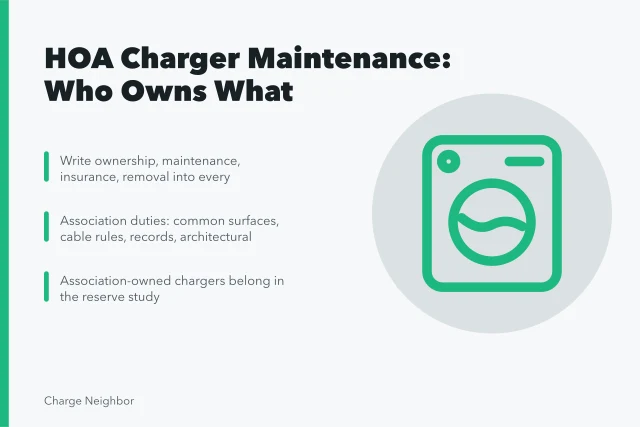
If the association owns the equipment, the maintenance obligations that follow are a real budget line, not a one-time purchase.
| Mistake | What it costs | The fix |
|---|---|---|
| Denying a charger state law allows | Attorney fees, then the same approval | Read the state statute first |
| Standard written after an application | A challenge to the rule itself | Adopt it while nothing is pending |
| Verbal approval | A board that cannot prove its own decision | Minutes plus the stamped plan |
| Clubhouse pedestal, no users | Subscription and power, every month | Estimate utilization before buying |
| No insurance certificate | Association carries the risk | Certificate naming the association |
Common questions
Our documents predate electric cars. Are they still binding?
Partly. General architectural provisions may still apply, while a blanket prohibition may be overridden by state law. Take the question to your attorney, not to a board vote.
Can we charge a fee for reviewing an application?
Often yes, if your documents allow it and the fee reflects actual review cost. A fee set high enough to deter applications is a different thing, and owners will read it that way.
An owner installed without approval. What now?
Check whether the work is compliant and whether your standard existed when it went in. Enforcing a standard retroactively against work done before it existed is weak ground.
Should we just permit everything and avoid the argument?
Permit freely inside private garages. Keep the standard for what is visible from common area and what touches association property, because those are the installations neighbors complain about.