Guides
Part of Apartment EV charging: cost guide for 2027
6 details of apartment EV charging budgets people miss
Six budget details apartment boards miss, from deposit exposure to retention release, and the four hidden moments when EV charging costs change late.
What to take away
- Track the budget by when cash leaves, not by construction phase. The two timelines differ.
- Most of the money is committed long before most of it is spent, so exposure peaks early.
- Four moments cause nearly every late cost change: opening the panel, trenching, plan check, and the utility response.
- Hold retention until commissioning passes and the closeout pack is delivered, not until the crew leaves.
- Spend on facts before hardware. Assessment-stage dollars cut uncertainty in a number ten times larger.
A construction schedule tells you when work happens. It does not tell you when you are exposed, and for a board approving a budget that is the more useful question.
Commitments run well ahead of payments in apartment charging. By the time significant cash has left, the decisions that set the total were made months earlier.
The cash timeline
Assessment. Small amounts: the electrical survey, possibly a professional engineer. A few thousand at most, and the highest-value money in the project. It is also the only stage where walking away costs almost nothing.
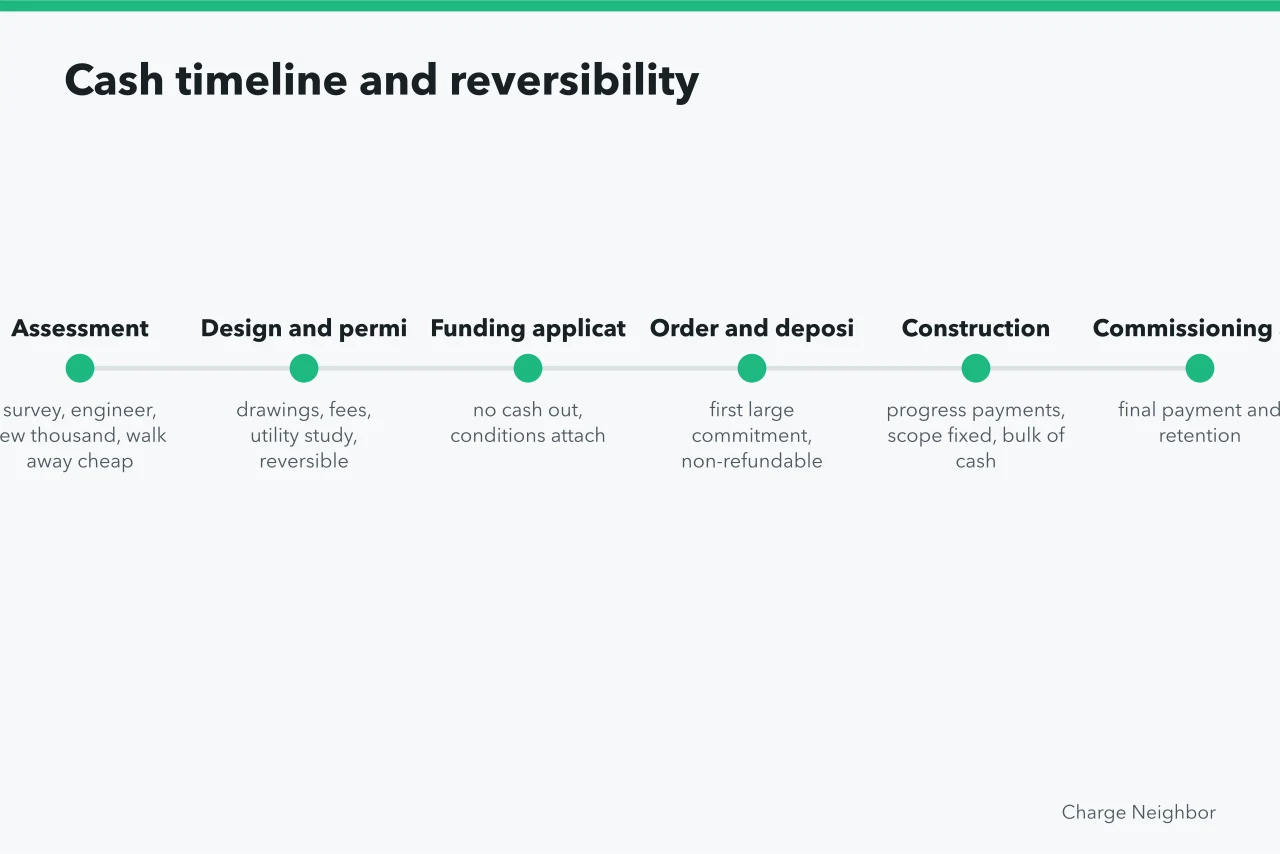
Design and permitting. Drawings, permit fees, sometimes a utility study. Still modest, still largely reversible.
Funding applications. No cash out, but this is where conditions attach. A program that requires approval before construction has just constrained your schedule.
Order and deposit. The first large commitment. Equipment lead times push ordering ahead of construction, and a deposit on switchgear or chargers is generally not refundable.
Construction. Progress payments against milestones. The bulk of the cash, and by now the scope is fixed.
Commissioning and closeout. Final payment and retention. The last hold you have on the contractor.
Your bargaining power is greatest at assessment, when almost nothing has been spent. It is gone by construction, when almost everything has.
Four moments where costs change late
When the panel is opened. Undocumented circuits, damaged raceways, less spare capacity than the schedule claimed. Older buildings hold surprises and this is where they surface, which is why an honest capacity assessment is the first thing to ask a contractor for.
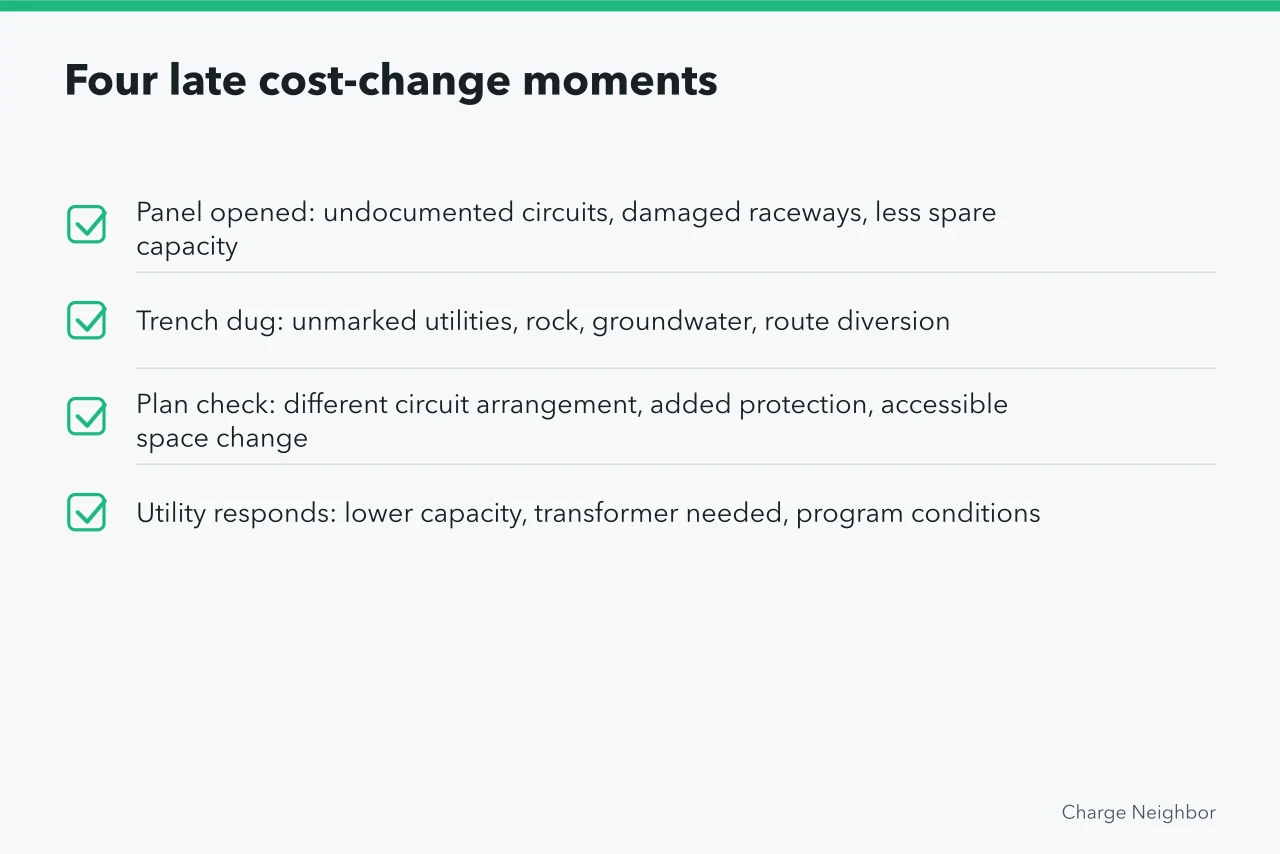
When the trench is dug. Unmarked utilities, rock, groundwater, or a route that has to divert. Trenching is the most common source of change orders in this work.
At plan check. A reviewer asks for something the design did not include: a different circuit arrangement, additional protection, a change to an accessible space. Cheap on paper, expensive if equipment is already ordered, which is the argument for treating plan check as a gate nothing gets ordered before.
When the utility responds. Capacity is lower than assumed, a transformer is needed, or the program has conditions. This sits outside everyone's control and carries the longest lead time.
Budget contingency against these four by name rather than adding a general percentage. It makes the number defensible to a board and shows what the contingency is for.
Sequence the money against the readiness
The general readiness sequence for a property preparing to add charging is covered in the Alternative Fuels Data Center's material on electric vehicle readiness. The budgeting point that follows is simple: spend on facts before spending on hardware.
Every dollar at assessment stage reduces uncertainty in a number ten times larger. Every dollar spent on equipment before the assessment is a bet.
Watch the funding calendar, not just the build calendar
Funding programs run on their own timetable, and it rarely matches yours.
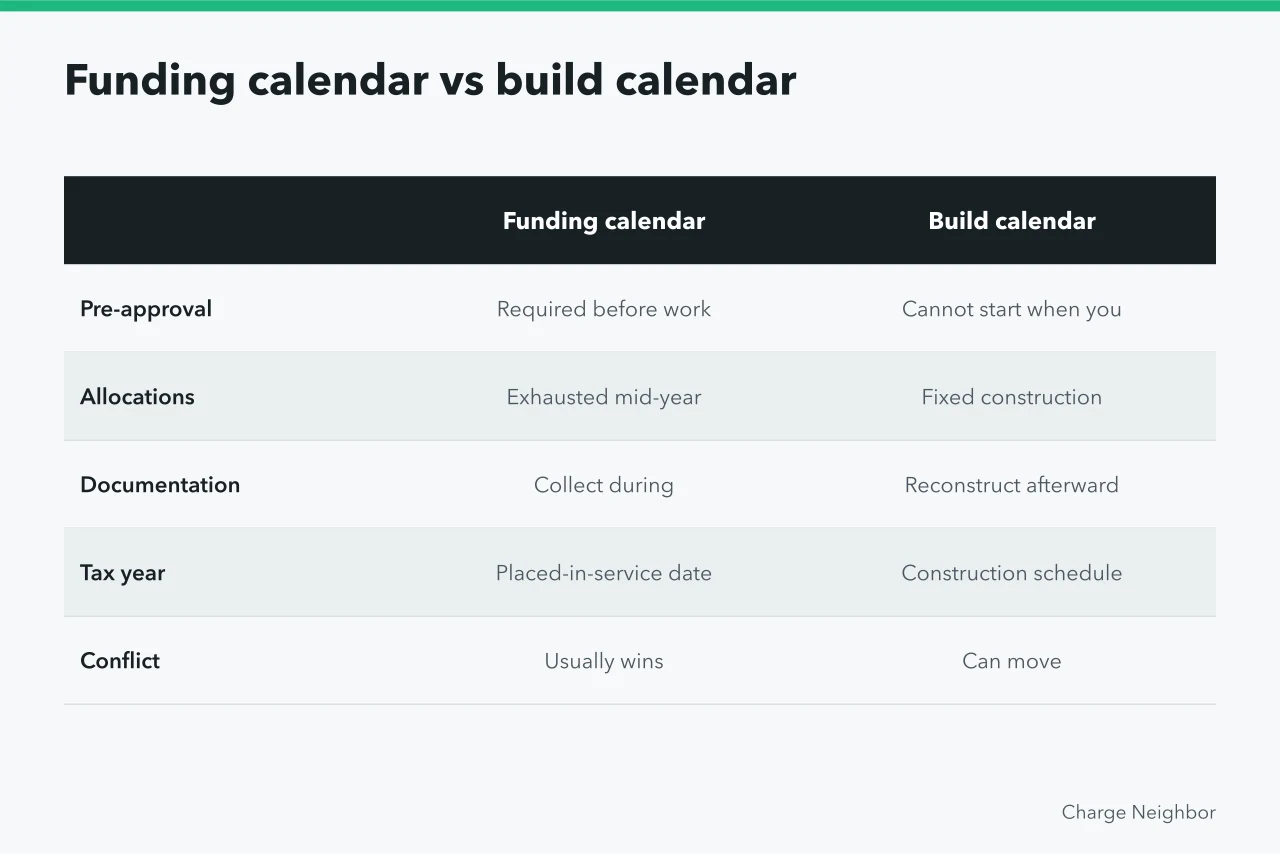
State programs vary widely in how these conditions are structured. The state-by-state records, such as the index of electricity laws and incentives in New York, show the level of detail worth checking for your own state before you set a construction date.
Map the funding deadlines onto the construction schedule on one page. Where they conflict, the funding calendar usually wins, because construction can move and an allocation cannot.
Hold retention properly
The final payment is the only hold you have left, and boards give it up too early.
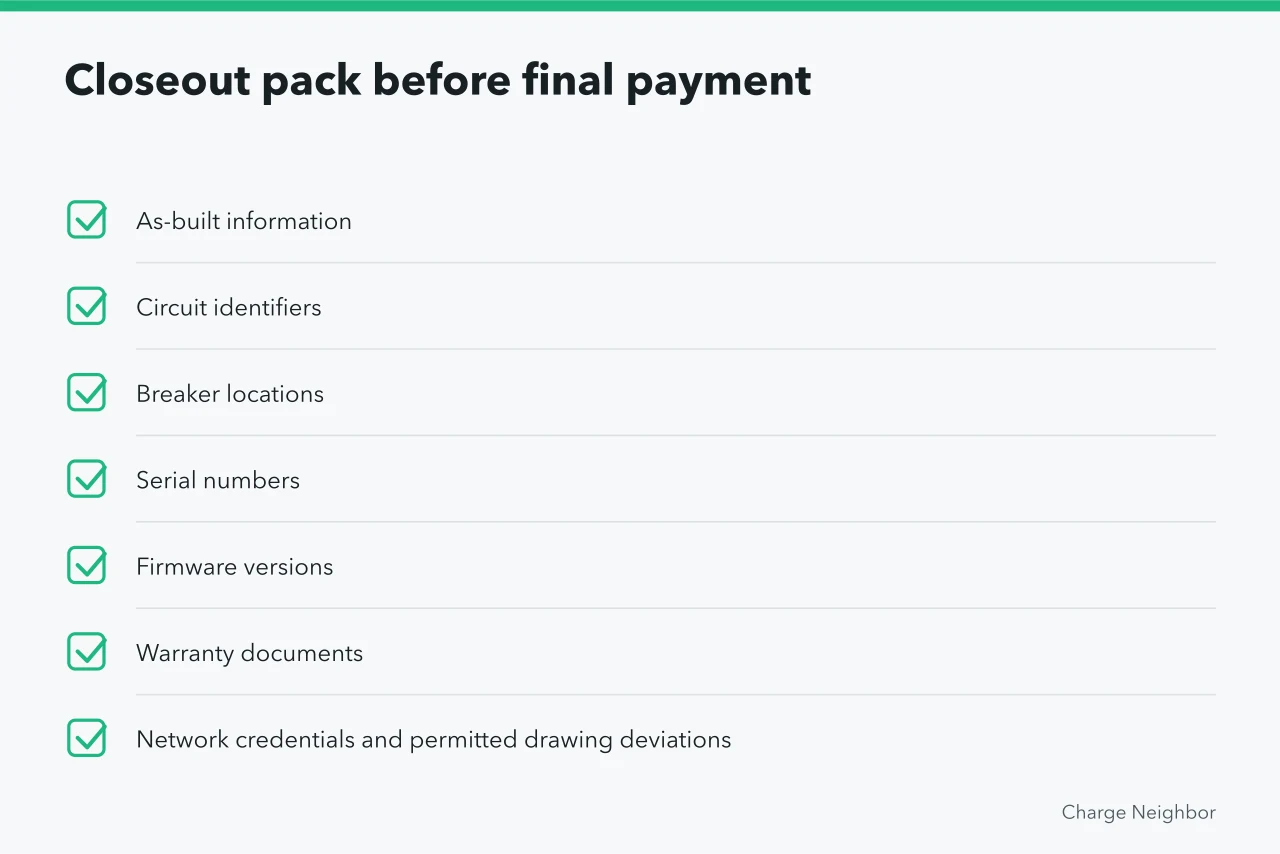
Release it when commissioning passes and the closeout pack is delivered:
- as-built information
- circuit identifiers
- breaker locations
- serial numbers
- firmware versions
- warranty documents
- network credentials
- any deviation from the permitted drawing That pack gets assembled while the installer is still on site, not afterwards.
Paying in full when the crew drives away means chasing that pack by email for three months.
A worked example of the tracker
Keep one sheet with four columns. Update it at each stage, because the gap between the first two columns is your exposure.
| Stage | Committed | Spent | Remaining | What would change it |
|---|---|---|---|---|
| Assessment | Survey and engineer fees | Same day | Full budget | Nothing. Walking away is nearly free |
| Design and permitting | Drawings, permit fees | Most of it | Full budget | Reviewer comments |
| Order and deposit | Equipment, non-refundable | Deposit only | Full budget | Lead times, price at order |
| Construction | Full scope | Progress payments | Contingency | Panel, trench, plan check |
| Commissioning | Full scope plus retention | All but retention | Retention | Failed commissioning items |
Boards get surprised because they track spending only. Tracking commitment shows the exposure while there is still time to act on it.
Where the money comes from is covered in the cost guide, and stress-testing the numbers before approval is what turns this timeline into a defensible decision.
Common questions
When is the last point we can stop cheaply?
Before the equipment deposit. Up to that point most of the spend is surveys, drawings and fees, and the scope is still open. After the deposit you are committed to most of the work.
How much contingency is realistic?
Enough to cover the four late-change moments that apply to your building. Ask the contractor which of them are likely here and price those, rather than picking a percentage out of the air. A number tied to named risks survives a board meeting.
Can we order equipment early to beat lead times?
Only after plan check. Ordering before review is how boards end up owning equipment they cannot install. Switchgear and chargers are not returnable in most cases, so the deposit is the point of no return.
Who tracks the funding deadlines?
Name one person. Missed conditions are almost always administrative rather than technical, and they can cost the whole allocation. Put the pre-approval date, the allocation deadline and the placed-in-service date on the same one-page schedule as construction.