Costs
Apartment EV charging: cost guide for 2027
Apartment EV charging costs in 2027: trenching, panels, chargers, network fees, power rates, and who pays under 30C and utility make-ready programs.
What to take away
- The federal 30C credit runs on property placed in service through 31 December 2032, but only in eligible census tracts. Check the tract before you count on it.
- The credit is 6% of cost up to $100,000 per item, or 30% if prevailing wage and apprenticeship rules are met. That gap changes who you hire.
- Utility make-ready programs often cover the most expensive part, the work between the transformer and parking space. Public programs cover 50% to 100% of that cost.
- 2027 benchmarks: trenching $18 to $45 per linear foot, conduit and wire $28 to $70 per linear foot, a Level 2 port $2,800 to $7,500, network fees $12 to $35 per port per month.
Most cost guides for this subject describe what things cost. That is the less useful half. In an apartment building the harder question is where the money comes from, because the answer changes what you can build.
There are four sources: the owner's capital, the federal tax credit, utility and state programs, and residents. Each has different rules, and one has a census tract requirement that quietly disqualifies plenty of buildings.
The federal credit, with its actual terms
The Alternative Fuel Vehicle Refueling Property Credit, usually called 30C, is the main federal route. The Internal Revenue Service sets out the terms for businesses claiming the refueling property credit, and four details decide whether it is worth anything to you.
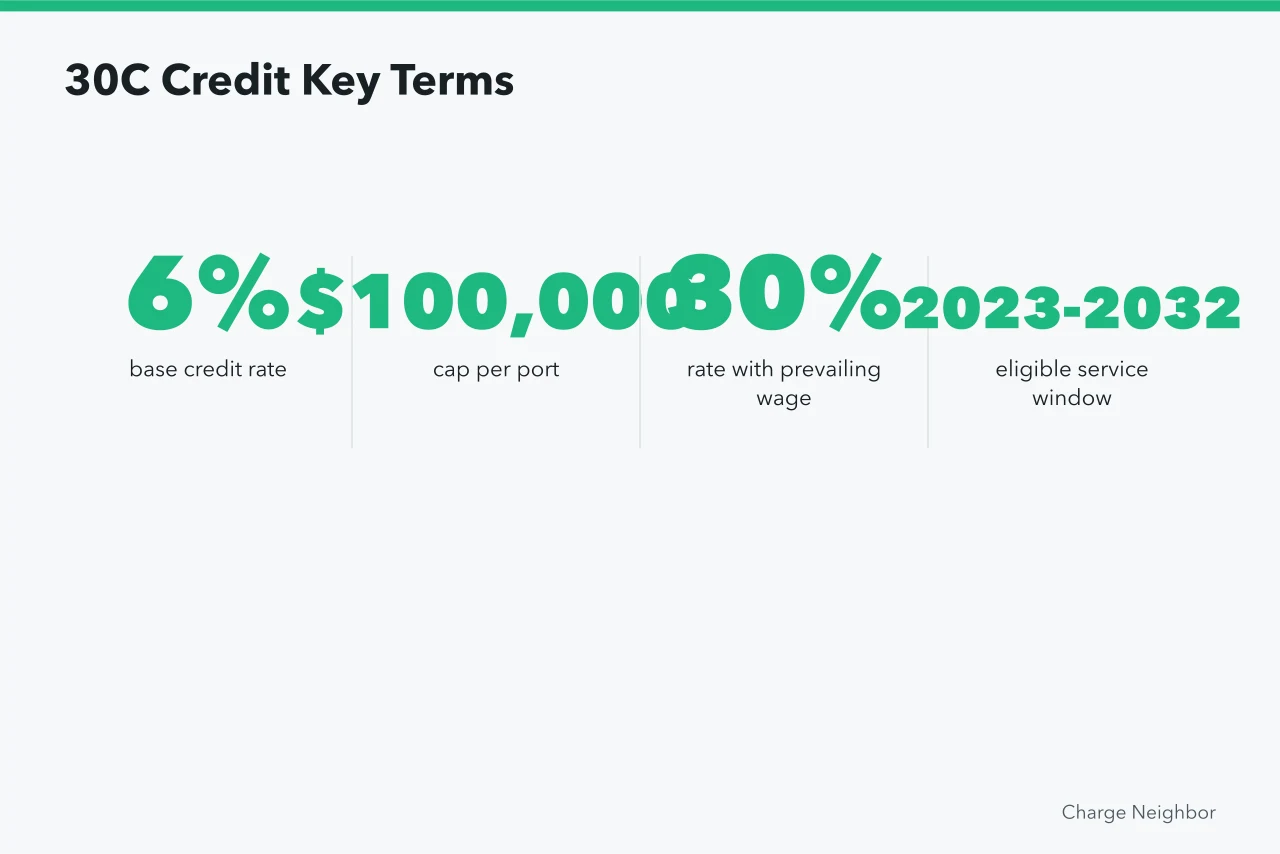
The window. Property placed in service from 1 January 2023 through 31 December 2032.
The rate. Six per cent of the cost including labor, capped at $100,000 per item. That rises to 30 per cent, same cap, if prevailing wage and apprenticeship requirements are met.
The per-item cap. It applies per item of property, which for charging generally means per port. That structure favors more ports rather than one expensive installation.
The census tract test. The property has to be placed in service in an eligible census tract, meaning a low-income community tract or a non-urban tract. This is the condition that catches people out, because it is a fact about your address rather than about your project. Which identifier applies also depends on when the property is placed in service, with different census tract identifiers for installations before and after 1 January 2025.
Check the tract before you build a budget around the credit. It is a five-minute check that decides a five-figure line.
What the 2027 line items cost
Use these ranges for planning, then get local bids. Costs vary by region, soil, asphalt, union labor and utility rules.
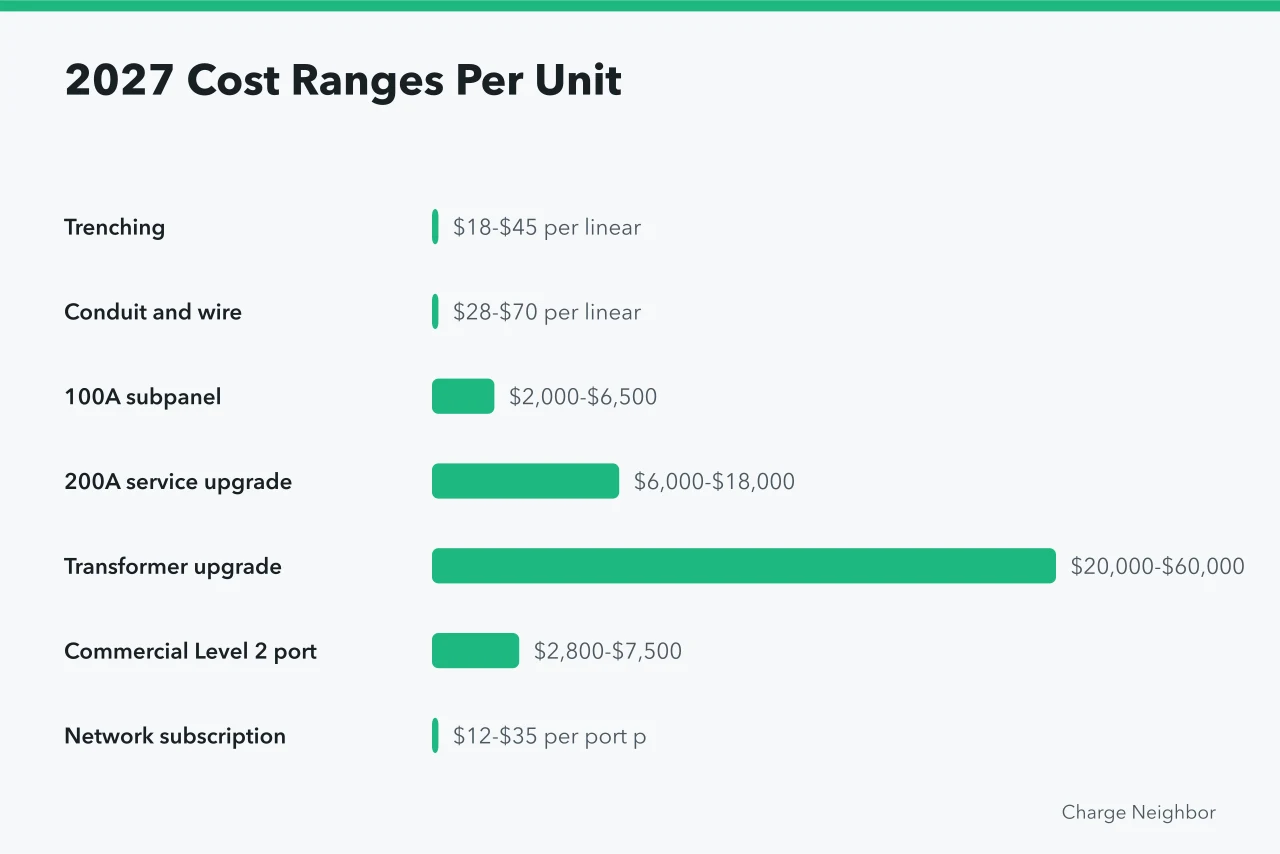
Trenching and conduit. Trenching runs $18 to $45 per linear foot. Conduit plus copper wire for 60A to 100A branch circuits runs $28 to $70 per linear foot.
Panels and service. A 100A subpanel costs $2,000 to $6,500. A 200A service upgrade costs $6,000 to $18,000. A transformer upgrade can run $20,000 to $60,000.
Chargers. A commercial Level 2 port costs $2,800 to $7,500. A dual-port pedestal runs $6,000 to $14,000 before network hardware.
Network and software. Network subscriptions run $12 to $35 per port per month. Payment processing takes 2.5% to 4.5% of each transaction.
Electricity and labor. Commercial rates in 2027 are likely $0.14 to $0.31 per kWh. Demand charges run $8 to $25 per kW. A car driving 10,000 miles uses about 3,000 kWh, or $420 to $930 per year. Electrician labor runs $85 to $150 per hour.
Utility programs and named providers
The single most expensive element is usually not the charger. It is the work between the utility's equipment and the parking space: trenching, conduit, panels, sometimes a transformer.
That is exactly what make-ready programs are designed to cover. The Alternative Fuels Data Center tracks how utility programs in this area are developing. Call the utility early. Program funds are typically allocated, applications often must be approved before work starts, and doing the work first usually forfeits the money. The funding calendar and the construction calendar rarely agree.
Named programs and tools set the 2027 market:
- Con Edison EV Make-Ready Program in New York can cover up to 100% of make-ready infrastructure costs. Con Edison owns the infrastructure.
- Southern California Edison Charge Ready installs and maintains make-ready infrastructure. The site host buys and owns the charging stations.
- Xcel Energy EV Supply Infrastructure offers rebates in Minnesota and Colorado. Preapproval is required before construction.
- ChargePoint sells networked commercial Level 2 stations and software. Pricing is quote-based, so ask for the per-port monthly software fee.
- Blink Charging offers host-owned and Blink-owned models. In the Blink-owned model, Blink shares revenue and keeps a portion of charging income.
- SWTCH Energy focuses on multifamily charging with load management. It offers turnkey installation and network plans.
Who carries which cost
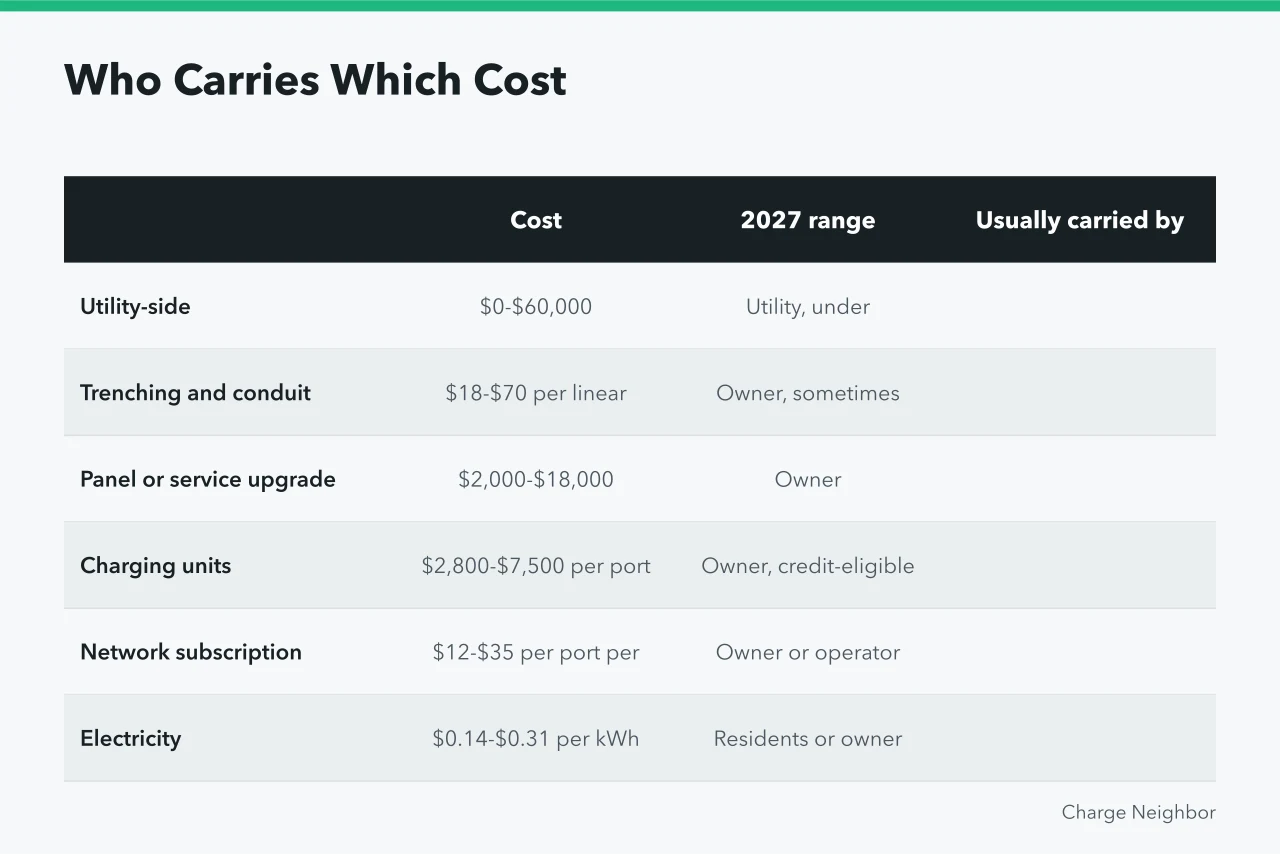
| Cost | 2027 range | Usually carried by | Worth negotiating |
|---|---|---|---|
| Utility-side infrastructure | $0 to $60,000 | Utility, under make-ready | Whether your scope qualifies |
| Trenching and conduit | $18 to $70 per linear foot | Owner, sometimes make-ready | The largest single variable |
| Panel or service upgrade | $2,000 to $18,000 | Owner | Load management versus upgrade |
| Charging units | $2,800 to $7,500 per port | Owner, credit-eligible | Per-port cap favors more ports |
| Network subscription | $12 to $35 per port per month | Owner or operator | Length and termination terms |
| Electricity | $0.14 to $0.31 per kWh | Residents or owner | How, and whether it is metered |
| Maintenance and cables | $150 to $500 per port per year | Owner or third-party operator | Response times and parts |
Fill that table in for your building before choosing a model. The rows where the answer is 'not decided' are where disputes come from.
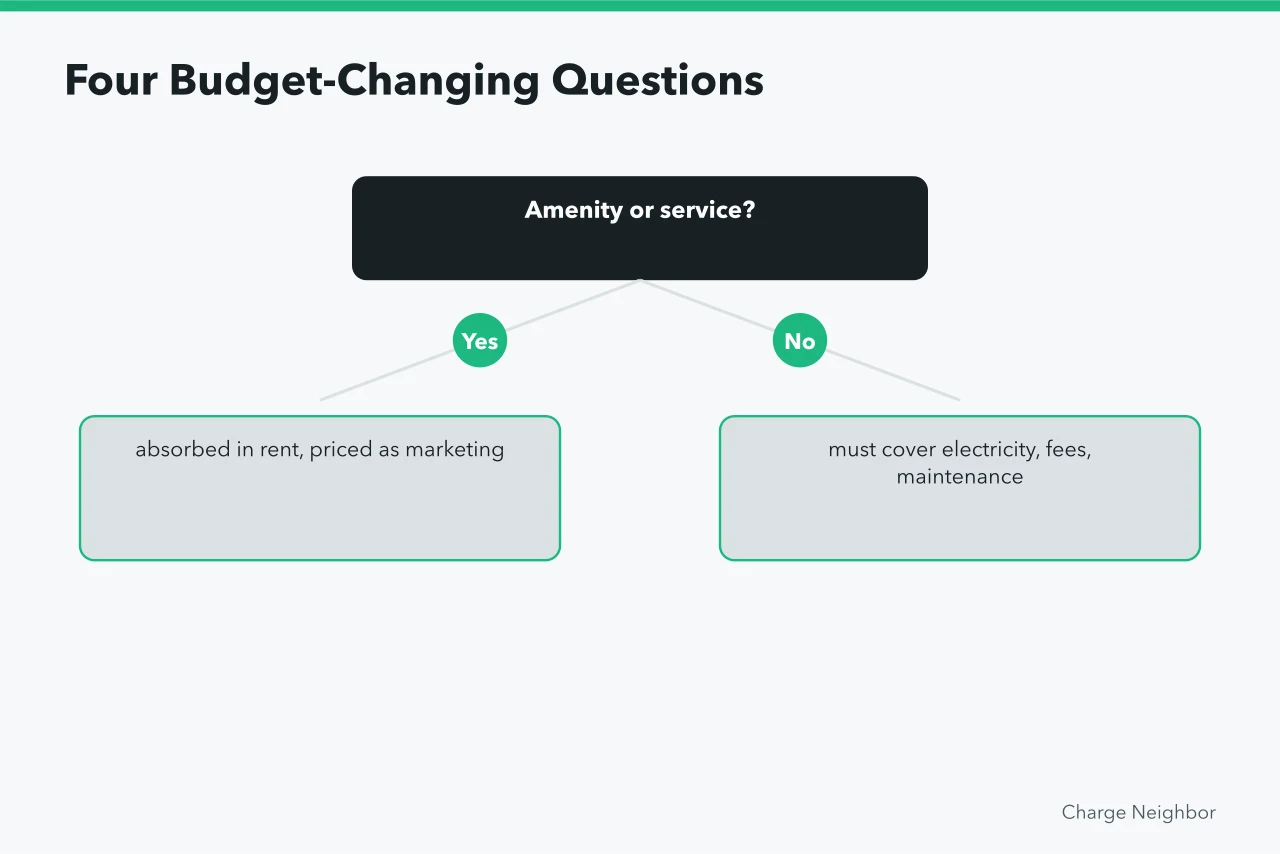
Four questions that change the whole budget
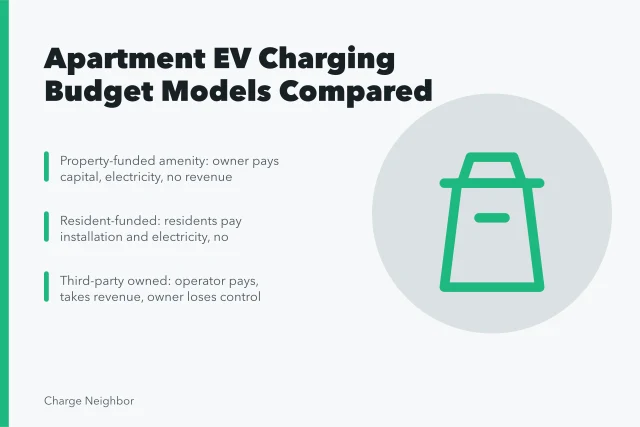
Is this an amenity or a service? An amenity is absorbed in rent and priced as marketing. A service has to cover its own electricity, fees and maintenance. That decision drives everything else.
Are you billing residents individually? If yes, you need metering, a payment path and a network, plus somebody to run it. If no, most of the software cost disappears.
Do you need capacity, or just management? A service upgrade is the big number, often $6,000 to $18,000. Load management often avoids it for a fraction of the cost, at the price of a lower guaranteed power per car.
How many ports, eventually? The per-item structure of the credit and the fixed cost of trenching both reward doing conduit once for more ports than you populate today. Layouts built around that idea, from a cable-tray backbone to EV-ready bays, are worth seeing before you fix a port count.
The mistake that costs the most
Counting funding before confirming it.
A board approves a project on the basis of a credit and a rebate, the work proceeds, and then the tract turns out to be ineligible, or the utility program required pre-approval, or the prevailing wage documentation was never collected. The shortfall becomes a special assessment.
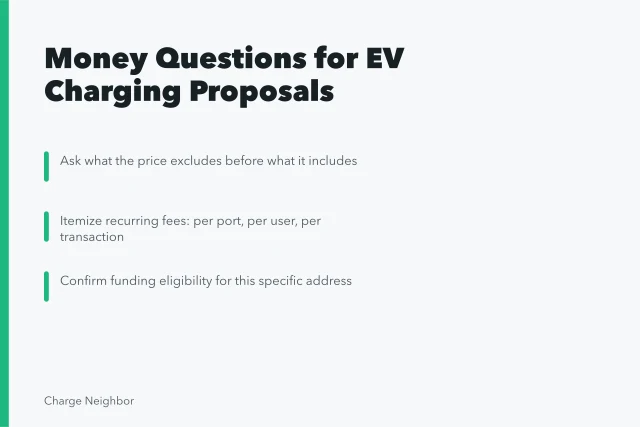
Confirm eligibility in writing, for your address and your ownership type, before the number enters an approved budget. It is the single most important item on the money questions a proposal has to answer. It costs a fortnight and it is the cheapest insurance available in this work.
For how each design decision moves these numbers, the budget choices set against each other is the next piece, and why a shared installation costs so much more per port than a house explains the gap that surprises most first-time buyers.
Common questions
Can a condominium association claim the 30C credit? It depends on the entity and its tax position, and tax-exempt entities have a separate route. Ask a tax adviser about your specific structure rather than assuming.
Does the credit cover installation labor? The business credit is described as a percentage of the cost including labor, subject to the per-item cap. Your adviser should confirm what qualifies for your project.
What if our census tract is not eligible? Then plan without the federal credit and concentrate on utility and state programs, which use different eligibility rules entirely.
Should we wait for better incentives? The current window runs to 2032, so there is no cliff forcing a rush. Waiting has its own cost if utility program funds are allocated annually and run out.
In this guide
- Apartment EV charging budgets: choices comparedApartment ev charging budget models: property-funded, resident-funded, third-party and phased charging budgets set against each other on who pays.
- 6 details of apartment EV charging budgets people missSix budget details apartment boards miss, from deposit exposure to retention release, and the four hidden moments when EV charging costs change late.
- Apartment EV charging costs for homes and shared buildingsA home charger and an apartment port use the same hardware and cost very different amounts. The six reasons, and which ones you can influence.
- Questions to ask before buying apartment EV charging budgetsAsk what a charging proposal excludes, what utility upgrades recur for ten years, and who absorbs the shortfall before your board signs anything.
- Apartment EV charging budgets: how to testStress-test a charging budget before you approve it: five scenarios, the demand charge exposure, and the four numbers to track after opening.