Reviews
HOA charging solutions compared for value, upkeep and fit
HOA charging solutions compared on value, upkeep and fit, from owner-garage units to networked pedestals, with what each costs to run and who it suits.
What to take away
- Most HOA charging solutions in single-family communities happen in an owner's own garage, where the board's role in HOA charging is architectural review, not electrical design.
- Value is not the purchase price. It is purchase price plus the network fee, the electricity, and the maintenance call-outs over the years you keep the unit. A Tesla Wall Connector typically lists near $420; a ChargePoint Home Flex near $550 to $800.
- Upkeep splits cleanly: a non-networked charger has no subscription and no remote diagnostics. A networked one has both, and you pay monthly for them.
- Fit is decided by who pays for the electricity and who owns the parking, not by charger specifications.
- Confirm any restriction against your state's rules and your own governing documents before the board votes.
The named products, and the job each does
The title asks for a comparison, so here is the field. Boards and owners bring these products to a meeting. They are grouped by the job they do.
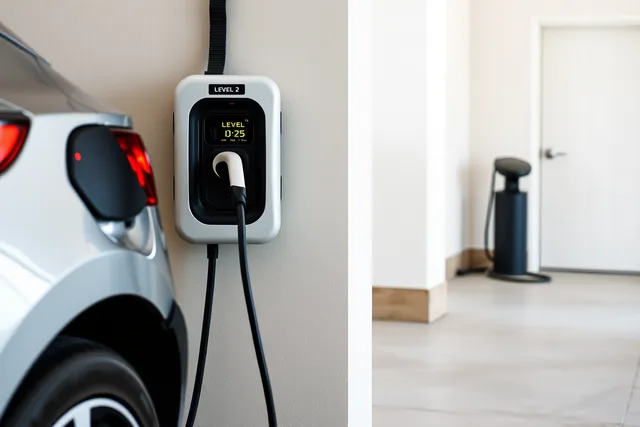
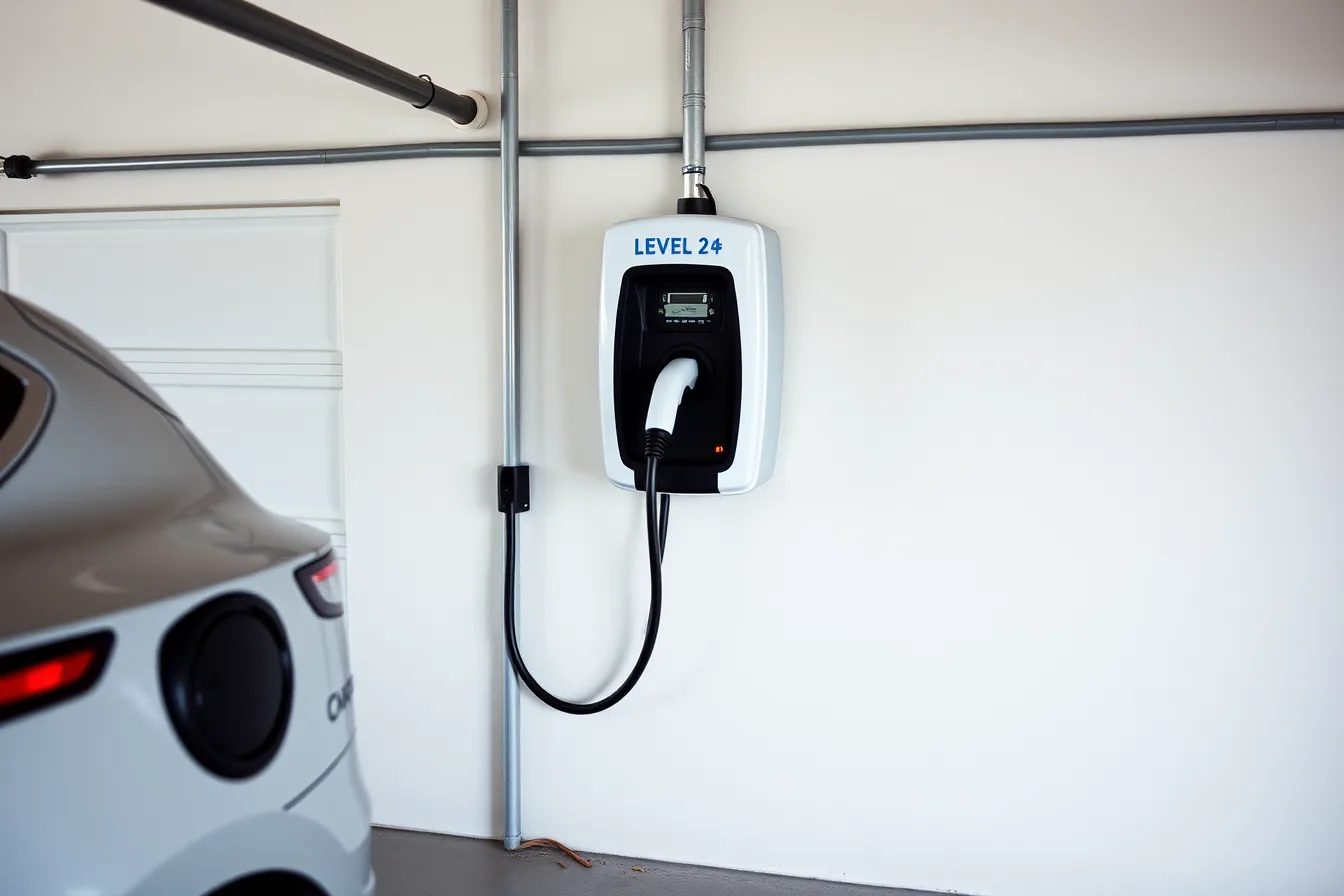
Owner-garage units. A Tesla Wall Connector, a ChargePoint Home Flex, an Emporia Level 2, a Grizzl-E Classic or a Wallbox Pulsar Plus. All are Level 2 units on the owner's own meter.
Typical hardware prices run from about $400 to $800, with the Wallbox Pulsar Plus at the top of that band. The board sees none of the electricity bill and none of the maintenance.
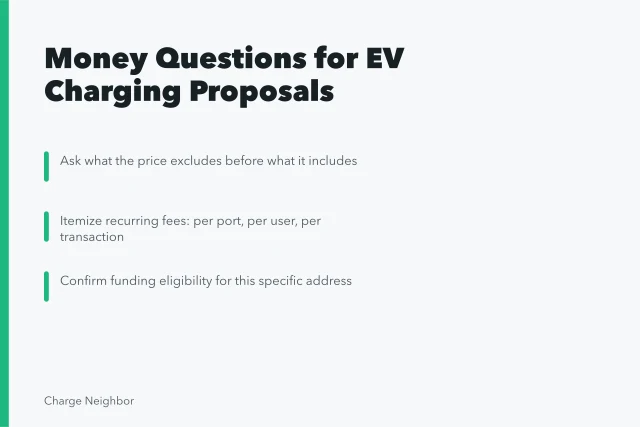
Association-owned pedestals and wall units. ChargePoint, Blink, Enel X Way and Shell Recharge sell networked commercial hardware with a subscription. Hardware typically runs $1,500 to $6,000 per pedestal. Network plans typically cost $20 to $60 per port per month, plus payment processing of about 2.9 percent and 30 cents per transaction.
They handle payment, access control and usage reports, which is what an amenity lot needs.
Non-networked commercial units. ClipperCreek, now part of Enphase, and Grizzl-E's commercial line. Hardware typically runs $800 to $2,500 per unit. No subscription, no payment processing. Suited to assigned resident parking where the association bills a flat amount through dues or rent.
Load-managed systems. DCC Electric's load controllers typically list between $600 and $900 depending on amperage. Wallbox's power-sharing is built into its Pulsar Plus and Commander 2 units at no extra hardware cost. Both let several chargers share one existing service instead of forcing a service upgrade. This is the option that most often decides whether a project is affordable at all.
Turnkey managed providers. Companies that own the hardware and charge users per kilowatt-hour, with the association supplying only the parking space. The host typically keeps 5 to 20 percent of revenue, or a flat monthly rent. Value here is zero capital cost against a revenue share you do not control.
Value: what the number actually contains
Purchase price is the smallest part of the comparison for anything the association owns. The rest is the network subscription, the electricity, the payment processing cut, and the service visits.
Write it as arithmetic the board can run with its own figures:
annual cost = (sessions x kWh per session x your rate)
            + (ports x monthly network fee x 12)
            + (service visits x cost per visit)
For owner-garage units every term after the first is zero to the association. That is why the middle column of the table below is where most boards spend their time.
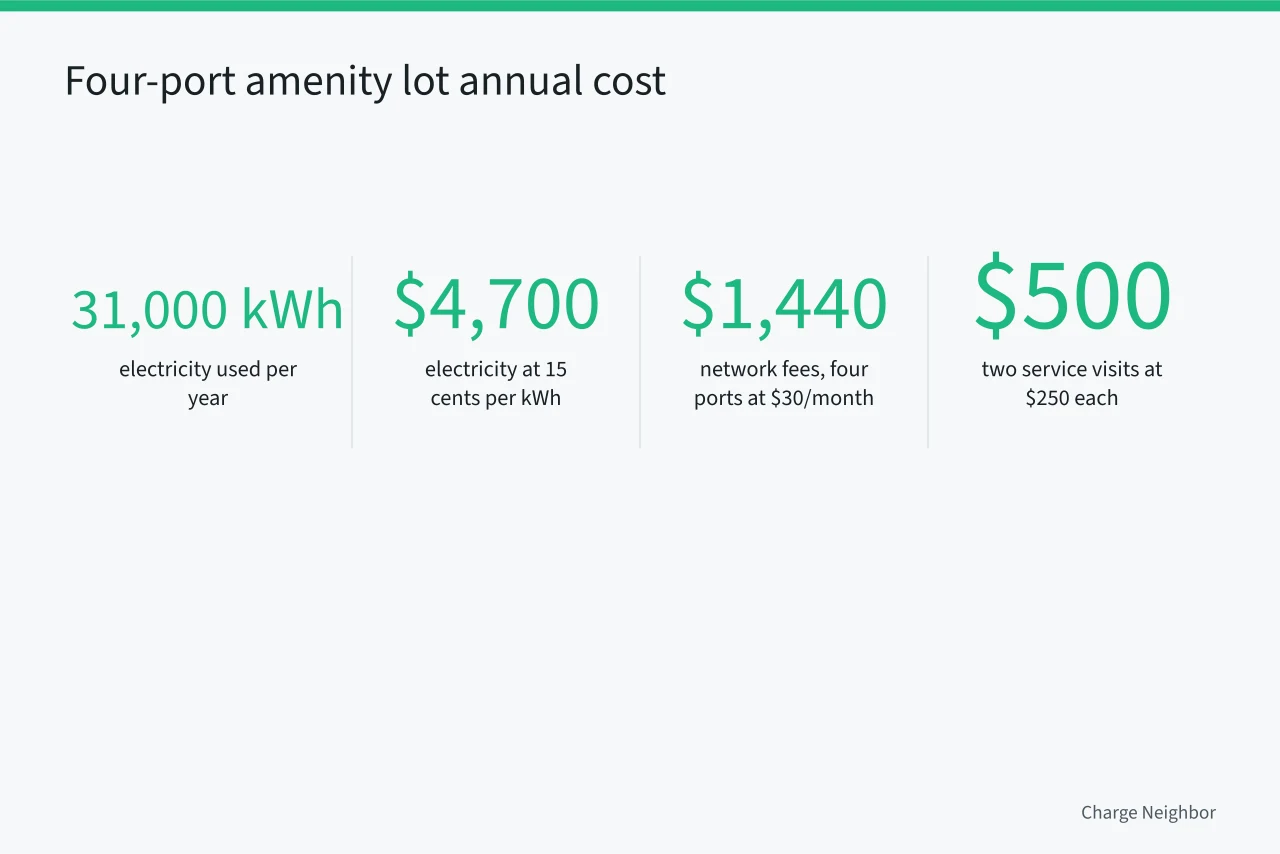
A four-port amenity lot is a useful example. Twenty sessions a week at 30 kWh each is about 31,000 kWh a year. At a typical commercial rate of 15 cents per kWh, that is roughly $4,700 in electricity.
Four ports at $30 per month adds $1,440 in network fees. Two service visits at $250 each adds $500. The annual total lands near $6,600 before payment processing.
Owner-garage arithmetic is simpler. A Tesla Wall Connector at about $420 plus an electrician's circuit install at a typical $800 to $2,000 is a one-time owner cost. The owner pays the electricity on their own meter, and the association pays nothing.
Upkeep: the part boards underestimate
A non-networked charger has one failure mode a board can see: it stops working. A networked charger has that plus firmware, cellular or Wi-Fi connectivity, a payment account, and a subscription that renews whether anyone plugs in or not.
Uptime is the number to track, and it only exists if somebody logs it. Keep an asset register with serial numbers, install dates, warranty terms and the certificate of insurance for each contractor who touched the equipment.
Ask every bidder who answers the phone at 9pm on a Saturday. The answer separates a local electrical contractor from a national network, and it is the single best predictor of what upkeep will feel like.
Fit: match the product to who owns the parking
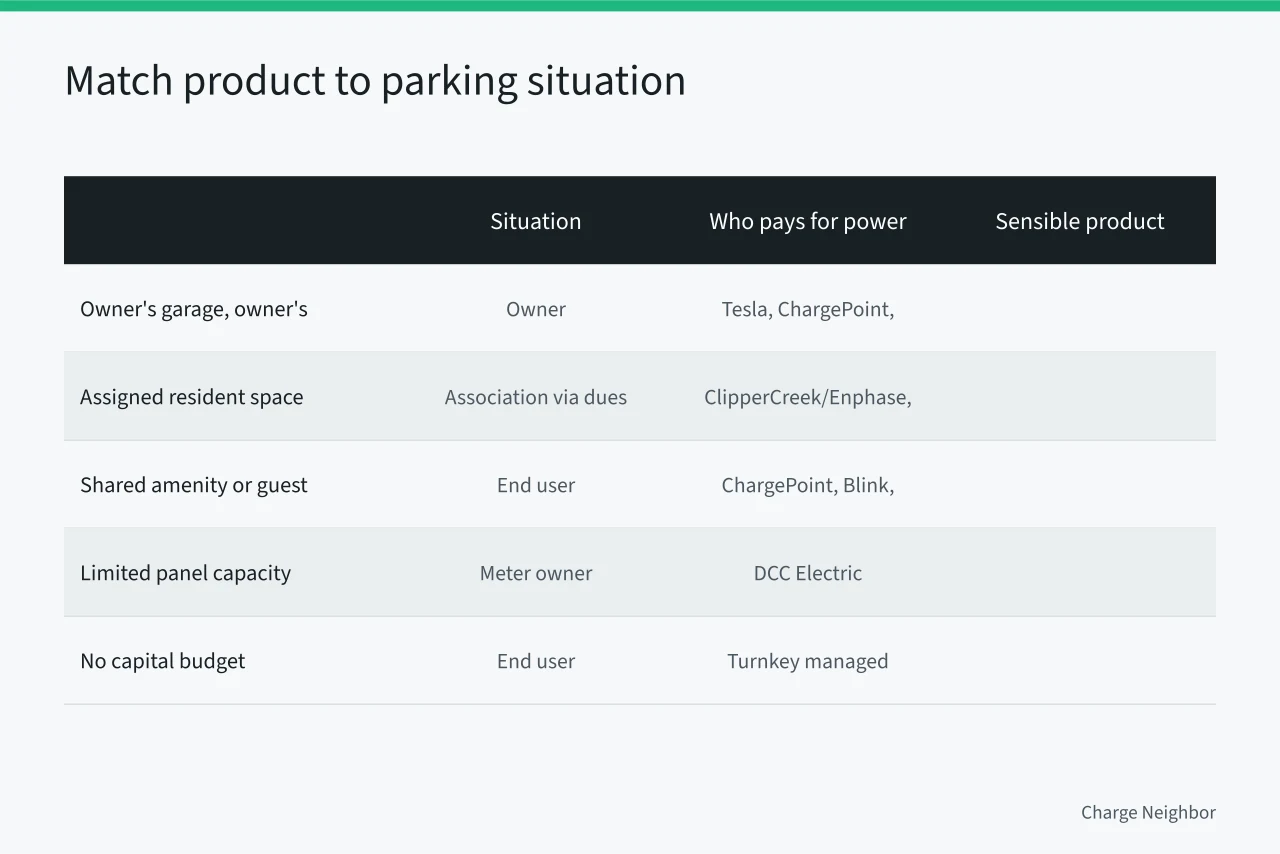
| Situation | Who pays for power | Sensible product | Board's role |
|---|---|---|---|
| Owner's garage, owner's meter | Owner | Tesla Wall Connector ($420), ChargePoint Home Flex ($550-$800), Emporia ($400-$500), Grizzl-E Classic ($400-$500), Wallbox Pulsar Plus ($650-$1,100) | Architectural review only |
| Assigned resident space, association meter | Association, recovered through dues | ClipperCreek/Enphase or Grizzl-E commercial ($800-$2,500), non-networked | Set the recovery method |
| Shared amenity or guest lot | End user | ChargePoint, Blink, Enel X Way, Shell Recharge networked ($1,500-$6,000 per pedestal plus $20-$60 per port per month) | Full policy, pricing, access |
| Limited panel capacity, any of the above | Whoever owns the meter | DCC Electric load controller ($600-$900) or Wallbox power sharing (no extra hardware) | Approve the approach |
| No capital budget | End user | Turnkey managed provider (zero capital cost, host keeps 5 to 20 percent of revenue) | Approve the contract terms |
The middle rows are where the money is. The top row is where most applications arrive.
Where the money goes wrong
Two errors recur. The first is buying networked hardware for assigned parking, then paying a monthly fee per port for payment processing nobody uses. The second is buying non-networked hardware for a guest lot, then discovering there is no way to bill a stranger.
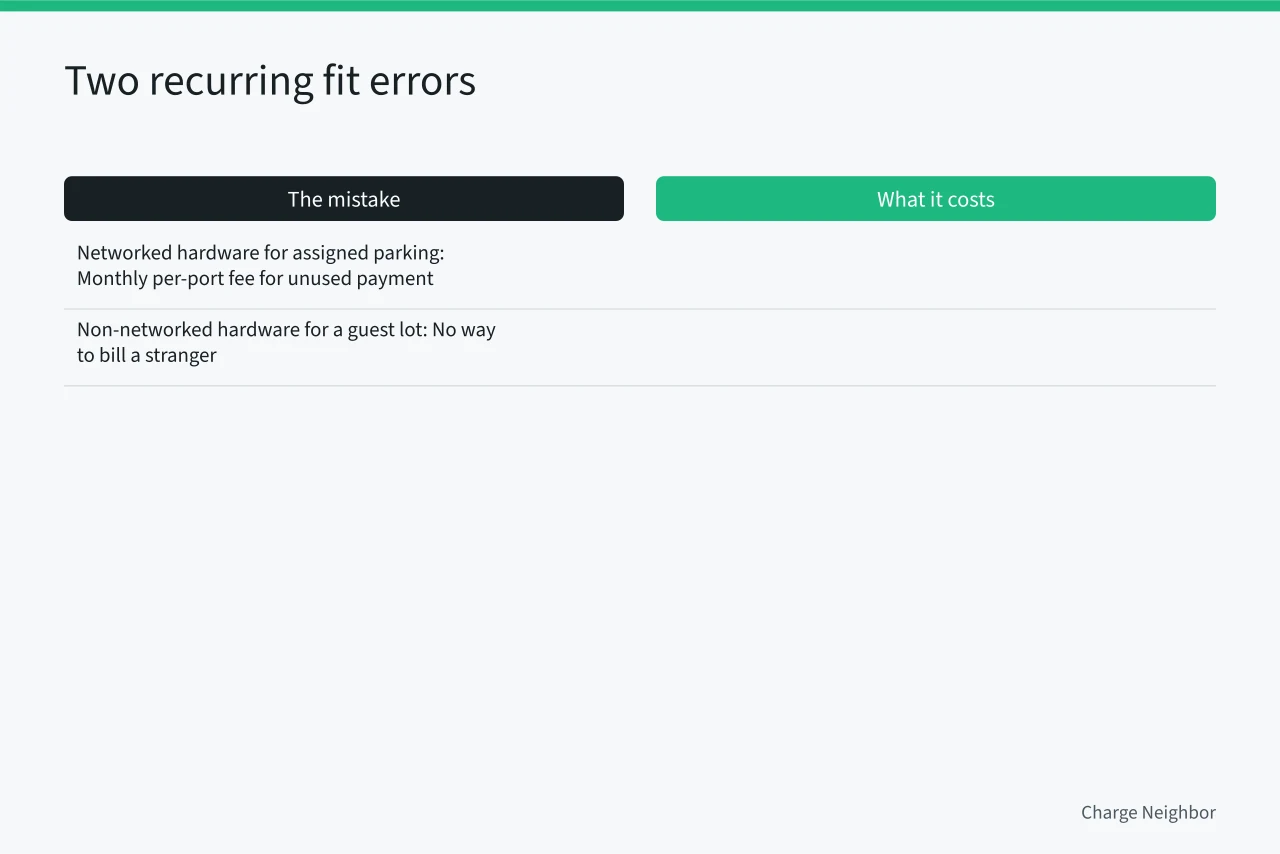
Both are fit errors, not product errors, and both are avoidable at the bid stage. The mistakes boards make here covers the rest of them.
Level the bids on the same scope before comparing totals. A make-ready bid that stops at the panel and a turnkey bid that includes the trench, the permit and the commissioning are not the same number, and the difference is usually larger than the spread between vendors.
What the owner is choosing, and why it is not yours
An owner installing in their own garage is buying on their own criteria: charge speed, cord length, whether it works with their vehicle, and what their electrician stocks. Energy Star's guidance on making a home electric ready walks through the service check that comes first.
An empty slot in a panel is not spare capacity. Older services often cannot take a Level 2 circuit without work, and that conversation belongs to the owner, a licensed electrician and the utility. The board cannot adjudicate it, and the contractor is working for the owner throughout it.
Several states limit what an association may prohibit here. The federal summary of charger policies for homeowners' associations shows the pattern, and your own governing documents and a qualified attorney settle the rest.
If the association is buying
Amenity charging makes the association a charging operator. That brings capacity, access control, billing, maintenance, accessibility and liability. It starts with parking and panel capacity rather than hardware. The planning order for that project is the right first read.
Ask who would use it. In a community where every home has a garage, the honest answer is often guests plus the two households whose panel could not take a circuit. That can still justify the spend, but the projection should be realistic before the budget is approved.
Before any of it, decide how owner applications are stored. A completed application holds more personal detail than boards expect, and the storage decision is easier before the first one arrives than after.
For the amenity shortlist itself, what to compare between products narrows the field further.
Common questions
Can we require owners to use a specific charger brand?
For equipment inside their own garage, almost certainly not, and it serves no architectural purpose. For visible exterior equipment, an appearance standard is defensible. Check your governing documents and state law before adopting either.
An owner runs a cord across the sidewalk. What can we do?
That is a safety and common-area matter squarely within your authority. Address it as a nuisance, not as a charging dispute, and refer any electrical question to a licensed electrician.
Do we need to install amenity charging at all?
No. In a community of single-family homes with garages, demand is often low. Decide it on realistic usage, not on the assumption that every property needs one.
Who decides whether a networked or non-networked charger goes in?
Whoever pays for the electricity. An owner's meter points to a consumer unit; an association meter on assigned parking points to a non-networked commercial unit billed through dues. A shared guest lot points to networked hardware with payment built in.
In this guide
- A practical maintenance plan for HOA charging solutionsA maintenance plan for HOA charging solutions starts with who owns what, then sets the checks, records and reserve lines the association actually controls.
- HOA charging solutions products worth comparing in 2027HOA charging solutions products worth comparing in 2027, from shared pedestals to garage units, with what each option does and who it suits.
- HOA charging solutions mistakes that lead to extra costsThe HOA charging mistakes that end in legal fees: voided prohibitions, rules written after one owner applies, and amenity ports nobody uses.