Reviews
Part of HOA charging solutions compared for value, upkeep and fit
HOA charging solutions products worth comparing in 2027
HOA charging solutions products worth comparing in 2027, from shared pedestals to garage units, with what each option does and who it suits.
What to take away
- The association's real buying decision is amenity ports, not what an owner installs in a private garage.
- Wallbox Pulsar Plus, Enel X JuiceBox, ChargePoint Home Flex and Grizzl-E suit owner garages; they are listed and widely installed.
- For shared clubhouse bays, compare ChargePoint CP6000, Blink Series 8, Enel X JuicePedestal and SemaConnect Series 6 on access control and offline behavior.
- Require a listing mark from a nationally recognized testing laboratory on every unit, owner or association.
- Check rebate conditions before the board picks a product, because eligibility often names the equipment.
- Budget typical U.S. ranges: owner units list around $400 to $800 before installation; shared networked ports often run $3,000 to $8,000 each plus install and monthly network fees.
HOA charging solutions products worth comparing in 2027 split into two buying decisions, and boards merge them.
One is what an owner bolts to a garage wall. The other is what the association buys for the clubhouse lot. The second is a full procurement, and it is where the title's products live.
What an owner can install
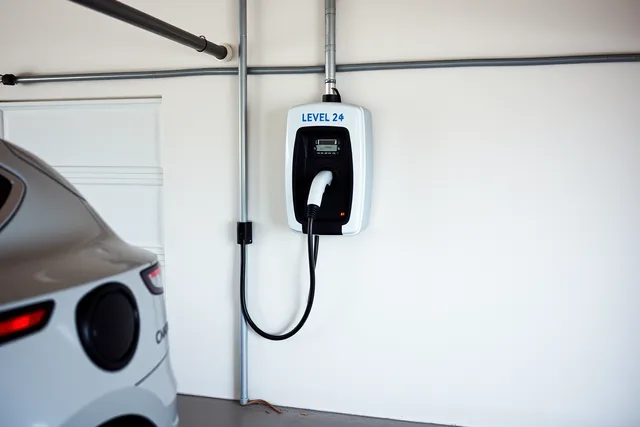
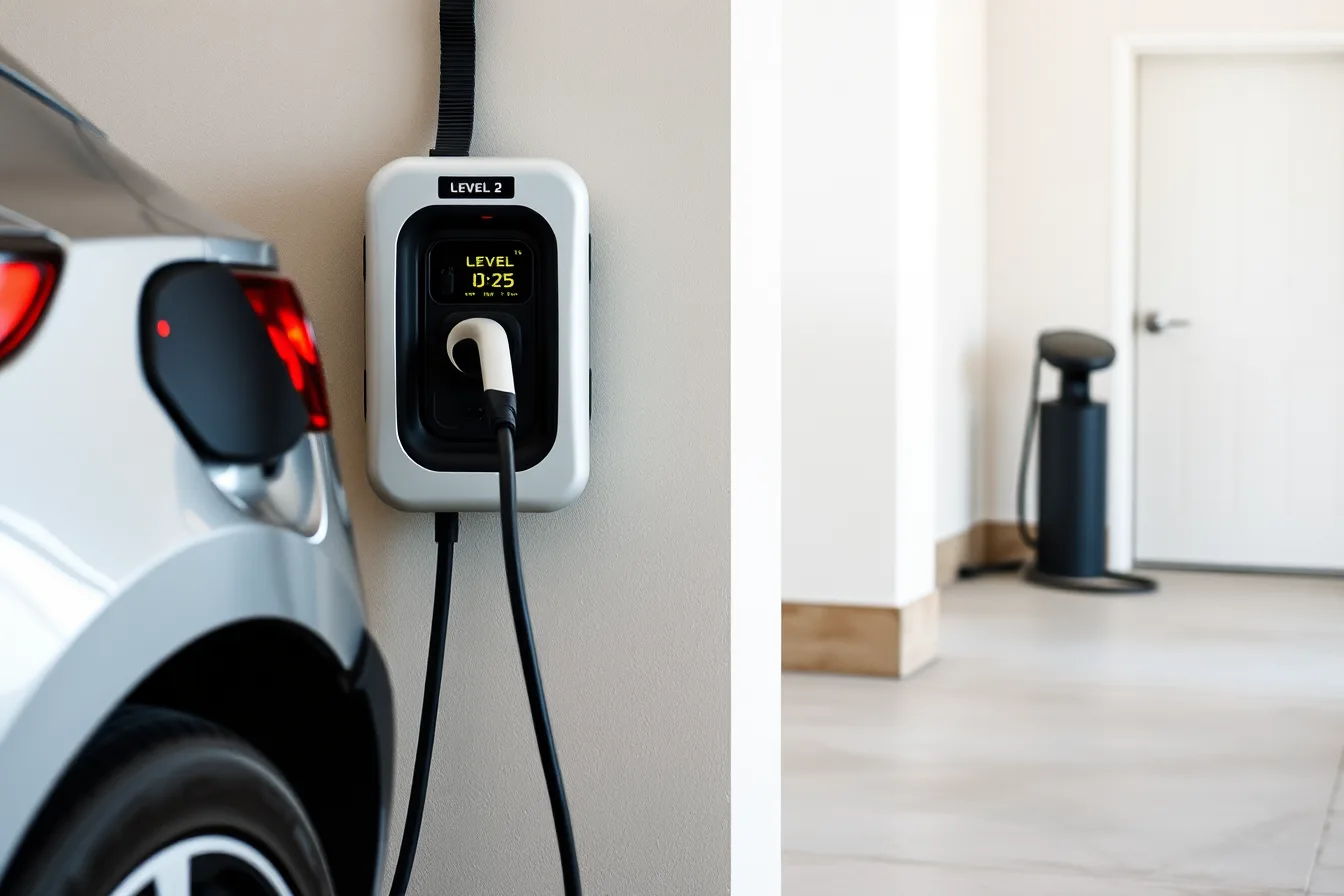
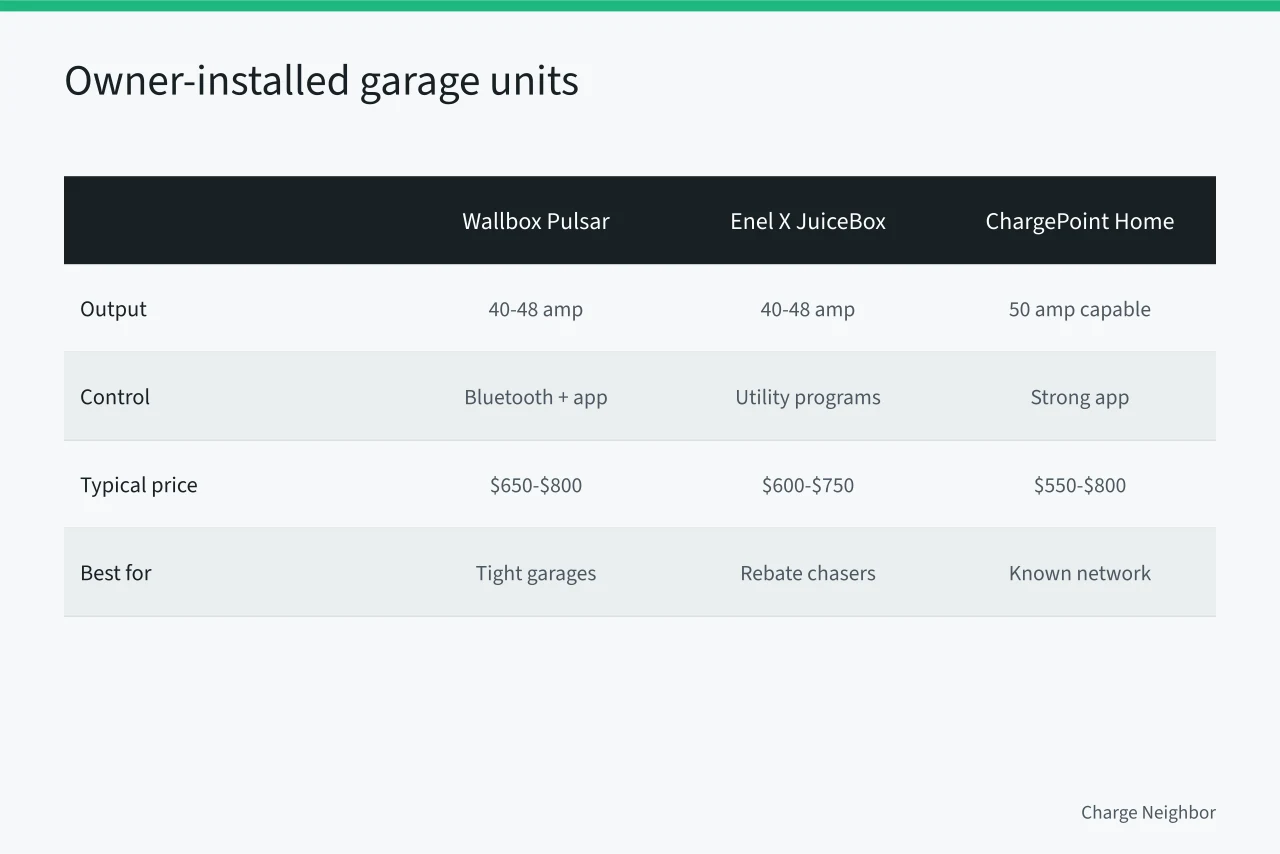
Four units show up again and again in attached garages, and all four carry a listing mark.
| Product | What it is | Who it suits |
|---|---|---|
| Wallbox Pulsar Plus | Compact 40 to 48 amp unit, hardwired or plugged, Bluetooth and app control; typically $650 to $800 | Tight garages, one car, owner pays |
| Enel X JuiceBox | 40 to 48 amp unit with a long history in utility rebate programs; typically $600 to $750 | Owners chasing a utility incentive |
| ChargePoint Home Flex | 50 amp capable, adjustable amperage, strong app and support; typically $550 to $800 | Owners who want a known network behind the box |
| Grizzl-E | Simple, rugged, no app required, popular in cold climates; typically $400 to $500 | Owners who want a dumb, durable box |
The board's legitimate interest here is narrow: listed equipment, a licensed electrician, a permit, and an outdoor rating if the unit sits outside. Brand, model, output and circuit design belong to the owner and their electrician. Requiring them invites a challenge the association loses.
Product listing and building standards for this equipment are documented in the record of charger building standards, which gives a board the vocabulary to ask precisely.
Installed cost for an owner unit often lands between $1,200 and $2,500, depending on panel capacity, conduit run and permit fees. That range excludes the charger itself.
What the association buys for shared bays
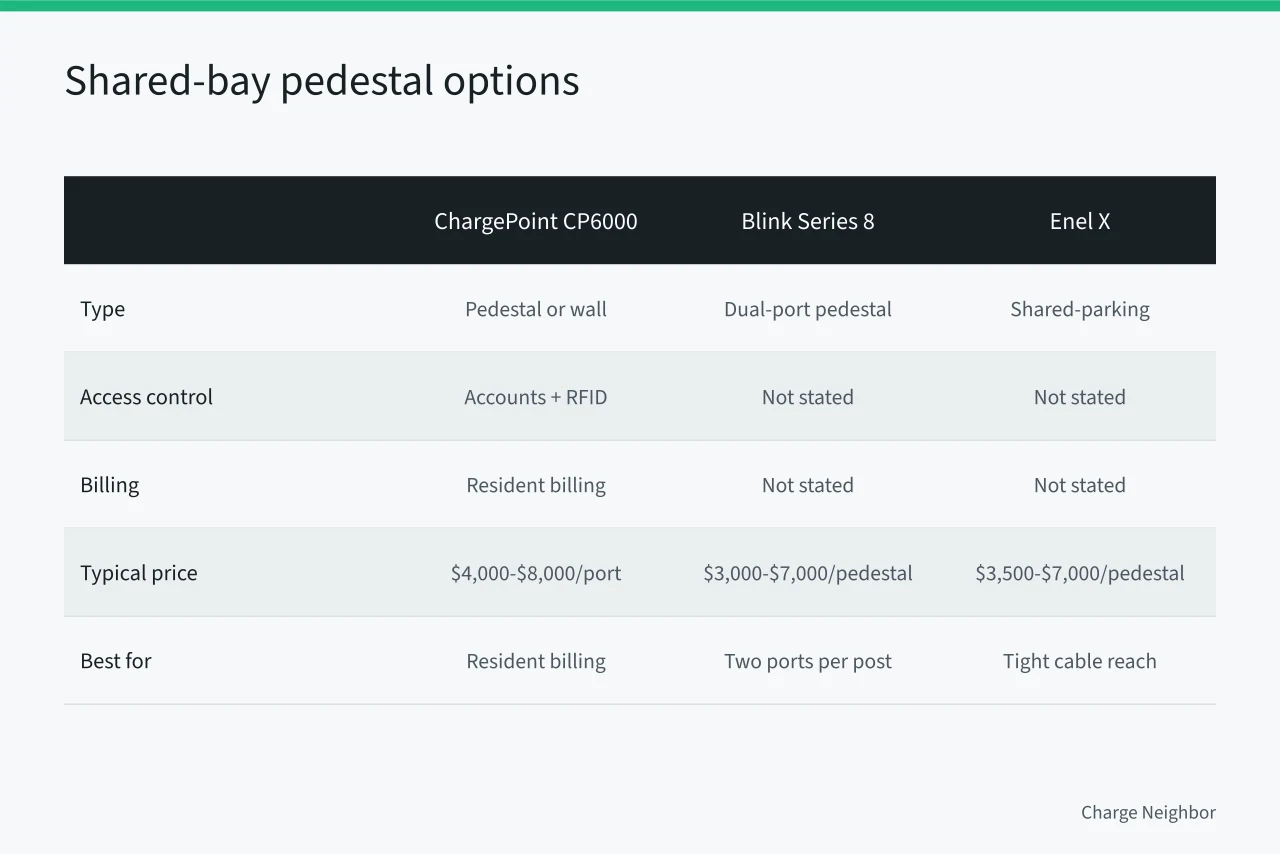
This is the comparison the title promises. Four networked pedestals and wall units cover most clubhouse and guest-parking projects.
| Product | What it is | Who it suits |
|---|---|---|
| ChargePoint CP6000 | Commercial AC pedestal or wall unit, OCPP-capable, strong access control and reporting; typically $4,000 to $8,000 per port | Associations that want resident billing and detailed usage data |
| Blink Series 8 | Commercial pedestal, dual-port options, common in multifamily deployments; typically $3,000 to $7,000 per pedestal | Sites needing two ports on one pedestal |
| Enel X JuicePedestal | Pedestal built for shared parking, pairs with JuiceBox internals; typically $3,500 to $7,000 per pedestal | Lots where cable reach and mounting are the constraint |
| SemaConnect Series 6 | Commercial pedestal and wall unit, OCPP-capable, broad installer network; typically $3,000 to $6,000 per port | Associations comparing multiple bids on similar hardware |
Compare them on the same criteria, not on the spec sheet headline. Start with the guaranteed minimum per car rather than the headline output.
| Product | Access control | Billing | Offline behavior to confirm | Typical price as of 2026 |
|---|---|---|---|---|
| ChargePoint CP6000 | Resident accounts and RFID | Resident billing and reporting | Local fallback when the network drops | $4,000 to $8,000 per port |
| Blink Series 8 | Blink accounts and RFID | Blink network billing | Dual-port load sharing when offline | $3,000 to $7,000 per pedestal |
| Enel X JuicePedestal | JuiceNet accounts and RFID | JuiceNet billing | Cable reach and pedestal mounting | $3,500 to $7,000 per pedestal |
| SemaConnect Series 6 | SemaConnect accounts and RFID | SemaConnect billing | OCPP mode and local fallback | $3,000 to $6,000 per port |
| Criterion | Why it matters at a clubhouse |
|---|---|
| Access control | Residents only, or guests too, and how that is enforced |
| Billing capability | Whether you can charge, and whether it is worth the fees |
| Offline behavior | Clubhouse connectivity is often worse than expected |
| Cable replaceable on site | Your most likely failure, in an unattended location |
| Enclosure and vandal resistance | Unattended parking, often unlit at night |
| Parts availability after discontinuation | Whether year eight is a repair or a replacement |
| Support hours | Nobody is on site to help a resident at 9pm |
| Typical network fee | Often $10 to $30 per port per month, plus transaction fees |
One question boards forget: what happens when nobody uses it? An amenity port with two sessions a month still pays its subscription monthly. An unnetworked unit absorbs electricity instead of running a billing system for pennies. One documented multifamily owner did exactly that and reported no equipment problems in five years.
Appearance rules for exterior equipment
Appearance is what architectural standards exist for, so this is solid ground.
Reasonable requirements: mounting location relative to street view, color or finish of visible equipment, and how exterior conduit is run and finished. Whether a pedestal is permitted on a driveway, and cable storage so nothing lies across a walkway.
Write it as a standard rather than a per-application judgment. "Equipment shall not be mounted on a street-facing elevation" is enforceable. "Equipment shall be tasteful" is not.
Where equipment serves common parking, accessibility enters the review. The U.S. Access Board's design recommendations for accessible charging stations define what an association-owned bay is measured against. They target shared installations, not a private driveway. Accessibility is one of several authorities bearing on the same bay, and none of them checks the others.
Rebates can decide the product
Rebate programs sometimes require specific equipment features, and that requirement can be worth more than the feature. Programs offering rebates on vehicles and chargers frequently condition the money on listed equipment, particular installers or specified capabilities.
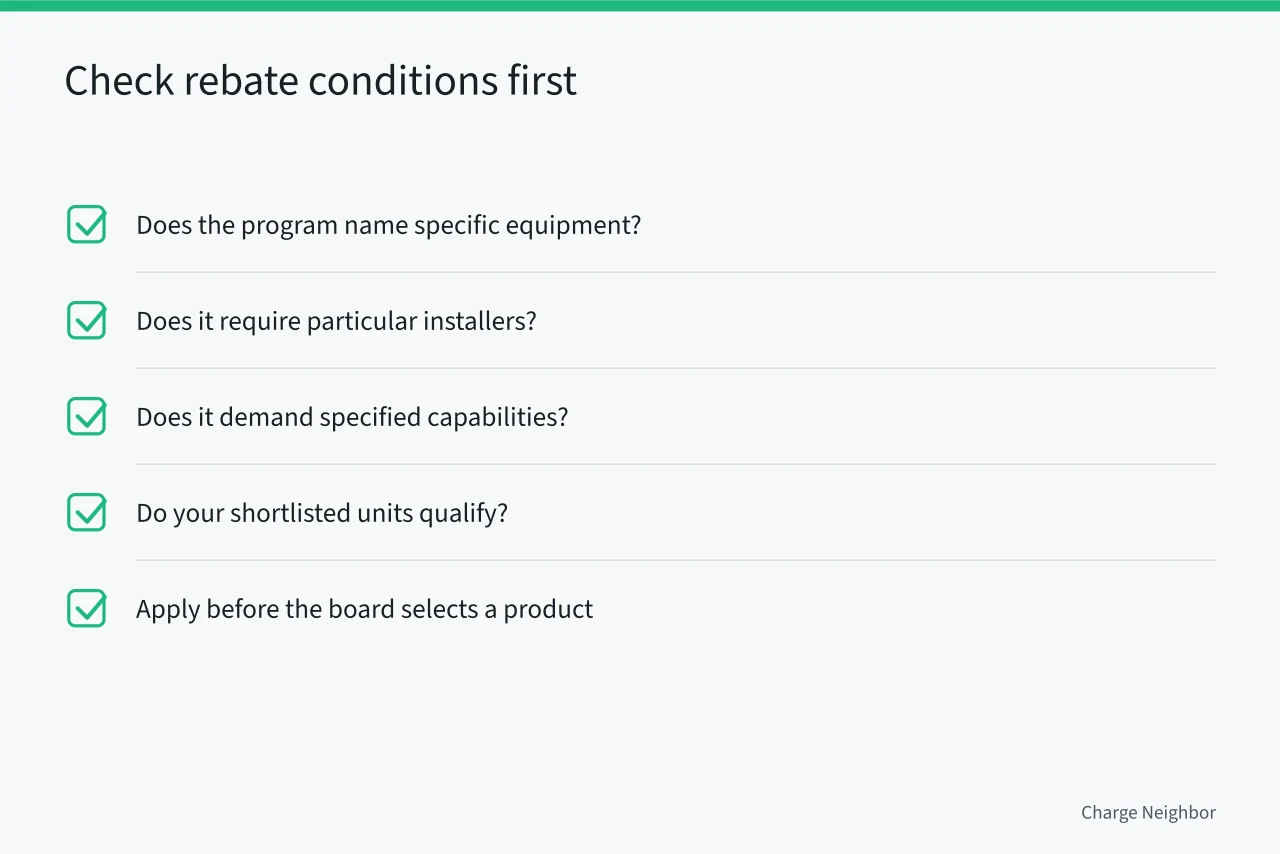
Check the conditions before the board selects a product. Choosing first and applying afterwards is how associations discover the unit they bought does not qualify.
Ask whether the program names ChargePoint CP6000, Blink Series 8, Enel X JuicePedestal or SemaConnect Series 6, and whether the owner units on your shortlist qualify.
The one-page rule
For owner equipment, require listing, licensing, permit and appearance compliance. Nothing else.
For association equipment, run the full comparison and remember you will be operating it for a decade.
That distinction is the whole of this article, and getting it right prevents most of the friction described in the mistakes boards make here. Where the boundary sits is covered in the comparison of HOA charging situations.
Common questions
Can we require all owners to use the same brand?
For equipment inside their own garages, no defensible basis exists. For visible exterior equipment you can standardize appearance, which is not the same as mandating a brand. Take any covenant question to the association's governing documents and a qualified attorney.
Should the association buy chargers for the clubhouse?
Only after asking who would use them. In a community where every home has a garage, demand is often minimal, and an unnetworked unit may be the better buy. Confirm the answer with the board before committing to a networked contract.
What does "listed" actually mean?
That a recognized testing laboratory has evaluated the product against a safety standard. Ask for the listing mark and the standard. Any legitimate supplier can give that in one line.
Which of these products should we shortlist first?
Start with ChargePoint CP6000 and SemaConnect Series 6 if you plan to bill residents, since both support access control and reporting. Look at Blink Series 8 or Enel X JuicePedestal if dual ports or cable reach drive the layout. Confirm current pricing and OCPP terms with each vendor, and check rebate eligibility before signing.