Rules
Part of A plain-English look at how EV charger installation works
How building rules can affect EV charger installation
How building rules can affect EV charger installation: codes now write charging into new construction and renovation. What that means for your project.
What to take away
- Building codes now specify charging provision in new construction, and increasingly in major renovation.
- "EV capable," "EV ready" and "EV installed" mean different things and cost very different amounts.
- Triggering a renovation threshold can pull requirements into a project that did not plan for them.
- An existing building with no work planned is usually governed by permit rules, not by these provisions.
Charging used to sit outside building codes entirely. Somebody wanted a charger, an electrician pulled a permit, and that was the whole regulatory story.
That has changed. Codes now specify how much charging provision new buildings must include, and the requirements are written in a vocabulary worth learning before you meet it in a plan review.
The three terms that decide the cost
They sound similar and they are not.
EV Capable vs Ready vs Installed
EV capable
- What's in place
- Capacity and raceway
- Wire run
- No
- Charger present
- No
- Relative cost
- Cheapest
EV ready
- What's in place
- Circuit terminated
- Wire run
- Yes
- Charger present
- No
- Relative cost
- More expensive
EV installed
- What's in place
- Charger mounted
- Wire run
- Yes
- Charger present
- Yes
- Relative cost
- Highest
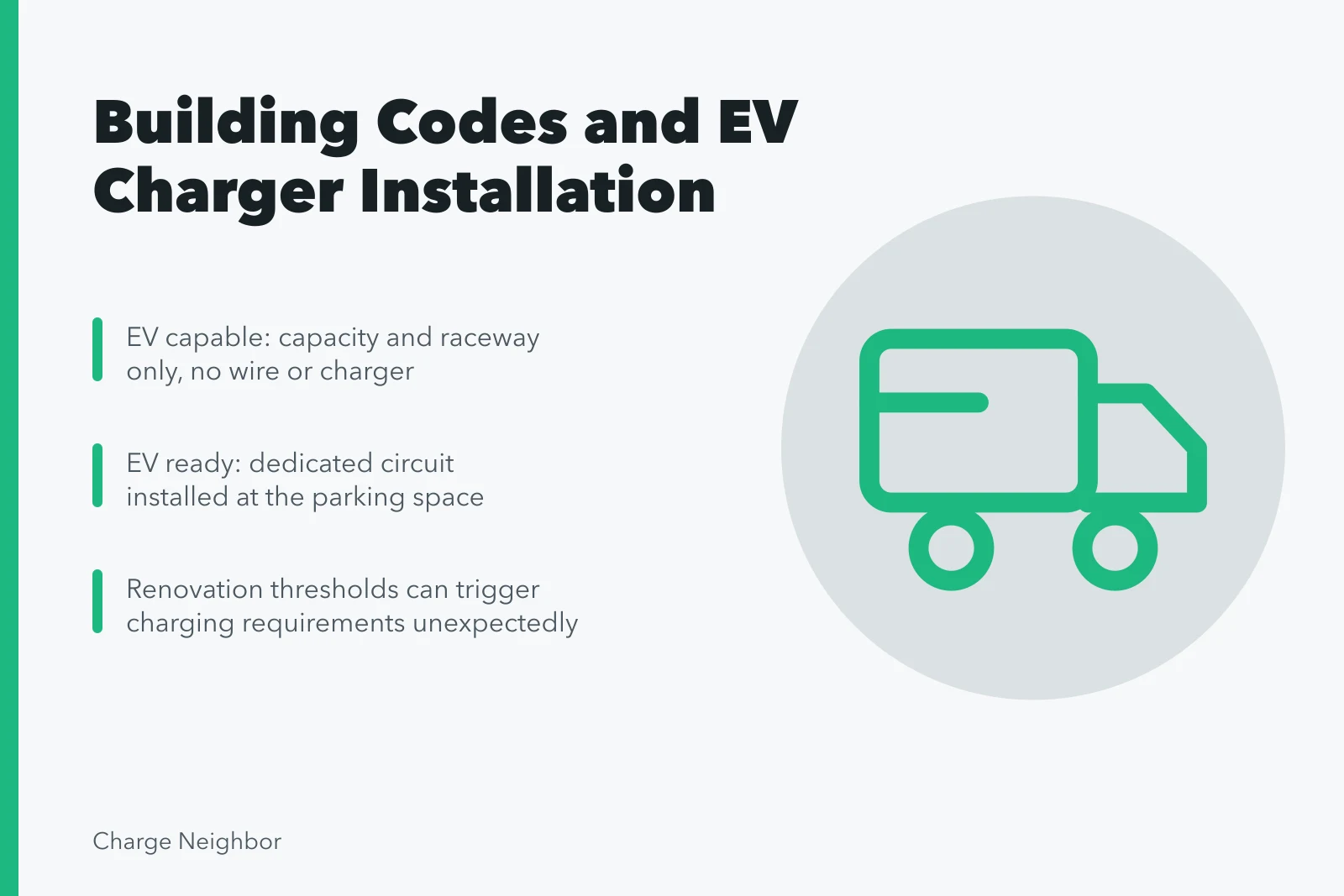
EV capable usually means the electrical capacity and raceway are in place so a circuit could be run later. No wire, no charger. Cheapest, and several shared layouts are built around exactly that idea.
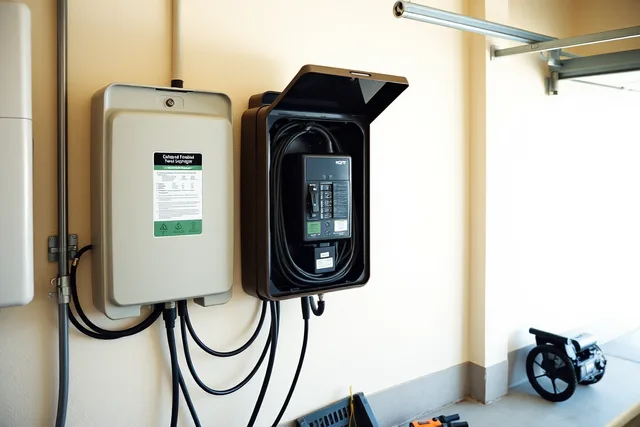
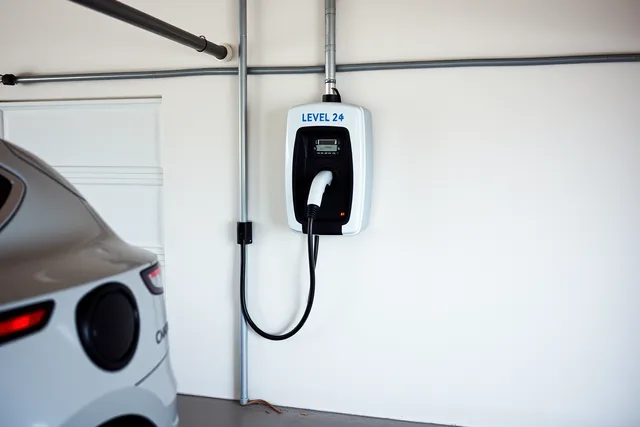
EV ready usually means a dedicated circuit is actually installed and terminated at the parking space, waiting for a unit to be mounted. More expensive.
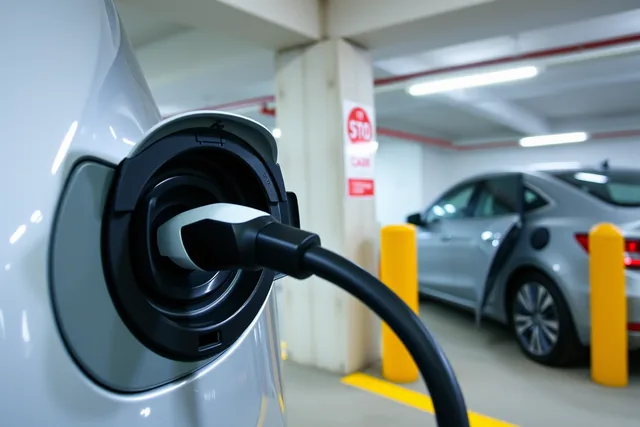
EV installed means the charger is there and working.
Codes typically require a mix: a percentage of spaces installed, a larger percentage ready, a larger percentage still capable. Getting the definitions wrong when reading a requirement means budgeting for the wrong thing by a wide margin.
A typical split in adopted code language runs about 20 percent of spaces EV capable, 5 percent EV ready and 1 percent EV installed. The adopted section governs, so read it rather than the summary.
Definitions do vary between jurisdictions, so read the one your code uses rather than assuming the general meaning.
What the code bodies have actually written
Model code work has formalized these provisions rather than leaving them to individual cities. The 2021 International Building Code added Section 429, Electric Vehicle Charging Infrastructure, for new buildings with parking in the occupancies it lists. The 2021 International Energy Conservation Code carries a parallel EV provision in its commercial chapter.
The ICC's building code amendments for electric vehicle charging set out the structure jurisdictions copy: which occupancies are covered, what share of spaces must be capable, ready or installed, and how each is defined.
Adoption is state by state and moves on different timetables. California writes its own rules. Its energy code, Title 24 Part 6, requires a dedicated 240 volt circuit for EV charging at new single family homes. CALGreen, Title 24 Part 11, sets EV capable and EV ready percentages for new multifamily parking.
Your jurisdiction may have adopted this, amended it, or written its own. The structure is still worth understanding, because it tells you what questions to ask your building department.
New construction is where the requirements bite
If you are building, the requirements are unavoidable and generally sensible: running conduit and capacity while the slab is open costs a fraction of adding it afterwards.
Many states now set explicit minimums. The federal record of new construction charging requirements documents the kind of provision being adopted, typically expressed as a percentage of parking spaces in a given category of building.
The practical consequence for a developer is that these numbers belong in the electrical design from the start. A percentage of spaces requiring dedicated circuits changes panel sizing, service size and sometimes the transformer, and discovering that at plan check is a redesign. Treating plan check as a gate rather than a formality is what prevents it.
Renovation is where people get caught
Requirements increasingly attach to major renovation, not only to new buildings, and major is a threshold. Common definitions use a share of floor area, often around 50 percent, a value of work set against the building's value, or a replacement or upgrade of the electrical service.
The trigger is set locally, so ask the building department early whether your scope crosses it. That question is cheap before design and expensive after.
What applies to an existing building doing nothing
If you are not building or substantially renovating, these provisions generally do not reach you. Adding one charger to an existing garage is governed by the electrical permit process, not by the new construction percentages.
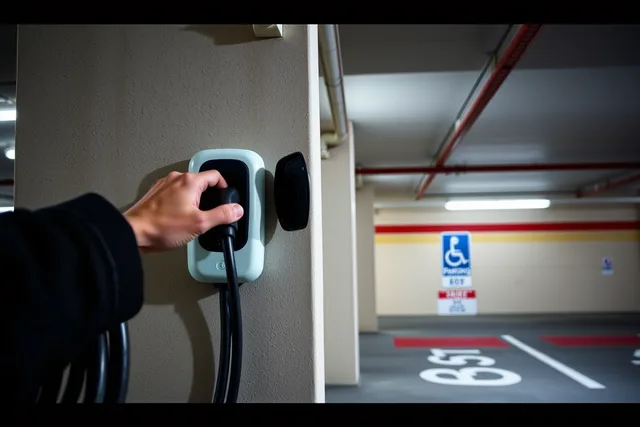
What can still apply: accessibility requirements where you create or alter parking, and local parking ordinances about signage and space designation. A state provision on charging in residential buildings may also apply, which in a condominium interacts with your own governing documents and can be overridden by neither.
The order to ask in
- Am I building new, renovating substantially, or altering nothing structural?
- If renovating, does my scope cross the threshold?
- What percentages and definitions has my jurisdiction adopted?
- Does the requirement count capable, ready or installed spaces?
- What does the building department want to see on the drawings?
Get those answers before design rather than at plan check.
Questions to ask before design
- New build, substantial renovation, or nothing structural?
- If renovating, does scope cross the threshold?
- What percentages and definitions has your jurisdiction adopted?
- Does the requirement count capable, ready or installed?
- What does the building department want on the drawings?
The installation process itself explains what happens once the rules are settled, and the checklist for choosing an installer covers who should be answering these questions for you.
Who enforces this
The building department is usually the authority having jurisdiction for permits and inspection. The AHJ is whatever office your jurisdiction designates: a city building department, a county, or a state agency for some occupancies. What it enforces is the code edition the state or city adopted, not the model code itself.
The plan checker reads your drawings against the adopted edition, and that is where percentages and definitions get tested. A concrete example of a plan-check question: which edition of the code has this jurisdiction adopted, and what percentage of parking spaces must be EV capable here? The answer decides whether the drawings show conduit only, circuits, or chargers.