Rules
Part of HOA charging solutions compared for value, upkeep and fit
Where privacy concerns appear with HOA charging solutions
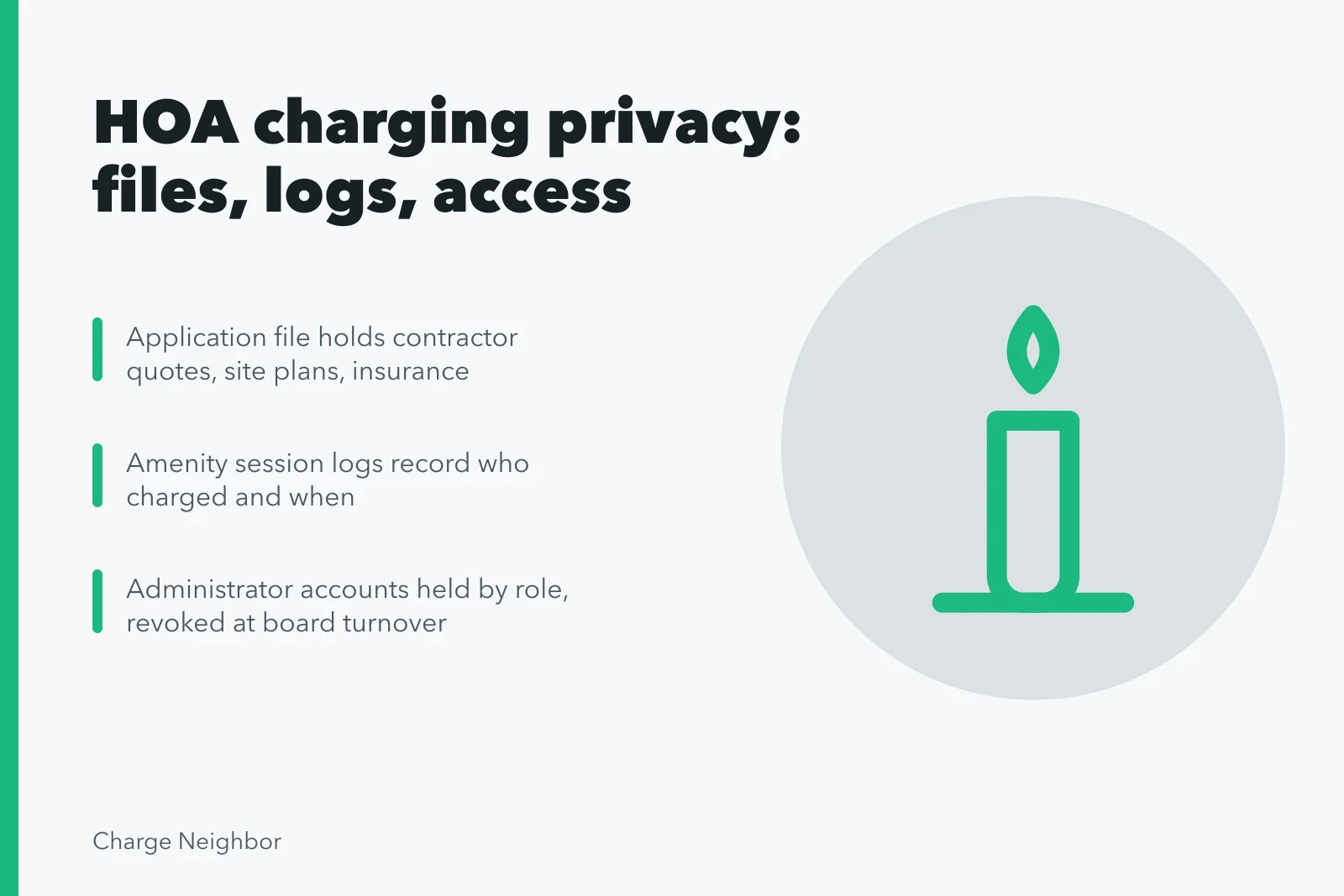
The HOA privacy exposure is the application file and the amenity session log, both held by neighbors who serve on the board and then step away.
What to take away
- The application file is the overlooked exposure. It can contain contractor quotes, plans and insurance details about an owner's home.
- Amenity session logs show who was at the clubhouse and when. Decide who may see them before anyone asks.
- Board members are neighbors, and they leave. Access that is never revoked is the recurring failure here.
- Owner equipment on an owner's meter generates no data the association ever sees, which is a reason to keep it that way.
Privacy in a planned community has a particular character. The people holding the records are not employees of a management company in another city. They are neighbors, they serve for a couple of years, and then they stop being on the board without anybody changing a password.
That is the risk worth designing around.
The file nobody thinks of
What the application file holds
- Site plan of the owner's property
- Contractor's quote showing what they paid
- Insurance certificate with policy details
- Correspondence about electrical service
- Keep approvals permanently; redact pricing before archiving
None of that is charging data, and all of it is personal information about a household, sitting in a folder that circulates among volunteers.
Decide who holds these files, in what form, for how long, and who gets them at turnover. Keeping approvals permanently makes sense, since they establish what was permitted. Keeping the contractor's pricing for a decade does not, and redacting it before the file is archived costs nothing.
Amenity charging creates a movement record
If the association installs ports at the clubhouse, and those ports are networked, the system records who charged and when.
In a shared garage, it would record when residents are home. At a clubhouse, it is a record of who was at the amenity and at what hour. That raises the same concern in a slightly different shape.
In a shared garage the exposure is sharper, because a session log there is close to a record of when people are home.
The questions are the same as any shared installation. Who holds an administrator login? Does the board see individual sessions or only totals? Is there an audit trail of who looked at what? Can residents see their own records?
The Department of Energy's multifamily charging guide is a useful reference for how these operational and data questions are usually handled. The answers translate directly to an association-run amenity.
The reasonable default is aggregate figures for the board, individual detail only with a stated reason.
Revoke access when boards change
This is where associations differ from any professionally managed property, and it is the failure that actually happens.
Offboarding administrator accounts
- Treasurer sets up the charging account
- Two years later they leave the board
- Nobody removes their login
- Write ruleaccounts held by role, not person
- Handover checklist covers credentials at every transition
A treasurer sets up the charging account. Two years later they are no longer on the board, and nobody removes their login. There is no offboarding process because there is no HR department.
Fix it with a written rule: administrator accounts are held by role, not by person, and the handover checklist at every board transition includes charging system credentials, along with the gate system, the pool fobs and everything else. It sits naturally with the rest of the file a new board inherits.
Gates, cameras and the surveillance question
Many communities already have gate access logs and camera coverage of common parking. Add charging session data and the association is holding several overlapping records of resident movement.
That combination deserves a deliberate decision, not default accumulation. Write down what each system records, how long it is kept, who may access it, and the circumstances for combining records.
The last point matters most: cross-referencing gate logs with charging sessions to profile one household differs from running either system.
The privacy argument for leaving owners alone
There is a practical conclusion in all of this. Owner equipment, in an owner's garage, on the owner's meter, generates no data the association ever holds.
Every record the association does not create is a record it cannot mishandle, lose at turnover, or be asked to produce in a dispute.
The multifamily owner who chose unnetworked hardware got the same benefit without planning for it.
It is one more reason for a board to keep its involvement to appearance and common area rather than reaching further.
State provisions on what associations may require of owners are summarized in the record of charger policies for associations, and staying inside those limits generally keeps the association out of the data business as well.
What to write down
A short notice, given with the application pack and again at amenity sign-up, covers what is collected, who sees it, how long it is kept, and who it is shared with.
Residents learn how to request records or a correction.
Half a page is enough. It prevents the argument far more reliably than it satisfies any statute.
Where the association's authority actually ends is set out in the comparison of HOA charging situations, and the mistakes that produce disputes here are largely the same ones that produce privacy complaints.