Industry
Part of HOA charging solutions compared for value, upkeep and fit
How local installers work with HOA charging solutions
Electricians work for the owner in a planned community, not the board. What that means for approvals, common area and the association's role.
What to take away
- In a planned community the electrician is the owner's contractor, not the association's. That changes who can ask them for anything.
- The board's useful contribution is a clear standard, given to the owner up front, in writing.
- Where work touches common area, the association needs its own conditions and its own certificate of insurance.
- A recommended-contractor list helps owners and creates liability. Decide deliberately which side of that you want.
Most charging work in an HOA happens on private property, paid for by an owner, performed by a contractor the association never hired. Boards that forget this end up trying to direct someone who does not work for them.
The association's influence is exercised through the approval, not through the contractor.
Who is actually working for whom
The electrician answers to the owner. They will size the circuit, check the panel, pull the permit and satisfy the inspector, and none of that involves the board.
Owner's electrician vs. board
Owner's electrician
- Sizing circuit
- Does it
- Checking panel
- Does it
- Pulling permit
- Does it
- Satisfying inspector
- Does it
- Issuing standard
- Receives it
Board
- Sizing circuit
- No role
- Checking panel
- No role
- Pulling permit
- No role
- Satisfying inspector
- No role
- Issuing standard
- Issues it
What the board can do is make sure the owner hands the contractor a clear standard before work is quoted. A contractor who learns at rough-in that exterior conduit must be painted, or that the unit cannot go on the street elevation, will charge to change it. The same information provided with the quote costs nothing.
So the single most useful thing an association can do is issue its architectural standard at application, in writing, in a form an owner can forward to a contractor without interpretation.
What a competent residential installer will do
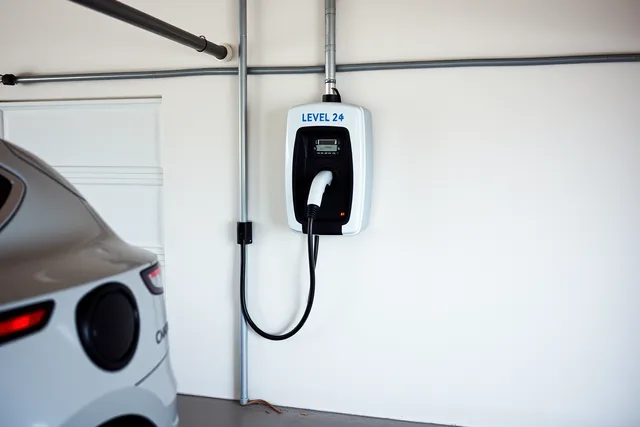
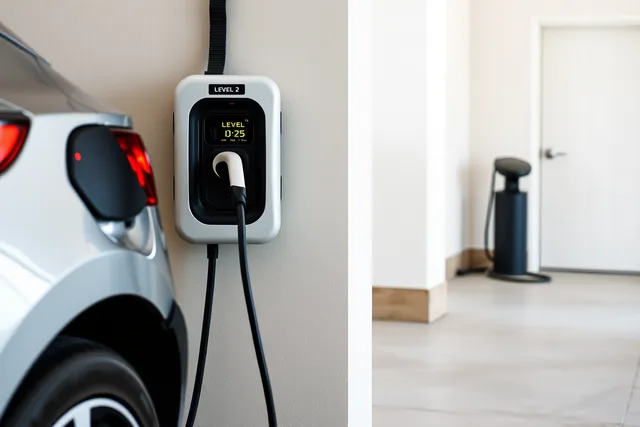
For a typical garage installation the work is well understood.
What a competent installer does
- Check what the panel can genuinely support
- Size for a continuous load
- Pull the permit
- Arrange inspection
- Advise owner to contact utility
They will check what the panel can genuinely support, not by counting empty slots. Older services can be tight once existing loads are counted.
Energy Star's guidance on building electric vehicle ready homes explains what readiness means in a house. That is useful background for a board that wants to know what owners are told.
They will size for a continuous load under whichever code edition the jurisdiction enforces, pull the permit, and arrange inspection. In some cases they will advise the owner to contact the utility, particularly where a service upgrade is in question.
Where the association does get involved
Anything crossing, attached to or drawing from common area. That is a different conversation and the association should run it properly.
Conditions worth attaching to any approval touching common property:
Conditions for common-area approval
- Licensed contractor, named, with current insurance
- Certificate of insurance naming the association
- Permit and inspection sign-off provided
- Defined reinstatement standard for disturbed surfaces
- Responsibility for future repair stated explicitly
- No cable or cord crosses a walkway
Get these into the approval rather than into a general policy. An approval with conditions attached to a specific plan is far easier to enforce than a policy nobody signed. Decide at the same time how long that file is kept and who reads it, because it now holds an owner insurance policy and a contractor quote.
State provisions increasingly address exactly this boundary, setting out what an association may require of an owner installing at their own expense. The federal summary of charger policies for condominiums and residential associations shows the typical shape: reasonable conditions permitted, blanket prohibition often not.
The recommended-contractor question
Some boards keep a list of electricians who have worked in the community and know the standard. It genuinely helps owners, particularly in communities where several homes install in the same year.
It also creates an implication of endorsement. If a listed contractor does poor work, the association will hear about it.
If you keep a list, say plainly what it is: contractors who have previously worked here and are familiar with the architectural standard, not a recommendation, with no responsibility accepted for their work. Keep at least three names so it does not look like a referral arrangement.
For amenity installations, you are the client
If the association is building at the clubhouse, everything changes. Now you hire the contractor, you sign the contract, you own the result.
Owner install vs. amenity install
Owner install
- Who hires
- Owner
- Who signs
- Owner
- Who owns result
- Owner
- Quotes needed
- One
- Retention
- Not applicable
Amenity install
- Who hires
- Association
- Who signs
- Association
- Who owns result
- Association
- Quotes needed
- Multiple
- Retention
- Held to commissioning
That is a procurement. It deserves multiple quotes, a written scope, a responsibility table, and retention held until commissioning.
The written questions that go to every bidder are the same ones any building would send. Here the board should stop thinking of this as an HOA matter and start treating it as a small commercial installation.
What the association controls in each case is set out in the comparison of HOA charging situations, and the ongoing obligations that follow are covered in the maintenance plan.