Guides
Condo EV charger application: a request form and decision record for the board
Create a condo EV charger application with clear property facts, evidence requests, review routes, careful decisions, and a complete record.
A condo EV charger application should make the request and the review path clear before anyone promises an installation result. The application gathers facts about the proposed location, property impact, available documents, and requested action. It should not make a resident decide legal ownership, electrical capacity, permit status, insurance coverage, or construction feasibility.
The association's job is to preserve the facts, identify current sources, route questions to the right reviewer, and issue a dated decision that says exactly what it does and does not authorize. This guide is a planning framework for U.S. condominiums. It is not legal, electrical, insurance, construction, utility, accessibility, tax, or permitting advice.
What to take away
- Record the request and property facts before asking for conditions.
- Use a separate review path for an individual installation, common-area work, and shared service.
- Identify open questions and their assigned reviewer instead of filling gaps with generic policy language.
- Keep the application, source records, decision, and resident notice together.
Start with a factual request page
The first page should describe what the applicant wants, not the association's expected outcome, and record the unit, applicant, parking location, proposed equipment or service if known, and requested action.
Intake facts to record
- Unit and applicant identity
- Parking location identified
- Proposed equipment or service
- Requested action stated
- Source label for each fact
Record visible property work and proposed power source if the applicant has that information. Attach a site photo, sketch, parking assignment, or equipment information if it helps identify the request.
Keep facts and conclusions separate. A resident can identify a parking space or describe a proposed charger. A current declaration, site record, qualified reviewer, local authority, insurer, utility, or board action may be needed to determine whether a particular condition applies. Label the source of every material fact: resident statement, association record, site drawing, vendor material, or pending confirmation.
Factual request page
| Application field | What it captures | What it should not decide |
|---|---|---|
| Requested action | Install, study, use, relocate, or remove what? | Final approval |
| Location | Unit, parking space, garage, or common area identified | Ownership or access rights |
| Proposed service | Equipment or provider information available now | Capacity, safety, or permit compliance |
| Property impact | Work or access described by the applicant | Governing-document interpretation |
| Documents received | Materials actually submitted | Whether the file is complete |
Avoid requiring a resident to certify technical matters they cannot establish. Instead, use a prompt such as "Describe the proposed work and attach available information." The later review can ask the appropriate person to assess electrical, structural, local, or insurance questions.
Sample form, one page
Copy this into a single page, add the association's name, and keep it with the evidence index.
Applicant entry
- Date submitted
- Unit and applicant
- Requested action
- Install, study, use, relocate, remove
- Parking location
- Space, garage bay, or common area
- Power source
- Existing outlet, new circuit, or unknown
- Property work
- Trenching, conduit, wall penetration, bollards
- Attachments
- Photo, sketch, parking record, vendor material
- Association use
- Date received, assigned reviewer, status
The form asks for facts. It has no line for a decision.
Classify the request before choosing the route
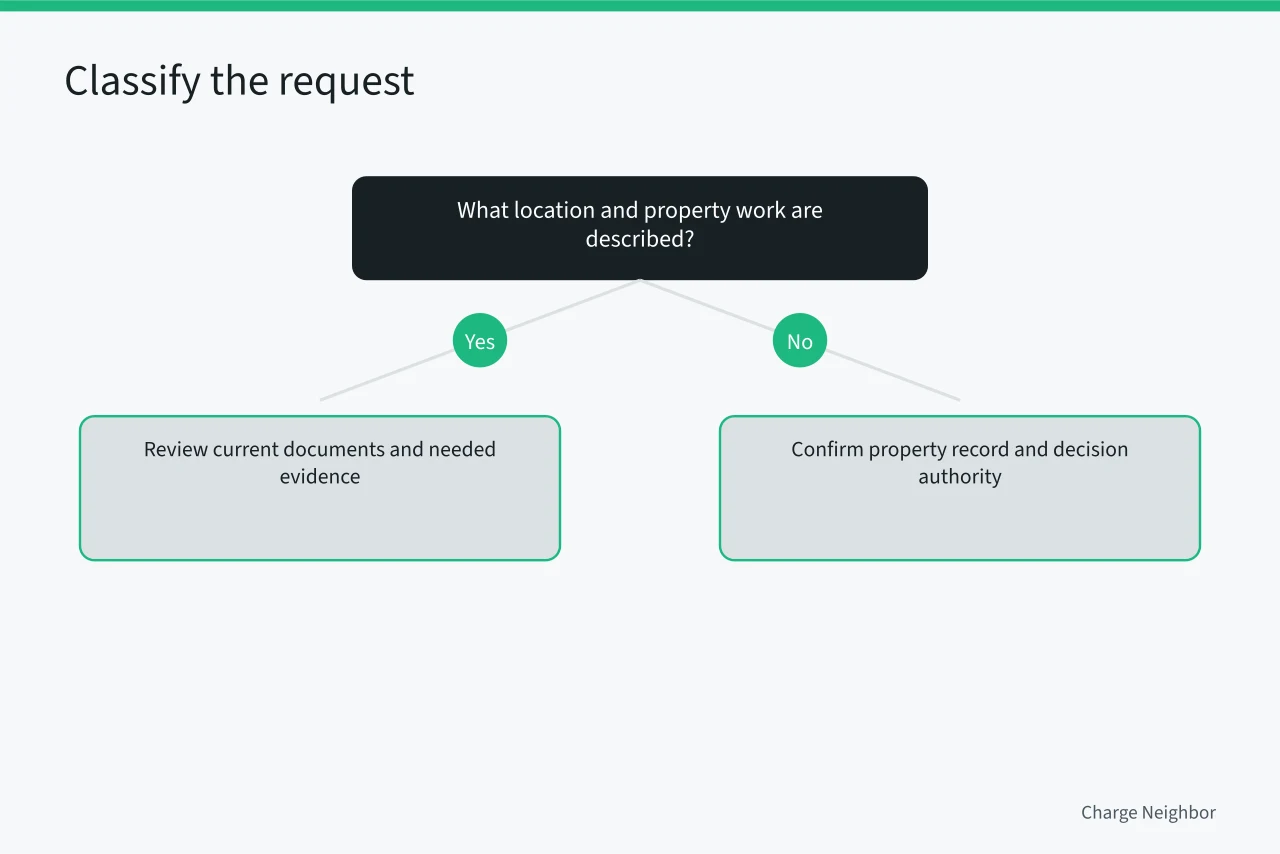
One form collects initial facts, but one decision track rarely fits every request. An equipment proposal in a unit or designated parking space may need its own application path. Crossing common infrastructure or changing common parking may need different association review.
A shared charger can require an owner, operator, account holder, and user rules. It may need a maintenance plan and future replacement path.
Use a plain classification note in the file:
Classify the request
| Request classification | First question | Next action |
|---|---|---|
| Individual proposal | What location and property work are described? | Review current documents and needed evidence |
| Common-area effect | What association property or service may be affected? | Confirm the property record and decision authority |
| Shared service proposal | Who would own, operate, and support the service? | Prepare a project brief before choosing a provider |
| Vendor-hosted proposal | What role would the association accept? | Review service responsibilities and site access |
| Site or parking project | Is charging one part of a larger change? | Use the project review process |
The note tells the association how to move from a general request to evidence-based review. A careful note can state that the file contains a proposed space and equipment concept, while property access, source documents, technical review, and outside approvals remain open.
Who pays for what
The application should ask who pays, but the intake page should not settle it. Cost turns on facts the applicant may not control: who owns the space, whether the work crosses common elements, and who holds the service account.
| Cost item | Usual payer | What decides it |
|---|---|---|
| Equipment and installation | The owner, for a single space | The declaration, the rules, and the terms the board sets |
| Panel or service upgrade | The owner, when the work serves one space | Load calculations a licensed electrician confirms |
| Work through common elements | The association or the owner under a license agreement | Ownership of the surface and any easement terms |
| Maintenance of owner equipment | The owner | The same terms, plus insurance requirements |
| Shared service | The association, the operator, or a cost share | The service agreement and the board vote |
Exact figures depend on region, panel capacity, and trench length, so ask for a written quote. Some declarations cap what an owner may be charged for shared service; if yours does, cite the section in the decision record.
Create a source and evidence index
Build a small index for the request. Include current governing documents, parking records, site plans, prior approvals, rules, architectural standards, provider material, insurer instructions, maintenance records, and any current local or utility sources that the association actually needs. List each item's date, version, storage location, owner, and relevance.
Source and evidence index
- Governing documents and parking records
- Site plans and prior approvals
- Rules and architectural standards
- Provider material and insurer instructions
- Maintenance records and utility sources
Not every useful document controls the decision. A vendor quote describes a proposal. A past board email may explain history. A parking map may identify a space. None of those documents automatically answers every question. The index helps reviewers see what authority is current and what still needs confirmation.
The evidence map matters because the association's statutory powers decide what it may grant. Before a board promises a space or a license over common elements, check which powers its state statute and governing documents give it over common elements, easements and licenses.
Legal touchpoints in the United States
Most states regulate condominiums and planned communities through a common-interest-community statute. The Uniform Common Interest Ownership Act is the model several states follow. California uses the Davis-Stirling Common Interest Development Act. Florida regulates condominiums under Chapter 718 of its statutes and homeowners' associations under Chapter 720. Texas regulates condominiums under its Uniform Condominium Act in Property Code Chapter 82.
California is one state with a direct EV charging rule for condos and HOAs: Civil Code 4745 limits an association's power to refuse an owner's charger request, and lets the association set reasonable conditions. This guide does not survey the rules of other states. Find the statute that governs your property, read its EV provision, and do not write a rule stricter than it allows.
The Fair Housing Act covers reasonable accommodation and reasonable modification requests, including requests tied to a disability. The Americans with Disabilities Act applies to places of public accommodation and to design and construction, which usually means commercial space and some public common areas rather than a private residential garage. Neither law settles who owns a charger.
Ask counsel which statute governs the property and whether an accessibility rule applies to the specific space.
Give the application a readable status
Status labels should report process, not imply a conclusion. "Received" means the association has the materials. "Incomplete" means named information is missing. "Under source review" means current records are being checked. "Qualified review requested" means a specific question was routed. "Decision recorded" means a dated association action exists.
Status labels and resident messages
Status
- Received
- Application received on date
- Incomplete
- File needs listed item
- Under source review
- Checking listed current records
- Qualified review requested
- Listed question needs review
- Decision recorded
- Action and scope in file
Good resident message
- Received
- Your charger is approved
- Incomplete
- You are ineligible
- Under source review
- Documents answer every question
- Qualified review requested
- Design or permit accepted
- Decision recorded
- All outside requirements satisfied
Avoid saying
- Received
- Incomplete
- Under source review
- Qualified review requested
- Decision recorded
Readable status
| Status | Good resident message | Avoid saying |
|---|---|---|
| Received | We received the application on the stated date. | Your charger is approved. |
| Incomplete | The file needs the listed item before review can continue. | You are ineligible. |
| Under source review | We are checking the listed current records. | The documents already answer every question. |
| Qualified review requested | The listed question needs an appropriate review. | A design or permit is accepted. |
| Decision recorded | The association action and stated scope are in the file. | All outside requirements are satisfied. |
A workable default for the sample form is 5 business days to acknowledge receipt and 30 calendar days to finish source review once the file is complete. The labels also create a better record if a future manager or board member needs to understand what happened.
Ask for evidence in stages
Request only the information needed for the current step. At intake, the association may need location, proposed action, available equipment information, and current parking facts. Once the route is known, it may identify a missing property record, request a project brief, or send a specialized question to a qualified reviewer.
Staged evidence requests
- Intakelocation, action, equipment, parking facts
- Route knownidentify missing property record
- Request project brief for shared service
- Send specialized question to qualified reviewer
Do not make the application an uncontrolled checklist. A long form can encourage reviewers to seek evidence that has no decision purpose. Every requested item should answer a stated question, such as where the work would occur, what property may be affected, or who must review a particular issue.
For a shared-service proposal, use a distinct project brief rather than treating the resident form as a completed business case. The brief can identify proposed users, owner, operator, account holder, support contact, expected property work, preliminary operations model, and unanswered questions.
The board can then authorize fact-finding, request professional input, seek proposals, consider a limited pilot, or decline the project.
A shared project may need an operating record apart from the resident application. That record does not establish what any condominium must approve.
Write a decision that a future reader can use
The final record should identify the request, location, sources reviewed, decision maker, date, action taken, stated conditions, issues outside the decision, and resident notice route. If the association authorizes a next review step, say that it has not authorized installation. If the association requests more information, name what is missing and why.
Decision record contents
- Request and location identified
- Sources reviewed listed
- Decision maker and date
- Action taken and conditions
- Issues outside decision
- Resident notice route
Avoid a sentence such as "approved subject to rules." It does not explain the scope, record, or next action. A stronger statement might say the association approved a limited feasibility review, did not determine permit or technical compliance, and will revisit the request after the listed source and qualified reviews are complete.
Worked example of a completed decision record (illustrative)
Decision record
- Request
- Unit 214 owner asks to install one Level 2 charger at space 37
- Sources reviewed
- 2019 declaration art. 8.3, parking map dated March 2024, rules rev. 2025
- Decision maker and date
- Board, 9 February 2027, motion 27-14
- Action
- Feasibility review authorized; the owner obtains the load study
- Conditions
- Written license required before work in common elements
- Outside the decision
- Permit, electrical code, and utility approval
- Notice
- Letter and email to the owner on 10 February 2027
Store the original application with the source index, messages, decision record, and later updates. Preserve older versions instead of overwriting them. A well-kept file lets a new decision maker distinguish a preliminary inquiry, an information request, a study authorization, and an actual association action.
Keep a dated trail of application sources and decisions, and follow the association's own record rules and governing documents.
Review the application process after real use
Set an annual review date and write it into the calendar. For 2027, that can be the February board meeting, with the outcome recorded in the minutes by 15 March. Revisit the process sooner after a governing document changes, a new parking arrangement forms, a provider relationship shifts, or an actual application reveals a recurring gap.
Annual process review
- Set annual review date
- Revisit after governing document change
- Revisit after parking arrangement shift
- Revisit after provider relationship shift
- Test with anonymized recent request
Test the application with a recent anonymized request: Can a resident tell where to start, can the association locate current source material, and does the decision note describe the exact scope? If not, improve the form or workflow before adding more rules.
The goal is not to create the longest application. It is to make the next careful decision easier to understand and repeat.
Use the same process for a request to remove, alter, or replace existing equipment. The history may be different, but the association still needs a clear location, current source records, decision boundary, and written notice.
If an application includes resident contact information, account details, or other personal data, limit it to reviewers who need it for the present stage. The NIST Privacy Framework provides general material on privacy risk and governance. It does not determine the condominium's legal disclosure duties.
Common questions
Does an application approve installation?
No. An application records a request and starts the association's review process. The decision is a separate dated action that names its scope and its decision maker. A file can stay open for months while records are checked, so date every step.
Should the resident provide every technical answer at intake?
No. Ask for the available proposal facts and route specialist questions to current sources and qualified reviewers. An electrician and the utility usually need the service address and the size of the existing service before they will quote, and the form can note who gathers those details.
What should remain in the final file?
Keep the original request, evidence index, documents reviewed, dated action, resident notice, open questions, and later updates. Retention periods come from state law and the declaration, so check both before discarding anything. Records that document a change to common elements often need to outlast the improvement itself.