Guides
Part of EV outlet vs hardwired charger for apartments: a 2027 service model guide
EV outlet and hardwired charger warning signs
EV outlet and hardwired charger warning signs include burned or melted parts, breaker and wiring mismatches, improper GFCI protection, and unlisted EVSE.
EV outlet and hardwired charger warning signs often show that an owner decision was never made. The equipment may still start a session, yet the property lacks a safe cable path, a responsible service contact, an approved cord list, or a reliable record of what is installed.
What to take away
- Treat vague scope, unapproved equipment, and damaged visible parts as operational warnings.
- Test cable paths, controls, protection, and pedestrian space with real parking positions.
- Do not let a fault bounce between a resident, manager, electrician, and charger vendor without one record.
- Use changes in equipment or resident assignment as an approval event, not a casual swap.
Electrical warning signs at an outlet or charger
- Burn or scorch marks, melted or softened receptacles or plugs, unusual heat, odor, buzzing, or repeated breaker trips can signal a fault. Stop using equipment that appears damaged or unsafe and contact a qualified electrician.
- A breaker that does not match the EVSE rating or circuit conductors, undersized conductors, or aluminum branch-circuit wiring that has not been checked for compatible equipment and terminations are reasons for an electrician to inspect the circuit.
- Missing or improper GFCI protection is a warning sign where the applicable code requires it. An outlet with the wrong NEMA configuration, or a connector that does not match the vehicle or charger, should not be made to fit with an improvised adapter.
- Treat EVSE that is unlisted or uncertified for its intended use as a warning sign. Have a qualified electrician verify the equipment and installation before use.
The scope says only "provide charging"
The proposal does not identify outlet or hardwired form, voltage, configured current, cord ownership, stall assignment, access, billing, cable storage, support, or maintenance. Replace the slogan with an equipment schedule and a resident workflow.
Every model should name the service promise, the assigned parties, and the exact condition for a stall to return to normal use after a change or fault.
Any resident cord is accepted
Staff do not record the product, plug, connector, settings, permitted adapters, cable condition, or environmental suitability. That turns a fixed outlet into an unknown equipment program. Establish an approval record and require it again whenever the resident changes a vehicle or charging cord.
Do not allow a splitter, extension cord, damaged plug, improvised repair, or undocumented adapter simply because charging happened once without an obvious failure.
The cable crosses the wrong space
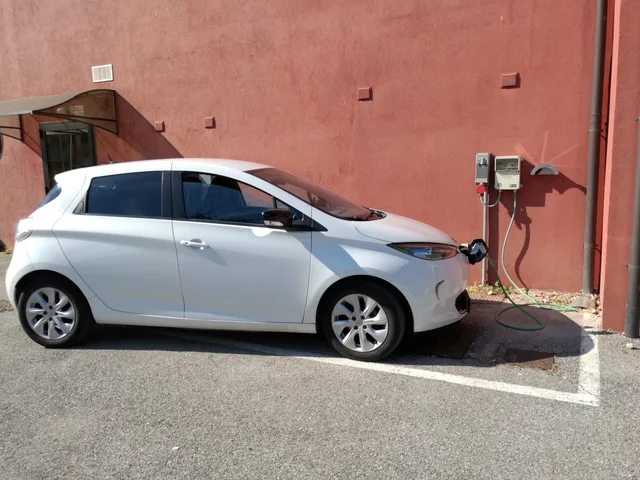
Trace the complete path with the actual vehicle orientations. A cable should not require a resident to cross a travel lane, route it through a neighboring stall, pull it over a curb, or leave slack in a pedestrian path. Also test where the cable sits while it is disconnected.
The U.S. Access Board's EV charging-station guide explains that bollards, wheel stops, curbs, and cable slack can obstruct access aisles, and it illustrates the relationship among charger placement, cables, and clear space. The technical guidance does not set every apartment requirement, but it supports checking the parking geometry as a connected system.
The visible equipment shows distress
Cracked covers, loose hardware, burn or scorch marks, melted or softened receptacles or plugs, discoloration, corrosion, water intrusion, unusual heat or odor, damaged cable jackets, repeated trips, and missing or improper protective elements are not small maintenance notes. Follow the property's safe procedure, preserve the incident record, and escalate to the responsible qualified party.
Avoid informal troubleshooting. An employee should not open equipment, reset protective devices, or certify a repair beyond the authority and procedure established for the site.
The Occupational Safety and Health Administration's electrical topic page describes electrical hazards and safety resources. It supports treating damage, abnormal conditions, and access to electrical equipment as items for the appropriate safety response. It does not diagnose a specific outlet or charger.
The charger has no service owner
One person calls the cable maker, another calls the installer, and the resident contacts an app provider. No one keeps the event time, photos, asset ID, configuration, action taken, or return-to-service test. Create one fault record and an escalation map before launch.
| Warning | Practical correction |
|---|---|
| No named service contact | Record primary and backup contacts plus the service boundary. |
| Charging rule not visible | Put the applicable instruction and reporting route in the resident materials. |
| Equipment changed without a record | Pause use until the configuration is reviewed and documented. |
| Cable path depends on luck | Rework the stall arrangement, equipment location, or permitted parking position. |
The Department of Energy's EVSE infrastructure training places charging equipment in a broader facility-infrastructure context. It supports tracking the equipment, operating rules, and responsible parties that form the actual service. It does not approve a specific apartment setup.
Close warnings with a controlled record
Keep the original observation, asset ID, visible condition, cable or charger identity, temporary restriction, person notified, response, repair evidence, retest, and return-to-service decision together. If the same concern returns, create a new dated entry instead of changing the first record. This gives the owner a clear history of a recurring condition or an earlier correction that did not hold.
The National Archives guide to basic records-management concepts explains that records require management through defined life-cycle activities. It supports retaining a warning, its response, and closeout context together. It does not prescribe a technical incident process.
Common questions
Should a property disable a charger after visible damage?
Follow the property's documented emergency and service procedure. Do not keep equipment in normal use when damage or unsafe behavior is suspected.
Are accessible-design guides the same as local apartment requirements?
No. The applicable requirements depend on the property and jurisdiction. For an EV charging installation, check the locally adopted edition of NFPA 70, the National Electrical Code, and confirm permit and inspection requirements with the local electrical or building department—the authority having jurisdiction (AHJ). Use the guide as technical input, then verify the rules governing the actual project.
Can staff approve a replacement cable or charger informally?
No. Treat a replacement as a controlled change. Verify the product, configuration, records, responsibility, and required review before service resumes.
How can I tell if an EV outlet is overheating or miswired?
Heat, discoloration, burn or scorch marks, a melted or softened receptacle or plug, buzzing, or repeated trips are warning signs, but they do not identify the cause. Stop using the equipment and have a licensed electrician evaluate it; do not open the outlet or try to test it yourself.
What should an electrician check on an outlet or hardwired charger?
Ask the electrician to compare the equipment rating and configured current with the breaker and conductor size, check for undersized conductors or aluminum branch-circuit wiring that may need compatible equipment and terminations, verify grounding and applicable GFCI protection, and check terminal torque against manufacturer specifications. The electrician should also confirm that the outlet configuration and EVSE listing are suitable for the installation. Thermal imaging and voltage-drop testing under load can help investigate heat or performance concerns; insulation-resistance testing may be appropriate in some cases.