Guides
Part of Level 1 Charging for Multifamily Housing: What to Verify
Level 1 apartment charging warning signs of hidden faults
Level 1 apartment charging warning signs include heat, scorch marks, repeated GFCI trips, and unknown outlet history; stop use and get qualified review.
Level 1 apartment charging warning signs can reveal an electrical, equipment, layout, or operating mismatch. Stop using affected equipment and obtain qualified review when safety concerns appear.
What to take away
- Treat heat, damage, repeated faults, and unknown circuit history as investigation triggers.
- Do not normalize extension cords, adapters, or unsafe cable routing.
- Preserve facts, photographs, and timestamps before deciding on a cause.
- Return an asset to service only after a licensed electrician and the property manager sign off on the fix.
Warning-sign log
| Observation | Record immediately | Next action |
|---|---|---|
| Heat or damage | Asset ID, time, photo, and cordset | Keep out of service and seek qualified review |
| Repeated fault | Circuit, protective-device behavior, and other loads | Investigate the circuit and equipment |
| Improvised connection | Route, adapter, and affected stall | Stop the workaround and redesign the arrangement |
| Unmet energy | Dwell time, delivered energy, and vehicle context | Recheck program fit or exception plan |
| Unclear owner | Asset, task, and missing decision | Ask the property manager to name an owner; if the fault stays open, escalate to the utility or a licensed electrician |
Example entry: outlet G-12, north garage stall 14; 6:40 p.m., 12 March; photo IMG-0421. Cordset and vehicle: 120 V portable set to 12 A, 2020 Bolt EV. Plug was too hot to hold after 20 minutes.
The outlet history is unknown
No one can identify the panel, breaker, branch circuit, shared loads, rating, installation record, or last inspection. A cordset powering on is not proof that the outlet is approved for continuous vehicle charging.
Qualified review must identify the circuit, field condition, and applicable requirements.
Heat or physical damage appears
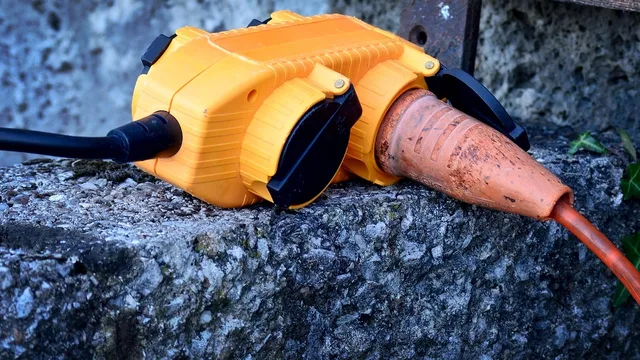
The plug, receptacle, enclosure, cord, or control box is hot, discolored, loose, cracked, wet inside, contaminated, or repeatedly disconnected. Some warmth is normal. A plug or receptacle too hot to hold comfortably, a scorched smell, scorch marks, browned or blistered plastic, flickering lights, a breaker or GFCI that trips repeatedly, or a charger that clicks on and off is a fault sign. Do not keep reconnecting it to see whether the condition returns.
Hidden faults behind these signs include a loose neutral, open ground, reversed polarity, shared-circuit overload, failed GFCI, damaged insulation, and counterfeit or uncertified EVSE. The National Electrical Code (NEC) Article 625 in NFPA 70 governs EV charging, and your local authority having jurisdiction (AHJ) issues permits and inspections. EVSE and cordsets should be listed by a nationally recognized testing laboratory (NRTL) such as UL, and GFCI protection is required for garage and outdoor receptacles.
Improvised connections are routine
Residents depend on extension cords, unapproved adapters, daisy chains, cords across travel paths, or a cordset hanging by its plug. Redesign outlet location and cord management instead of normalizing the workaround.
The Consumer Product Safety Commission explains that general extension cords missing safety characteristics can present shock or fire hazards in its extension-cord guidance.
Trips and faults repeat
The same breaker or GFCI operates repeatedly, charging stops without explanation, lights dim, another garage load interrupts charging, or different residents report inconsistent results. Check EVSE indicator lights and error codes such as ground fault, over-temperature, or pilot signal, plus voltage drop, termination torque, temperature rise, circuit load calculation, and thermal imaging. Compare readings with the manufacturer's limits and code requirements, and preserve the event history.
Routine energy need is not met
Residents frequently leave with less energy than the site's charging plan predicted, meaning the energy per overnight session that the property manager or charging provider assumed when the program was designed. Check connection duration, delivered energy, vehicle limitations, outages, dwell time, and changing travel before concluding that the driver used the program incorrectly.
Nobody owns the service
Outlet inspections, cordset eligibility, billing exceptions, resident moves, faults, and upgrade decisions have no responsible party. Assign ownership and close each warning with diagnosis, approved correction, resident notice, and verification evidence.
Preserve the record and close with evidence
Create an incident record with the outlet and circuit IDs, resident report, cordset, vehicle, timestamps, photographs, environmental conditions, protective-device status, and people notified. Keep the equipment out of service while the review is open.
Separate observed facts from possible causes; a trip might involve the circuit, receptacle, cordset, vehicle, or shared load. It might involve moisture, damage, or another condition, so do not edit the record to fit the first theory.
When you close an item, record the observed condition, owner, work done, retest result, date, and any reopen condition. Keep the original incident note.
Changing it after repair obscures whether the same warning returned, so the record must separate an unresolved hazard, a repaired asset, and a program-fit issue needing a different charging option.
Attach diagnostic steps, professional conclusion, repair, replacement, retest evidence. Review similar outlets when a cause could affect a broader group; communicate restrictions to residents before returning the asset to service.
Common questions
Does a working outlet prove that Level 1 use is safe?
No. See the outlet-history section above for what a cordset powering on does and does not show.
What should happen after repeated faults?
Preserve the event record, restrict use as required, and have qualified personnel investigate the actual circuit and equipment.
Why document observations before naming a cause?
The same symptom can have several causes. A clear record keeps the later review tied to what was observed.