Reviews
Part of Shared charger planning mistakes that cause delays
Questions to ask a shared EV charging bidder before you buy
23 questions to ask a shared EV charging bidder about assumptions, schedule, who controls what, handover and staff training before you buy it.
What to take away
- Ask what a bidder assumed about panel capacity, conduit route and utility coordination, then ask what happens to price and schedule when an assumption fails.
- Ask which parts of the timeline they control and which sit in someone else's queue. A single confident end date covering a utility is a warning sign.
- Ask who your named contact is and who replaces them. A shared-building job runs for months across a board, a manager and a utility.
- Ask what the handover pack contains and whether retention is held until it arrives. The first responder to every fault for the next decade is someone on your property.
- Score answers for specificity, not optimism. "Eight to twelve weeks, submitted week one" beats a promised completion date.
Product questions get good answers from everyone, because the answers sit on a datasheet. Schedule questions get bad answers from most bidders, which is what makes them useful. Send the product and contract set alongside these.
What have you assumed about our building
- What spare panel capacity did you assume, and who verified it?
- Which conduit route did you assume, and did anyone walk it?
- What did you assume about the utility, and have you contacted them?
- What did you assume about our access model and pricing?
- If an assumption is wrong, what happens to price and schedule?
Question five separates a bid from a brochure. An honest bidder names the adjustment mechanism. A weak one says it will be fine.
Assumptions to verify before bid
- Spare panel capacity verified by whom
- Conduit route walked on site
- Utility contacted and timeline confirmed
- Access model and pricing assumptions
- Adjustment mechanism if assumptions fail
What do you control, and what do you not
- Which parts of this timeline are yours?
- Which depend on the utility, the permit office, or us?
- What is your current lead time on the proposed equipment?
- What is your crew availability, and are you subcontracting any of it?
- What else are you running at the same time as our job?
A bidder who separates their own commitments from other people's queues is describing reality. One who gives a single end date for a process containing a utility is not.
Bidder control vs external queues
Bidder controls
- Timeline
- Crew schedule
- Permits
- Application prep
- Equipment
- Order placement
- Labor
- Own crew
- Site access
- Coordination
Others control
- Timeline
- Utility queue
- Permits
- Permit office
- Equipment
- Lead time
- Labor
- Subcontractors
- Site access
- Resident readiness
What stops the job
- What are the three most common reasons a job like ours pauses?
- When that happens, who absorbs the cost of the pause?
- What would make you walk away mid-project?
- If we are not ready when you are, what does that cost us?
Question eleven is worth asking every bidder. Vague answers usually mean limited work in shared buildings.
Who owns this on your side
Who owns this
- Who is our named contact, and what happens if they leave?
- Who attends the inspection?
- Who talks to our residents, if anyone?
- How do we escalate when something is not moving?
Continuity matters more than people expect on a project running several months across a board, a manager, a utility and a contractor.
What happens afterward
- What does the handover pack contain, and is retention held until it is delivered?
- What is your response time for a fault, and does it change at night or on weekends?
- Who services this in year three, and are they the same people?
- What training or documentation do our staff get?
That last one is easy to overlook. Somebody on the property will be the first responder to every fault for the next decade, and whether they were shown anything at handover decides how many calls become invoices.
Employer-run charging programs face the same handover problem. The federal workplace charging program guide is a good model for the policy and operational documents worth insisting on.
The competence question nobody asks
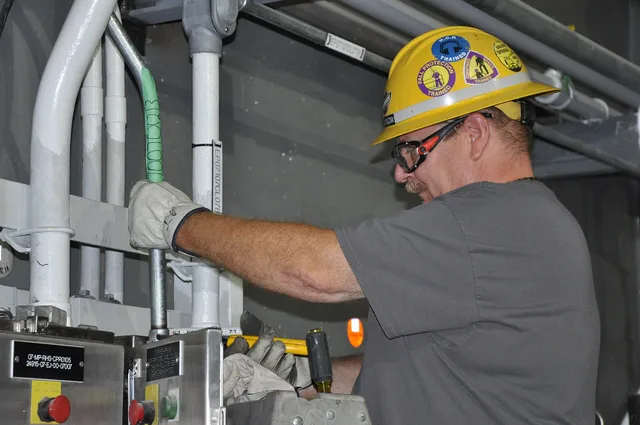
- Who will actually do the work, and what is their experience with shared buildings specifically?
Charging in a multi-unit property differs from a residential garage. Coordination, accessibility and permitting all change. What a competent contractor is doing on a shared job goes well beyond pulling wire.
The skills gap is well recognized, and the Joint Office maintains workforce development resources because trained capacity has constrained deployment.
You are entitled to ask whether the people on site have done this before.
Reading the answers
Score specificity, not optimism. A bidder who says the utility takes eight to twelve weeks in your area and they will submit in week one is more useful than one who promises completion by a date.
Where these projects lose time is set out in what costs them time and money, and the cost of planning itself covers what you should expect to spend before construction.
Common questions
Should we send all twenty-three?
Yes. They take a bidder an hour and they are the cheapest diligence available.
What if nobody answers question eleven well?
Then you have learned something about the local market and should build more contingency.
Is a bidder who lists lots of risks being negative?
Usually they are being experienced. Compare their list against what the others left out.
Do we need these for a two-port installation?
A shorter version, yes. The assumptions and the handover questions still apply.