Guides
Part of Apartment EV charger power sharing: write a clear rule
Apartment EV charger power sharing budget: 7 cost lines to price before 2027
Price seven apartment EV power sharing cost lines before 2027, from the allocation rule and resident onboarding to the controller reset nobody budgeted for.
An apartment EV charger power sharing budget has seven cost lines to price before 2027. Miss one and the total looks fine until the first charger is replaced or the first resident calls about a car that never charged.
The figures below are typical U.S. ranges as of 2026. Your building department, utility and site conditions set the final number.
What to take away
- Price the allocation rule itself, alongside the chargers it controls.
- Budget resident onboarding and signage as a line, not as goodwill.
- Ask for a written transition scenario covering replacement, added ports, expired subscriptions and controller resets.
- Keep every quote, assumption and acceptance record in one file, so a later price change can be compared against scope rather than total.
- Confirm load, wiring and code questions with a licensed electrician and the authority having jurisdiction.
The seven cost lines
Each line below is a decision, not an invoice. The ranges are typical U.S. figures as of 2026, and site conditions drive them. Where a figure matters, substitute your own: the arithmetic is what carries across buildings.
| Cost line | Typical U.S. range as of 2026 | What drives it |
|---|---|---|
| Capacity review and allocation rule | $2,000 to $8,000 combined; load study $500 to $2,500; engineer stamp $1,500 to $5,000; rule drafting $500 to $3,000 | Panel headroom, utility capacity queue, rule complexity |
| Charging equipment and cable management | $1,500 to $6,000 per port for hardware; $150 to $600 per retractor; $150 to $500 per bollard | Network tier from ChargePoint, Enel X, Wallbox or ClipperCreek; cable reach; mounting; repair versus replacement |
| Controllers, meters and network service | $500 to $3,000 per controller or gateway; $300 to $1,500 per meter; $5 to $20 per port per month | Whether sharing depends on an OCPP controller, meter, gateway or software tier; ChargePoint, EV Connect or Monta network tier |
| Installation, permits and inspection | $5,000 to $25,000 per site typical; trenching $15 to $50 per linear foot; panel work $1,500 to $8,000; permits $100 to $1,000 | Trench length, panel distance, utility upgrade, inspection schedule |
| Commissioning and acceptance testing | $500 to $3,500 | Third-party test, documentation, network acceptance, re-test after fixes |
| Resident onboarding, signage and staff training | $1,000 to $5,000 | Number of units, signs, portal setup, staff session, first-month support |
| Change and transition work | $1,000 to $5,000 per event; annual reserve $2,000 to $10,000 | Replacement, added port, lapsed subscription, controller reset, parking rule change |
- Capacity review and allocation rule.A licensed electrician or professional engineer confirms panel headroom and how much current the group can share. The deliverable is a written rule: who gets how many amps, in what order, and what happens when demand exceeds supply. Price the study and the rule as one line, because a rule without a capacity number is a wish.
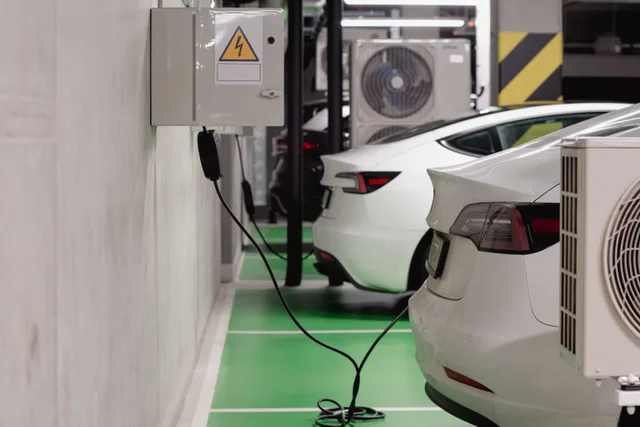
- Charging equipment and cable management.Level 2 chargers, holsters, cable retractors, bollards and mounting hardware. Cable reach decides how many stalls a single unit can serve, so measure before ordering. If existing units are involved, weigh repair against replacement with the hardware reuse decision before the quote is signed.
- Controllers, meters and network service.Power sharing usually runs through a controller, a meter, a gateway or a software tier. Ask which of those the sharing behavior actually depends on, and whether the subscription is monthly, annual or bundled into the hardware price. Name the account holder in the contract.
- Installation, permits and inspection.Trenching, conduit, panel work, permit fees and inspection scheduling. Lead times for a utility service upgrade or transformer can run into months, so this line carries a date as well as a dollar amount. Your utility and building department set the sequence.
- Commissioning and acceptance testing.A representative test that shows the group stepping down current as more cars plug in, recorded and signed. Without it, the property owns an unverified system. The GSA EVSE ordering guide treats acceptance and documentation as acquisition activities, not afterthoughts.
- Resident onboarding, signage and staff training.Welcome instructions, stall signs, the support phone number, escalation contacts and a short session for property staff. A system can allocate power exactly as configured and still generate complaints if nobody owns the explanation.
- Change and transition work.Replacement charger, added port, expired subscription, controller reset, revised parking rule. Each one can trigger inventory, account access, configuration capture, testing and a fresh resident notice. Fund it as a recurring cost, so the money exists before the event.
The Department of Energy's smart charge management guidance runs planning, site assessment, procurement and operations in that order, which is also the order these costs arrive.
Mandatory or deferrable: lines 1, 2, 4 and 5 are required for a working, inspected system. Onboarding can be scaled down, and transition work can be funded as an annual reserve.
Canada pricing note: the same seven lines apply, quoted in Canadian dollars. Provincial utility rules, provincial inspection and GST or HST change the totals. Ask each vendor for a landed Canadian price instead of converting a U.S. figure.
Worked example: a 40-unit building with 8 shared ports, an indoor garage, no trenching and existing panel headroom. Mid-range figures from the table above give these amounts.
- $4,000Capacity review and allocation rule
- 8Charging equipment and cable management
- $1,500Controllers, meters and network service
- $6,400Installation, permits and inspection
- $1,500Commissioning and acceptance testing
- $2,000Resident onboarding, signage and staff training
- $4,000Change and transition work: reserve for the first year
Capital subtotal: $37,800. Add the first-year reserve of $4,000 and network service of $960, and the first-year total is $42,760, or about $5,345 per port.
From year two the recurring figure is the reserve plus network service: about $4,960 a year, or about $52 per port per month. These are typical figures from the ranges above, not a quote.
Write the allocation rule down
A sharing rule that lives in a vendor's portal is not a rule the board can defend. Put the amps per port, the priority order and the peak limit in one page the association keeps. The apartment power sharing rule is the reference residents and staff will argue from, so it has to exist outside the app.
One-page allocation rule
- Amps per port
- Priority order
- Peak limit
- Kept by association
- Exists outside vendor app
- Authoritylicensed electrician or engineer
State the authority, not the answer: load calculations, wiring and panel specifications belong to a licensed electrician or professional engineer, and the authority having jurisdiction signs off on the installation.
Onboarding is where budgets quietly break
Residents learn the system from a sign, a text or a neighbor. If the sign names an old support number, every failed session becomes a staff call. Budget the printing, the portal setup and the first month of hand-holding.
The apartment charger power sharing setup decides how many cars charge overnight. The onboarding decides whether residents trust it. Both belong in the same budget conversation.
Ask for a transition scenario in writing
Price five transition events
Charger replaced under warranty
Port added to existing group
Subscription lapses
Mark each event as quoted, provisional, excluded, owner-supplied or pending review. The table above shows typical ranges for these transitions as of 2026.
A transition scenario is one page from the proposer that answers five questions. Which events are in scope? What does each one cost? Who supplies the part? How long does the property go without charging? Who signs off?
Ask for it with the proposal, not after approval. Set a review date each year, before the budget cycle, and put the added-port rate and the replacement model on the 2027 budget calendar. Most boards approve the next year's budget in the fall, so the first review belongs before that meeting.
Compare bidders on the same five events rather than on totals. A low total that excludes replacement often hides the cost in a later invoice.
NREL's electric mobility opportunities report notes that apartment charging carries electrical-service, parking-access and operating-cost challenges.
Keep the file that explains the number
Store the quote, the scope version, the assumptions, the exclusions, the decision notes and the acceptance records together. When a revised price arrives, compare scope against scope. The National Archives guide to records management explains records as evidence of decisions, which is exactly what an estimate file is.
Common questions
Is the app subscription part of the budget?
If the sharing behavior depends on it, yes. Show it as a recurring line with the renewal date and the account holder named, rather than folding it into a general technology allowance.
Why pay for a commissioning test?
The board needs an observed record that the group actually reduces current as cars plug in. Installed equipment is not evidence of working allocation.
Who confirms the electrical numbers?
A licensed electrician or professional engineer, with the authority having jurisdiction approving the installation. The budget line covers their time, not a conclusion you can write yourself.
Does a provider change force a new budget?
Often. Inventory, account access, configuration capture, retesting and resident notices can each become separate work. That is why the transition scenario is requested before approval, not after.