Guides
Part of Apartment EV charger access observation: how to log a concern and refer it for review
Apartment EV charger space observation: what to record before you ask for a review
Record the charger label, space number, and vehicle position at an apartment EV charger so a qualified reviewer can answer the question you actually have.
An apartment EV charger space observation records what someone saw at a specific charger and space. It is not a finding about layout, space count, signage, or enforcement. The record exists so a qualified reviewer can answer one narrow question later.
What to take away
- Write the charger label and space number first. Everything else hangs off those two identifiers.
- Describe vehicle position in inches or in named landmarks, not as "blocked" or "in violation."
- Keep the observation separate from a resident parking dispute and from a charger fault.
- Send the question to the authority that owns itthe property's design professional, the building official, or the towing authority for enforcement.
- Store contact details and account numbers outside the shared log.
Identify the space before you describe the event
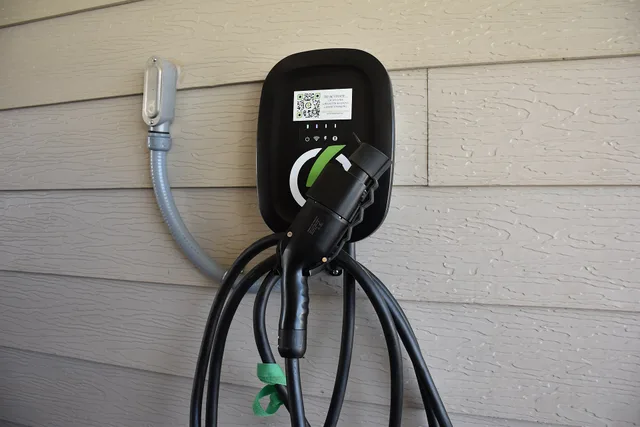
A charger label alone is not enough. Two pedestals can share a label prefix, and a resident reading "B-4" on a wall may be standing at B-4A. Record the label, the space number stenciled on the pavement if one exists, the level or row, and one fixed landmark a stranger could walk to.
If no space number exists, build the description from fixed features. Use the level, row, and nearest column line. Also use the nearest stair or elevator door. Include the charger's own label. A dated photo carries more than a paragraph of prose.
Describe vehicle position in measurable terms
"The vehicle was parked wrong" tells a reviewer nothing. "The left rear tire sat about 18 inches past the painted line on the passenger side" gives a reviewer something to check against a plan.
Record the vehicle's position relative to the space marking, the charger cabinet, and any bollard or wheel stop. Note the time and who reported it. Do not add why the driver parked that way, and do not name a rule the position may or may not break.
| Field | What to write | What to leave out |
|---|---|---|
| Charger | Cabinet label, exactly as printed | Assumed model or amperage |
| Space | Stenciled number, level, row, landmark | "The usual spot" |
| Position | Distance past a marking, in inches or feet | "Blocked," "illegal," "wrong" |
| Source | Resident message, staff walk-through, provider note | The reporter's unit number |
| Evidence | Dated photo or message, with file location | Speculation about intent |
| Question | One sentence, one decision needed | A proposed fix |
Keep parking function and charging function apart
California's permitting guidebook treats charging and parking as functions that can carry different code provisions, and it tells readers to work from the current building code rather than the guide itself. Read the California EV charging permitting guidebook.
That distinction matters at intake. A vehicle parked across a striped area raises a parking question. Whether the striping, the aisle width, or the charger placement meets a current standard is a design question. They route to different people, and merging them in one record delays both.
Route the question to the right authority
Match the question to the party that decides it, then stop.
- Space layout, aisle width, clearances, or charger placement:the property's licensed design professional, with the building official and fire marshal as the authorities having jurisdiction.
- Accessibility provisions for a specific space:the local accessibility code authority. The U.S. Access Board standards page is a reference, not a determination for your site.
- Enforcement, towing, or relocation:the property's parking policy and the towing authority that governs the lot.
- Charger hardware, network, or idle-fee behavior:the charging provider under its service agreement.
Send one narrow question, not a summary of the whole situation. "Does the striping at charger B-4 meet the aisle width in the approved plan?" gets an answer. "Is this space compliant?" gets a request for more information.
Write the record so a later reader can use it
Keep the shared log to location, time, source type, and the question referred. Personal contact details, account numbers, and resident identifiers belong in the property's approved system. The NIST Privacy Framework is a useful reference for limiting a record to what the stated purpose needs.
Date every entry: reported, referred, answered, closed. The National Archives describes records management as control of a record across its life cycle, and the same discipline applies here. See the National Archives records-management overview.
Close out with what was actually done and what remains open. "Striping re-measured by the design professional on 14 March; aisle width question still with the building official" is a usable closeout. "Space issue resolved" is not.
Common questions
Is an EV charging space the same as an accessible parking space?
Not necessarily, and the answer depends on the code edition and site plan that apply to your property. Record what you saw, then ask the local accessibility code authority or your design professional to make that call.
What if the space has no number?
Build the description from fixed features: level, row, nearest column line, nearest stair or elevator door, and the charger's own label. Add a dated photo so the next reader can find the same spot.
Can a parking dispute go in the same record?
Yes, but label it as a reported dispute or a property-policy question. Keep it in its own entry so it does not get read as a technical or compliance finding.
Who decides whether the striping or aisle is correct?
The property's licensed design professional, working with the building official and fire marshal as the authorities having jurisdiction. Staff record the referral and the response, and do not fill the gap themselves.